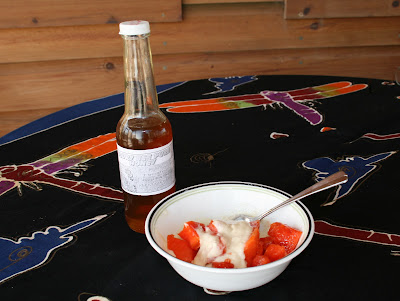
Just a quick post of two of the many photos I took in Belize as a teaser for entries to come...
05 November, 2010
02 November, 2010
More from DuPlooy’s Jungle Lodge
We are back in Rochester now, but I have one more entry that I wrote while we were traveling.
DuPlooy’s is a delight for a nature photographer. I could have happily stayed there for a week or more photographing insects, birds, plants, animals. I hope to go there again in the different seasons to see additional birds and plants in all their various stages of flowering and fruiting.
We saw a series of large mounds from leafcutter ants more than 2 feet in diameter and nearly a foot high along the path down to the Macal River. There were multiple columns of ants marching back to the mounds triumphantly carrying new leaf material for their fungi. It was too dark to get photos. :-(
They have a mutualistic relationship with their fungi, providing them with new plant material to degrade, and in return the ant larvae get to feed on fungus itself. It is a very complex relationship that is actually a ménage a trois involving a bacterium as well. Wikipedia has this to say about leaf cutter ants:
“Their societies are based on an ant-fungus mutualism and different species use different species of fungus, but all of the fungi the ants use are members of the Lepiotaceae [now the family Agaricaceae]. The ants actively cultivate their fungus, feeding it with freshly-cut plant material and keeping it free from pests and molds. This mutualist relationship is further augmented by another symbiotic partner; a bacterium that grows on the ants and secretes chemicals—essentially the ants use portable antimicrobials. Leaf cutter ants are sensitive enough to adapt to the fungi's reaction to different plant material, apparently detecting chemical signals from the fungus. If a particular type of leaf is toxic to the fungus the colony will no longer collect it. The only two other groups of insects that have evolved fungus-based agriculture are ambrosia beetles and termites.The fungus that is cultivated by the adults feeds the ants larvae, and the adult ants feed off of the leaf sap. The fungus needs the ants to stay alive, and the larvae need the fungus to stay alive.”
The next day after hard rainfall all night, the above ground mounds were nearly deserted and the ant activity was sporadic. In the picture below you can see a few ants, 2 of whom are carrying a little piece of leaf. On the right side of the photo you can see where large pieces previously had been cut neatly out of leaves.
I seem to have thing about assassin bugs; I find them wherever I go. Here is one on a soursop fruit. If you enlarge the photo you can see its impressive looking rostrum (piercing mouthpart).
Looking out from our veranda I spotted this little damselfly on its photogenic perch on the tip of bird of paradise flower.
Early one morning this little frog was on the table in the outdoor dining area. I didn't see any other frogs while we were there, but I am sure there were plenty around.
Several times as we returned to the casita we saw a pair of agouti scampering back into the underbrush. They are sweet looking little beasts, sort of like overgrown guinea pigs. All I managed to get was this shot from behind right at dusk.
At the deck near the bar is a feeding station that is used to lure in birds and other wildlife. One evening when ripe bananas were used as bait, this little kinkajou made an appearance. The staff at DuPlooy's discourage their guests from using flash when photographing these animals at night, so I set my camera on manual with the ISO at the max (1600) and the aperture wide open, and well, here is best I got. These rarely seen, appealing animals are nocturnal aroboreal mammals related to raccoons and coatis. They are also known as honeybears.
The first night, as we came back from dinner, we found this possum had dropped in to investigate the remains of our wine and cheese on the veranda. It is a little smaller than the possums in North America, but every bit as toothy.
Believe it or not, there were other more fantastic animals that I captured in silico. Below is a colorful deer mask of a style used in Maya ceremonies.
Slightly more realistic is this carving of a jaguar,except of course for the saddle. :-)And last of all is this 2 headed dog which kindly served as our luggage rack.
Stay tuned for additional Belize posts including Belize Bird of the Week as I sort through my photos.
01 November, 2010
Making Lobster Stew and Yogurt in Belize
Dennis’s Belizean Lobster Stew
We were given 4 lobster heads and decided to make a stew with what we had on hand.
Boil up the heads of 4 just-caught lobsters in a big pot of slightly salted water (water to cover the lobster heads and ½ TBS salt). Sauté 2 chopped onions, 1 chopped green pepper, 6 cloves garlic, slivered carrot, chopped cho-cho (aka chayote), 3 diced potatoes (skin on), By this time the lobster has cooked enough, so take it out of the water and allow it to cool. Let the lobster-water continue to boil gently to reduce in volume. Add part of the water to the sautéed vegetables and let it cook down. Once the potatoes are soft, mash them and the other vegetables so that there are still identifiable chunks, which give some texture to the soup. Meanwhile, pick the lobster meat out of the heads. Combine all the reduced lobster stock to the mashed vegetables. This yields about 2 quarts. Take one quart and stir in 1 packet of dried coconut milk. Bring back to a boil, add the picked lobster meat and serve immediately with a sprinkle of chopped culantro (similar in taste to cilantro, but a totally different plant) and a dash of Marie Sharp’s hot sauce. Perfectly complemented by a glass (or two) of crisp white wine.
Save the reserved additional quart of lobster stock with veggies for the meat from heads on the 4 lobsters that cost $50BZ ($25US). Tails to be grilled separately after marinating in lime juice overnight.
Long ago, in his college days, Dennis had made yogurt from powdered milk. We thought it would be good to try that in Belize, especially since it is easy to keep powdered milk on hand. We bought a canister of powdered milk once we arrived. Step one is to mix up the powdered milk half again as strong as the directions and then carefully bring it just to boiling. Sounds easy, right? The mixing instructions on the powdered milk are in Spanish and neither of us speak Spanish. What we could decipher was that the whole container should make 9 liters of normal strength milk. So we measured the volume of the powder, divided by 9 to get how much makes 1 liter and then multiplied that by 1.5 to get the strength we needed for the yogurt. Now we are ready to start. Whisk the powder into the water in the pot, bring it just to a boil, and let cool to 110 F before adding the purchased yogurt starter. Pretty simple, really, especially since Dennis had brought some cooking thermometers down with us. Once the yogurt starter is mixed in, you transfer the mixture to your yogurt container (in our case a clean, used container of store bought yogurt we also brought down with us), and put that container in a larger of warm water to incubate it at around 90-100F until the yogurts sets. It set in about 7 hours. The taste was wonderful. Once you get a batch going, you can use a couple of tablespoons of the old yogurt instead of yogurt starter to make new yogurt. I like it sweetened with Belizean honey and served with fresh fruit mixed in, as shown below, or in savory dishes such as poached snapper and vegetables.
We also made a thicker, Greek-style yogurt by straining some of the whey out. Notice the high tech rig we made to suspend the bag of yogurt over the pot to collect the whey. Yes, that is a wooden spoon stuck between the drawer and cupboard door. ;-)
31 October, 2010
From seaside to mountainside in Belize
With our good friends Sue and Chris Harris (SteppingStones Resort, Englishtown, Belize) we are taking a short holiday in the mountain jungles of Belize. We drove up to the twin towns of San Ignacio and Santa Elena, one on either side of the Macal River, and then followed the river about 8 miles further into the mountains. We are staying at DuPlooy’s Jungle Lodge (http://www.duplooys.com/about-us.php) overlooking the gorge through which the Macal River runs. DuPlooy’s was established in 1987 and was the first jungle resort in Belize that catered to international travelers. This is the end of the off season in Belize, and the four of us actually had the place to ourselves. It is a beautiful place, kept very natural in most areas and is also the site of the Belize Botanic Garden. The birding and plants are fabulous, and the accommodations are not too shabby either. It is not an inexpensive place to stay, but is the price is reasonable for what you get. We have a spacious 2 story casita that feels quite secluded. While standing on the veranda, you are thrust right into the jungle which drops off into the gorge below. A long boardwalk from the casita leads to a stone path, with smaller cabanas along one side and the gorge on the other, ultimately connects to the restaurant, bar, and gorge overlook.
The next morning we awoke to overcast skies and an occasional shower. Never-the-less, after breakfast the four of us embarked on a self-guided tour of the botanic gardens. This area was affected a bit by Hurricane Richard. On the drive up we had seen downed trees with increasing frequency. There are some downed trees here, but actually more “drowned” trees from flooding from the hurricane rainfall. We did seek shelter from the rain at one point in a bird hide overlooking a small pond which had most definitely overflowed its banks.
We stayed close to the casita after lunch. I took photos off the veranda, checked email, and read a few blogs (I am soooo far behind!). Tonight is our last night in Belize. :-( Tomorrow we fly out of the Belize International Airport to Dallas, Texas. We will spend the night in Dallas and then get to Rochester by way of Chicago on the next day.
Macal River and gorge wall
Sue, testing the bed
Boardwalk to the Casita
Palm along the boradwalk
bar
We spent several afternoon hours relaxing on the upstairs veranda with wine and cheese while I watched all the birds in the tree canopy. The first night while walking back to the casita after our dinner, a soft rain began to fall, and moments after entering the casita, the heavens opened up; we were treated to the soothing sounds of rainfall during most of the night. The next morning we awoke to overcast skies and an occasional shower. Never-the-less, after breakfast the four of us embarked on a self-guided tour of the botanic gardens. This area was affected a bit by Hurricane Richard. On the drive up we had seen downed trees with increasing frequency. There are some downed trees here, but actually more “drowned” trees from flooding from the hurricane rainfall. We did seek shelter from the rain at one point in a bird hide overlooking a small pond which had most definitely overflowed its banks.
view from blind
The botanic garden had areas with cycads, gingers, plants used as traditional ornamental plants, an orchid house, and a natural rainforest. Many of the plants were labeled. The sun came out and until a light breeze commenced blowing, the air was very hot and muggy. Our camera and glasses lenses kept steaming up in the saturated air. Below are photos of several Heliconia plants. These iconic jungle plants have folilage similar to bananas (a close relative) and very striking and colorful flowers. Below is a beehive ginger plant. also closely related to Heliconias and bananas. Easy to see how this one got its name.
And here we have Dutchman's Pipe, a vine with its interesting flower designed to trap its pollinators.
Dennis and I carried a bit longer than Chris and Sue, but after nearly 3 hours of walking and photography, we too turned back for a short rest before lunch of gazpacho and chicken pesto quesadillas. We stayed close to the casita after lunch. I took photos off the veranda, checked email, and read a few blogs (I am soooo far behind!). Tonight is our last night in Belize. :-( Tomorrow we fly out of the Belize International Airport to Dallas, Texas. We will spend the night in Dallas and then get to Rochester by way of Chicago on the next day.
29 October, 2010
Plumbing in Paradise: Installation of the New Kitchen Sink
There is nothing fancy about the sink we brought with us to install in the cabana kitchen. But it is made of a heavier gauge stainless steel and the double basins are just slightly larger than the old sink. The faucet, with its brushed nickel finish, solid metal construction, single lever, and spritzer, is much nicer than the old plastic piece of junk. Below is Dennis holding the old sink and faucet that he has just removed from the cabinet.
Even though the basins were slightly larger and at least an inch deeper than the existing sink, we thought the footprint for the countertop cutout was identical. Once Dennis scraped all the old caulking off, we could test that by dry-fitting the new sink.
It fits! Yea!!! First hurdle is cleared.
Then Dennis fitted new strainer units into the sink basins with plumber’s putty and secured the tailpieces of the drains. Time for another dry-fit to see if the tailpieces match up to the location of the drain pipes. Yes and no. Yes, they lined up to the same spots. No, they were much too long. What to do, you may ask. ;-) Dennis took the old tailpieces off the old sink and used them to get a closer match and made up the difference with the play in the PVC drain pipe.
The water supply, which uses flexible IPES tubing, was easier to connect. Or was it? Turns out the connector that Dennis brought down here with us was defective, so again, he scavenged parts from the old sink until he can replace it with newer material. Not having a hardware store within easy reach brings makes one resourceful. ;-) (We were ale to buy the proper piece when we went on our 6 hour round trip to the village of Independence for supplies. Dennis will replace that today while I am posting this from an internet café in the slightly larger village of Placencia.)
Now for the real installation. Dennis filled the channels on the underside of the lip of the sink with silicone caulking and we carefully lowered the sink into place. From underneath, he tightened the clips that hold the sink firm to the countertop. In the photo below you can see the excess caulking that was squeezed out when the clips were tightened.
And finally, the sink fully installed.
Just look at the single lever faucet and wonderful spritzer! We get excited by the simplest things here in Englishtown. And as David from “Adventures in Paradise” (http://winjama.blogspot.com/) will tell you, it is truly plumbing in paradise when you can complete a job in a single day with just a handful of hyphenated words to color the air blue!
Even though the basins were slightly larger and at least an inch deeper than the existing sink, we thought the footprint for the countertop cutout was identical. Once Dennis scraped all the old caulking off, we could test that by dry-fitting the new sink.
It fits! Yea!!! First hurdle is cleared.
Then Dennis fitted new strainer units into the sink basins with plumber’s putty and secured the tailpieces of the drains. Time for another dry-fit to see if the tailpieces match up to the location of the drain pipes. Yes and no. Yes, they lined up to the same spots. No, they were much too long. What to do, you may ask. ;-) Dennis took the old tailpieces off the old sink and used them to get a closer match and made up the difference with the play in the PVC drain pipe.
The water supply, which uses flexible IPES tubing, was easier to connect. Or was it? Turns out the connector that Dennis brought down here with us was defective, so again, he scavenged parts from the old sink until he can replace it with newer material. Not having a hardware store within easy reach brings makes one resourceful. ;-) (We were ale to buy the proper piece when we went on our 6 hour round trip to the village of Independence for supplies. Dennis will replace that today while I am posting this from an internet café in the slightly larger village of Placencia.)
Now for the real installation. Dennis filled the channels on the underside of the lip of the sink with silicone caulking and we carefully lowered the sink into place. From underneath, he tightened the clips that hold the sink firm to the countertop. In the photo below you can see the excess caulking that was squeezed out when the clips were tightened.
And finally, the sink fully installed.
Just look at the single lever faucet and wonderful spritzer! We get excited by the simplest things here in Englishtown. And as David from “Adventures in Paradise” (http://winjama.blogspot.com/) will tell you, it is truly plumbing in paradise when you can complete a job in a single day with just a handful of hyphenated words to color the air blue!
Exploring Black Creek
We have a small, locally-made, fiberglass, keel-less canoe that is called a dory around here. We moved it around back to Black Creek so that I can take it out to paddle around and take photos. Black Creek is almost a lagoon except that it is feed by natural drainage from the surrounding marshes rather than being tidal seawater. It has a very gentle flow and feels more like a lake than a creek.
The brackish water is a dark tea-color from the tannins in the mangrove leaves that drop into the water. It is major nursery for tarpon and permit fish to mature from mere wee babes to juvenile fish large enough to head out to the open sea. Of course, not all of them make it out of childhood because the mangroves surrounding the creek are home to large numbers of egrets, herons, kingfishers, cormorants, anhingas, and osprey. Bird photos will come later, I promise.
I got up early a few days ago for a dawn paddle in Black Creek.
As the morning grew late, I saw a cloud of white out the corner of my eye. I turned the dory around to see a flock of white birds wheel around the far, broad end of the creek. I managed to take some photos, hoping to see where they landed, but they flew off without landing.
The brackish water is a dark tea-color from the tannins in the mangrove leaves that drop into the water. It is major nursery for tarpon and permit fish to mature from mere wee babes to juvenile fish large enough to head out to the open sea. Of course, not all of them make it out of childhood because the mangroves surrounding the creek are home to large numbers of egrets, herons, kingfishers, cormorants, anhingas, and osprey. Bird photos will come later, I promise.
I got up early a few days ago for a dawn paddle in Black Creek.
It is so quiet and serene with no one else around. Quiet, that is, until a crocodile launches itself into the water with a big kersplash when I startled it out of its morning slumber. I didn’t get a good look at it, but based on the size of its head (about a foot long and 8-10 inches wide), I estimate it to be a smallish croc about 3 to 4 feet long. There are reliable sightings of a croc at least 15 feet long that resides in Black Creek. Suddenly, my dory feels pretty small and tippy.
As the morning grew late, I saw a cloud of white out the corner of my eye. I turned the dory around to see a flock of white birds wheel around the far, broad end of the creek. I managed to take some photos, hoping to see where they landed, but they flew off without landing.
Looking at the photos later, I could tell they were snowy egrets with their golden slippers. It is a bit of a challenge to take action shots with a long(ish) lens using a monopod in a keel-less canoe while adrift! But I am getting a little better at it and I haven’t tipped over yet. ;-) Which is a good thing considering the crocs …
27 October, 2010
Fragrant Limes and Conch Ceviche
A friend of Richard’s knows how much we like the fragrant limes from a tree in his yard so he very thoughtfully brought us a bag full of them.
I have never seen limes anything like these – they are orange inside, but taste nothing like oranges. They taste like kafir lime leaves used in Thai cooking smell when you crush them, heavenly. If anyone recognizes them, I would be delighted to know what the varietal name is.
I have used them in cooking, at times a little too liberally according to Dennis. Mostly I have used them to make lime juice. The juice from these limes is so potent, you can dilute it 1:10, add a fair amount of sugar or sweetener, to make a wonderfully refreshing cold drink. Lime juice from regular limes is very common on restaurant menus along with watermelon, guava, grapefruit, and orange juices. Street vendors also sell juices, especially on market days.
It is conch season right now. We bought 3 conchs (out of the shell) and I made conch Ceviche from them using juice from the fragrant limes. First, you chop up the conch into small pieces, put them in a bowl and add enough lime juice to cover them. Then, you chop onion, sweet peppers, garlic, tomatoes, and a bit of habanera pepper to add to the bowl along with some black beans if you like. Season with salt and let marinate at room temperature if you plan to eat it soon or in the fridge if you eat it more than 4 hours later. Just before serving it, add fresh cilantro. If you need to tone down the hotness of the pepper, you can add avocado at any time.
Serve it with tortilla chips, soda crackers, or plantain chips as an appetizer. Marie Sharp’s Hot Sauce, a product of Belize, can add some zing if you dare. A nice gin in lime juice (my favorite) or Campari and soda (Dennis’ drink of choice) are compatible drinks.
Tags: ,
26 October, 2010
Out of Order in Belize :-)
This should have been my second posting for our Belize trip, but it didn’t get posted due to hurricanes and lack of internet connections when I wrote it. So here it is, out of order:
Belize, Day 2
Joy very thoughtfully had awaiting us in our cabana several vases of flowers, 2 bunches of sweet little bananas, and 3 papayas – all from our yard.
The rain started to fall just as we finished getting everything into the cabana. We puttered around, getting the groceries put away and generally trying to make headway in getting things sorted out, which is a challenge in a cabana that is fairly small with limited storage space.
When the rain stopped I went outside to check on the plants and see how they had fared in the last 5 months. The native spider lilies are doing well, with quite a few in bloom. The locals consider these plants to be weeds, but we love them for their beauty and their ability to thrive in places that are too windy and sea-sprayed for other plants.
Also of note are the white orchids that are blooming along the path to Black Creek. As I compare the photo below of the small orchid to the one above of the spider lily, I can see that the difference in their size is not very apparent. The spider lily plants are about 6 feet wide compared to the orchid which is not even 6 inches wide.
I also found one of the the new papaya plants that are bearing such nice looking fruit. And the best part is that they are short enough for me to reach the fruit.
Belize, Day 2
Joy very thoughtfully had awaiting us in our cabana several vases of flowers, 2 bunches of sweet little bananas, and 3 papayas – all from our yard.
The rain started to fall just as we finished getting everything into the cabana. We puttered around, getting the groceries put away and generally trying to make headway in getting things sorted out, which is a challenge in a cabana that is fairly small with limited storage space.
When the rain stopped I went outside to check on the plants and see how they had fared in the last 5 months. The native spider lilies are doing well, with quite a few in bloom. The locals consider these plants to be weeds, but we love them for their beauty and their ability to thrive in places that are too windy and sea-sprayed for other plants.
Also of note are the white orchids that are blooming along the path to Black Creek. As I compare the photo below of the small orchid to the one above of the spider lily, I can see that the difference in their size is not very apparent. The spider lily plants are about 6 feet wide compared to the orchid which is not even 6 inches wide.
I also found one of the the new papaya plants that are bearing such nice looking fruit. And the best part is that they are short enough for me to reach the fruit.
Subscribe to:
Posts (Atom)