Showing posts with label mangroves. Show all posts

14 December, 2021

Paddling in Black Creek/Lagoon

I really want to call it "Black Lagoon" instead of Black Creek; it sounds so much more exciting, bringing to mind images from the horror movie "The Creature from The Black Lagoon".  So henceforth I shall call it Black Lagoon!  It really is more of a lagoon than a creek anyway, since it is entirely sea water diluted somewhat intermittently by runoff from the surrounding swamp.  We even tested the salinity after a series of heavy rainfalls where 2 small streams feed into the lagoon and found that it was in sea water range.  We were hoping to have a source of fresh(ish) water for watering our vegetable garden during the dry season, but it is far too salty for that!
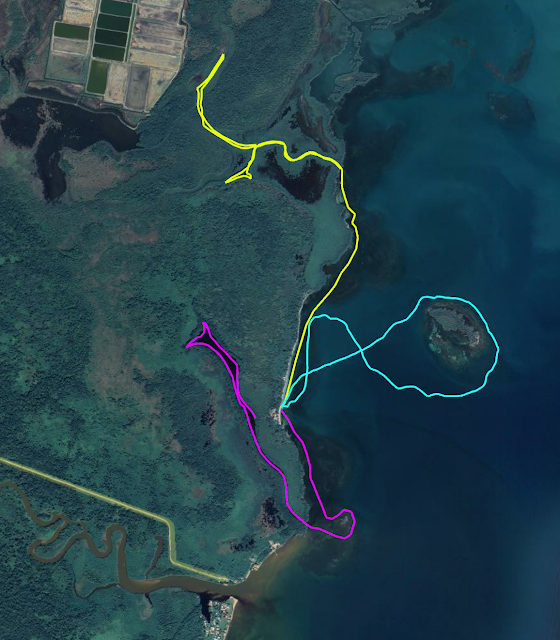
The fuchsia route into Black Lagoon.

I launched the kayak from the same spot as before, but this time I headed south, towards Little Monkey Cay.  I looped around the cay, which is a roost and/or breeding site for lots of sea and wading birds - brown pelicans, white ibises, cormorants, anhingas, green herons, white egrets, little blue herons, and great blue herons.  I learned recently that another name for Little Monkey Cay is Crown Cay.  Next time I am out there, I will try to get some good  bird photos.  I didn't get any this time because the light was against me.  

I turned into the entry to Black Lagoon and began a very leisurely paddle towards its north end.  
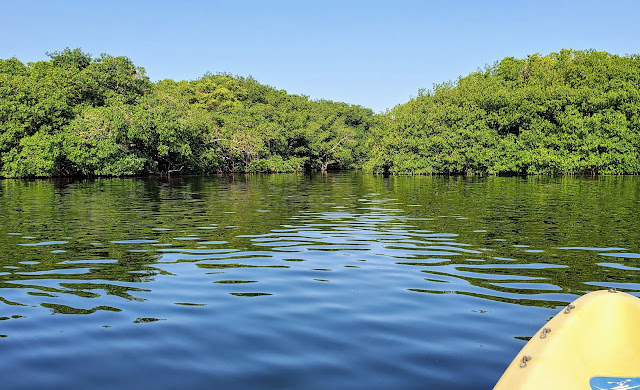
The narrow entry is just to the right of center.

Right at the mouth, I saw a great blue heron fishing from the prop root of a mangrove tree.  It flew off as I paddled closer.
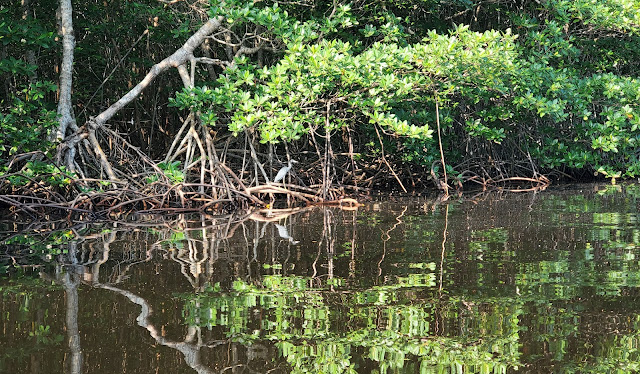
Great Blue Heron,
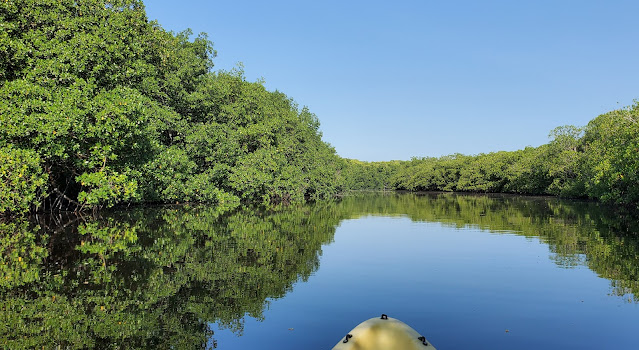
The banks of the lagoon are lined with a mix of red, white, black, and button mangroves, with the red being predominant and right along the edge.
The lagoon widens just after the mouth.  The water is the color and clarity of black coffee due to the tannins leached out of the dead leaves in the swamp.

Flocks of immature little blue herons with their tie-dyed transitional mix of white and blue feathers scattered before me as I headed north.  A lovely green heron sat immobile as I went by, but it was too far away for my camera phone to do it justice.  The same with the immature white ibises.

Two small streams feed into the north end of the lagoon.  I paddled up each stream as far as I could.  The vegetation changes a little bit and the large white mangroves were more evident.
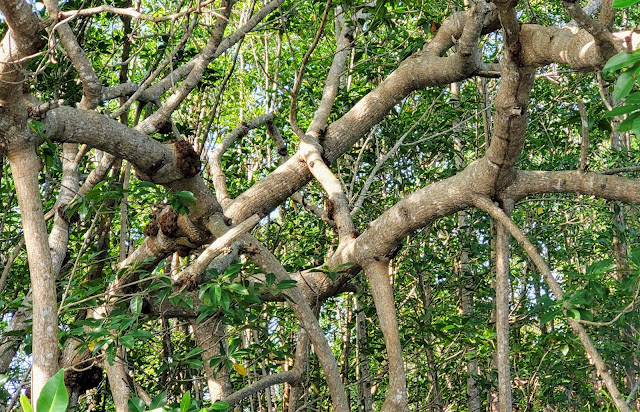
I love this white mangrove tree with its network of fat branches and massive prop roots  Each time I see it I want to climb it.  So far I haven't . . . .

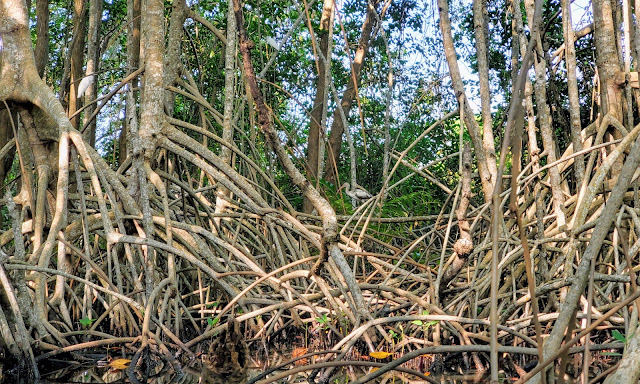
Younger white mangroves with a tangle of prop roots hide lots of birds.

Perhaps you can spot the immature white ibis with its long, orange, decurved bill and lots of dark feathers remaining in its plumage at the center of the photo.  Also what I think is a snowy egret in the upper left quadrant. Or it could be a very juvenile little blue heron that still has all its white feathers.

As I made my way to our back landing where I ended this trip, I heard a squirrel cuckoo, lots of brown jays, kiskadees, and unidentifed birds and saw a bare-throated tiger heron.  I recently installed an app on my phone that identifies birds by sound (the Merlin App).  Next time I will be sure to have it running while I am out in Black Lagoon.

In all it was a 2.7mile trip and took about 2.5 hours because I kept a leisurely pace with lots of stops to appreciate the beauty.  Forgot to mention the trip to Great Monkey Cay and back was 2.9 miles. 


25 February, 2012

Small is Beautiful

Almost every time I have been out on Black Creek Lagoon, I have seen a flashes of a small green and cinnamon colored kingfisher flitting through the dense mangrove vegetation.  Back in October, I was finally able to get a good look at one of them and even took some photos that were good enough to ID the little bird as an American Pygmy Kingfisher, aka the Least Green Kingfisher, Chloroceryle aenea.


There are 2 other green kingfishers found in this habitat that this one can be confused with, but, at 5 1/4  inches, this one is the smallest of them.  Probably why it is called "pygmy".  ;-)


The American Pygmy Kingfisher has a cinnamon collar, in contrast to the white collar of the Green Kingfisher and the Amazon Kingfisher.


A few days later I was able to get a look at and some better shots of another Pygmy while kayaking in the mangroves.

Unlike the Amazon Kingfisher, which is considerably larger (11 plus inches!), the Pygmy Kingfisher and the Green Kingfisher both have rows of white spots on their green wings.  The female pygmy and green kingfishers have a green band across their breast.


This was a very friendly male who sat and talked to me for about 15 minutes while I photographed it from the kayak.


Nearby were what looked like nest holes excavated on the bank of the creek.  I will definitely come back later to see if I can detect any nesting behavior.Posted by Picasa

18 February, 2012

More Scenes and Birds from the Canal

The entry to the drainage canal from the sea is broad and flanked by low growing red mangroves.


Farther up the canal where the water is fresh rather than brackish, there are steep banks.
On the right bank, you can see ferns cascading down toward the water.  In my previous post, I had a photo of the ferns.  
Mixed in among the ferns were beautiful Lycopodium, also called club moss.
On the left bank, where the soil is bare, there was a spotted sandpiper scrambling along.


It didn't fly off as I floated by in the kayak, letting me take some photos as I went.


It bobbles its tail up and down as it goes.
After reaching the end of the canal, I turned around and went slowly downstream toward the sea, eventually reaching the mangroves.  In a protected sort of bay surrounded by mangroves, there a number of herons and egrets.  
The light was terrible for photography, and it didn't help that the birds were far away and against the grey sky.
Never-the-less, the shots were good enough to ID this bird as an adult Little Blue Heron.


I was able to do a bit better with this individual that was considerably closer and cooperated nicely with the camera.
Its colors are quite subtle with some pale blues and pinks along the base of the bill.


The legs are greenish yellow and eyes are yellow.
It turns out this is a juvenile Little Blue Heron before it begins its color change from white to blue.


A lovely bird; one of the exceptions in which the juvenile is more striking than the adult.
Posted by Picasa

15 February, 2012

A Bit of Belize: Land, Sea, and Air

A small selection of photos from two of my Belize kayak trips back in October and November; mostly to bring to mind a warm,sunny place on these cold February days when we are so ready for spring.  Spring is still a few months away for us in Minnesota.  :-( 
The two "land" photos were taken along the canal where I was surprised to see a couple of ferns growing just above the water line.  
I haven't keyed this fern out yet.  It appears to be a climbing fern that was growing profusely on the banks of the canal. I need to get photos of its spore-bearing leaves to help ID it.
Actually, I am not positive that this one is a fern, but I think it may be in the genus Ophioglossum (adder's tongue ferns) or maybe a tongue fern.  
I will have to go back to take a closer, more definitive look.   hmmm... a good mystery to work on next time I'm in Belize.
Seeing the ferns along this part of the canal made me realize that I was upstream of the tidal portion and in an area that is fresh water.
Back out into the salt water, I saw this sting ray making its way along the shallows.  This is a medium sized individual.
Closer to home in Belize, this little whelk was grazing in the shallows.  I love the way the sunlight is refracted by the little ripples on the water; you can see how clear the water is.
While paddling back in the mangrove marsh, I heard this  frantic flapping of a flock of birds that I disturbed as they went crashing through the trees.  When I was finally able to see them, I was surprised that they were doves.  There is no solid ground below these mangroves, and I am more used to doves that like to hang out on the ground.


They wouldn't sit still for a second so my shots are not very good.  But they were good enough for me to identify them as Pale Vented Doves, which are known to prefer mangrove habitats.  I would like to get some better shots of them.
Looks like I have work my cut out for my next trip.  :-)

02 February, 2012

Abstract Belize

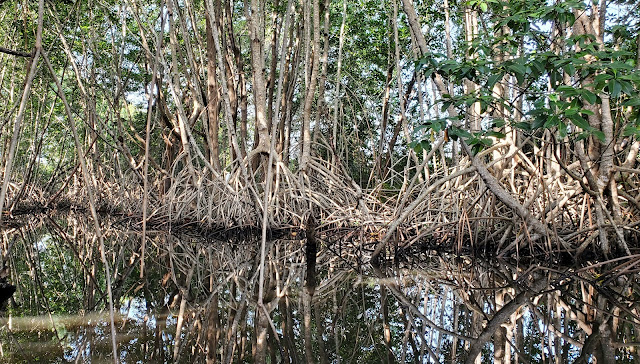
I was inspired by Andrew's "Which Way is Up" post (click here to see it) to show these images of the mangroves along the edge of Black Creek lagoon behind our place in Belize.  Like Andrew's photos, these are water reflections, and I was struck by their abstract beauty when viewed sideways.


Up close it looks vaguely arthropodic (is that a word?)  to me.

Posted by Picasa

29 January, 2012

Kayaking with Dennis

Dawn came with a silky stillness in the primordial air.  

Gentle undulations rock the sea like a faint heartbeat, punctuated by the silent passage of egrets skimming the surface.
To the north, the sky clears as dawn breaks free of the low clouds and day begins in earnest.  
A day made for kayaking, slipping soundlessly along the water's surface, at one with the natural world.  Dennis and I head toward the sunlight in the north, easing in and out of passages amongst the mangroves.
We glide up to herons, like this yellow-crowned night heron.
Alert to our prescence, this yellow-crowned night heron is not unduly agitated.
OK, you are getting into my personal space here.
A little too close for comfort; I am out of here...
Way back in the marsh we saw a flash of peacock blues and greens.  What on earth?  It flew into the heavy mangrove tangle and walked from root to root, always keeping on the far side of vegetation, giving us only glimpses of a bird with a heron-like neck and bill but with a bulky, turkey-like, body.  It cautiously peeked out at us, seemingly as curious about us as we were about it. I got a couple of shots in hopes of being able to key it out later.  I succeeded in capturing the world's worst photos of the world's most beautiful bird - the Agami Heron.  Click here for the world's best photos of this fabulous bird.
I marked the tip of its beak with a purple arrow and its eye with a vertical arrow. Doesn't seem possible, does it?  But you can see it again in the next shot.
And again vertical arrow marks the eye and the horizontal one marks the tip of the beak.  The unusually long beak is one of the Agami's identifying characteristics.
Better luck in photographing a juvenile green heron.
The gloom of the tangled vegetation can't hide this lovely bird, but doesn't do much for the photo.  :-(
It very nicely cooperated and turned its streaked breast toward the camera.
We'll be back for more of that Agami heron and perhaps to see the green heron mature.
Posted by Picasa