Showing posts with label egrets. Show all posts

22 January, 2022

Birding and Hiking along the Leisurely Trip to Belize City

Jonathan met us at the Dangriga Airstrip and we began birding right away. The weather seemed to be clearing up a bit, but Jonathan told us that the Hummingbird Highway was very rainy with a low ceiling of heavy clouds - not great conditions for birding in the jungle. We dallied along the shore, giving the weather a chance to clear off in the mountains.
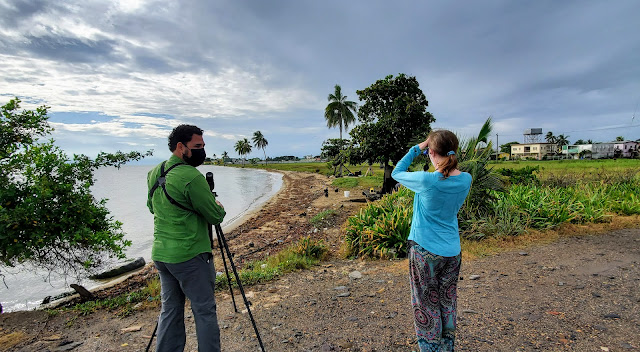
Setting up the spotting scope.
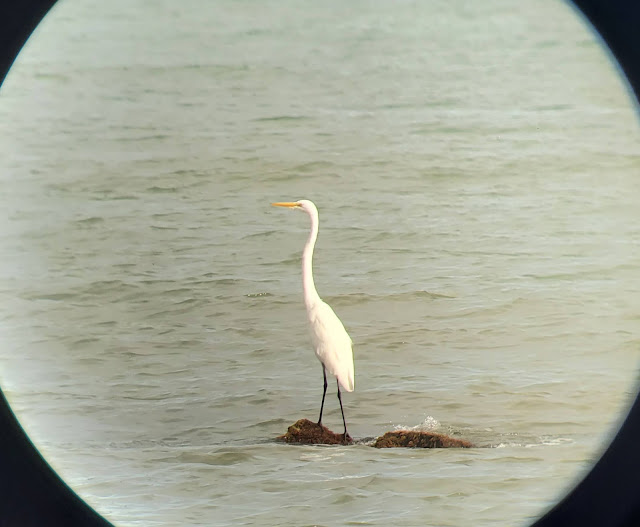
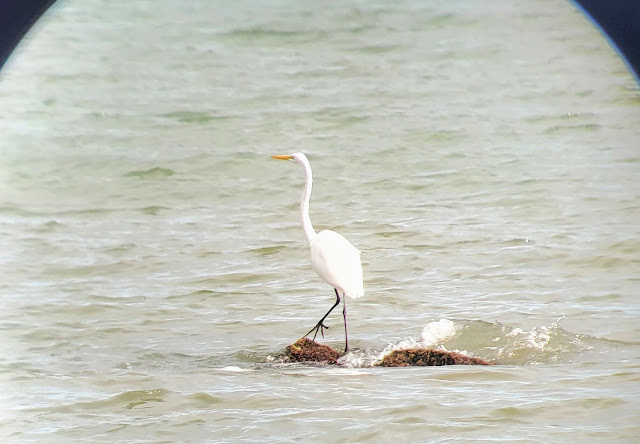
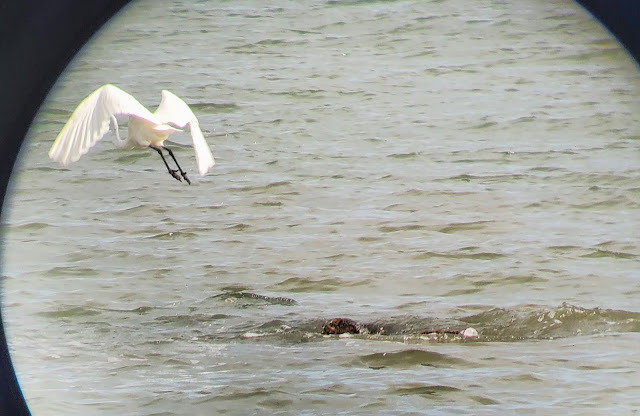
Jonathan very kindly took some digiscope shots with my phone camera through his spotting scope.  Here is a series of a very distant great egret as it leaves it rocky perch in the sea.


The vignetting is due to the edge of scope's eye piece.  
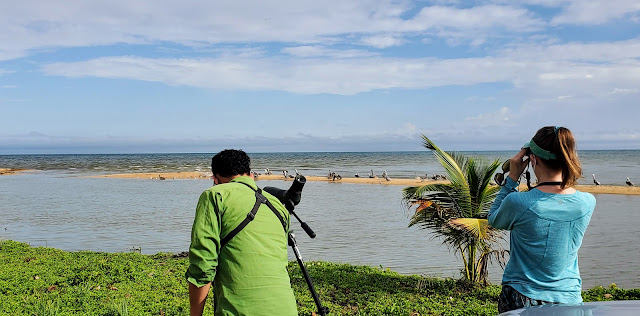
Scoping out the birds on the sandbar.
The birds on the sandbar were not bothered at all by our presence, probably because they felt protected by the expanse of water separating us.  Lots of good birds out there.
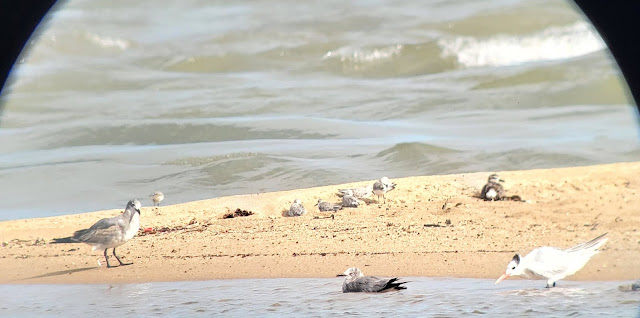
A group of 7 or so little sanderlings, a black-bellied plover, and a laughing gull having a bath.

A royal tern (lower right) joined them, as did a couple of sandwich terns which are not in this image.

A couple of my favorite sightings of the day were a tricolor heron and a willet.  Alas, no photos.

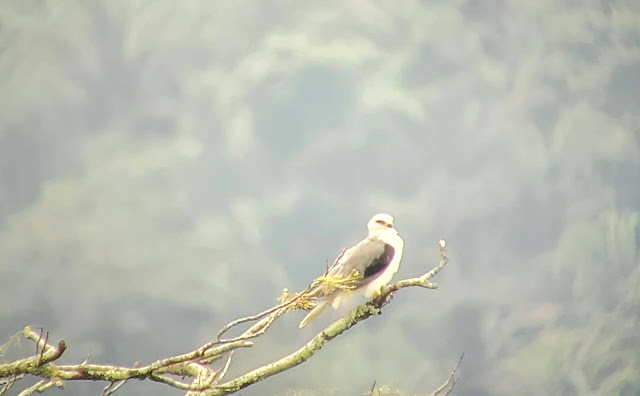
We moved on to St. Herman's Blue Hole National Park.  Along the highway we set up the scope to see this lovely bird - a white-tailed kite.  These are digiscoped photos that Jonathan took with my phone and his scope.
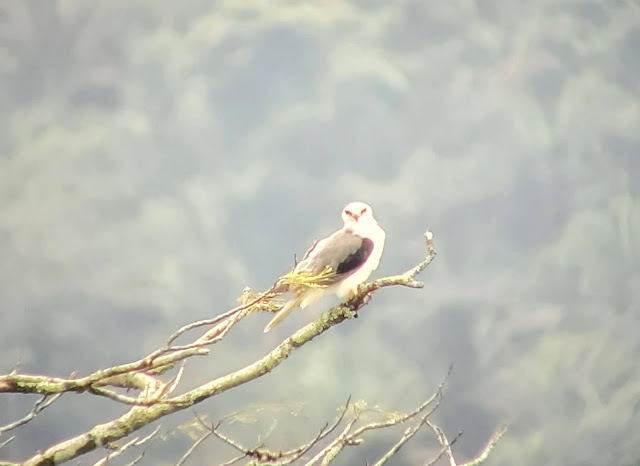
Look at that fierce face!

Fluffing up against the cold dampness.
The weather was not cooperating and you can see that we struggled with visibility.  But you work with what you get in birding.
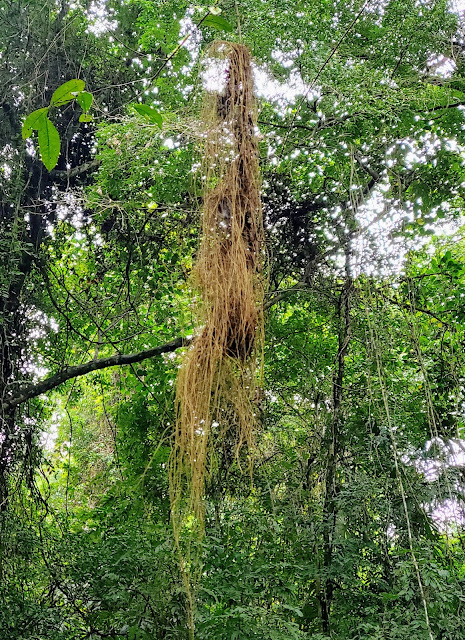
The nest of a royal flycatcher.
We heard and had glimpses of many birds at St. Herman's, but with the drizzle and low light, photos were hard to come by.  In the distance we could hear a keep-billed toucan, but didn't even manage a glimpse.  We did get good looks at several hummingbirds - a stripe-throated hermit, a wedge-tailed sabrewing, and a white-bellied emerald.  Also watched a very active lineated woodpecker on a tree just next to the hiking trail.  We hurried back to the van as the drizzle turned to actual rain and continued on our way.  After lunch in Belmopan, the weather cleared a bit, and we paid a visit to one of my favorite places in the world - Belize Bird Rescue.  That stop will get its very own post very soon, maybe tomorrow.  Then it was time to get on the George Price highway toward Belize City with a birding stop at Captain Hook's Shrimp Farm while we waiting for our "to go" shrimp dinner to be prepared.
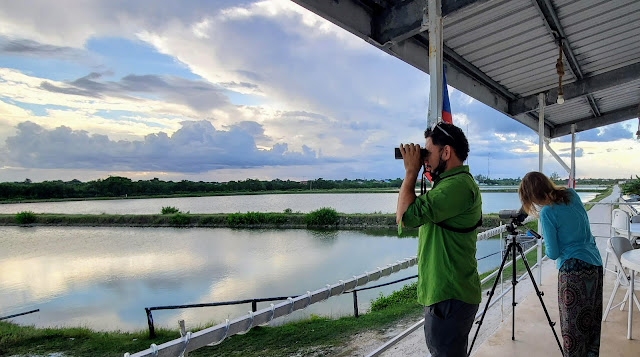
Looking out over the shrimp ponds near dusk.
Jonathan spotted a clapper rail along the bank of the pond.
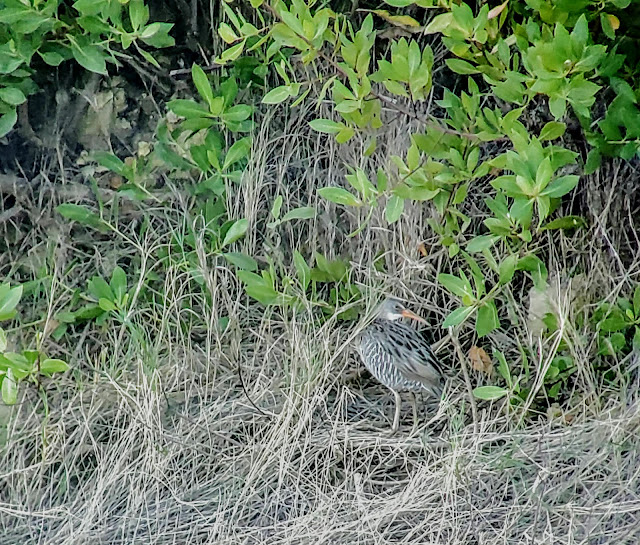
They aren't rare, but they are rarely seen.  I was thrilled to watch this bird through the scope as it preened.

We also had great looks at another tricolor heron, green heron, great and little blue herons, yellow-crowned night herons, great egrets, snowy egrets, lesser scaups, anhinga, white ibis,  These birds love their shrimp!

In all we saw or heard 62 different bird species.  And we got to our hotel in time for Becki to have her departure covid test before we ate our shrimp dinners relaxing by the hotel's pool.
29 January, 2012

Kayaking with Dennis

Dawn came with a silky stillness in the primordial air.  

Gentle undulations rock the sea like a faint heartbeat, punctuated by the silent passage of egrets skimming the surface.
To the north, the sky clears as dawn breaks free of the low clouds and day begins in earnest.  
A day made for kayaking, slipping soundlessly along the water's surface, at one with the natural world.  Dennis and I head toward the sunlight in the north, easing in and out of passages amongst the mangroves.
We glide up to herons, like this yellow-crowned night heron.
Alert to our prescence, this yellow-crowned night heron is not unduly agitated.
OK, you are getting into my personal space here.
A little too close for comfort; I am out of here...
Way back in the marsh we saw a flash of peacock blues and greens.  What on earth?  It flew into the heavy mangrove tangle and walked from root to root, always keeping on the far side of vegetation, giving us only glimpses of a bird with a heron-like neck and bill but with a bulky, turkey-like, body.  It cautiously peeked out at us, seemingly as curious about us as we were about it. I got a couple of shots in hopes of being able to key it out later.  I succeeded in capturing the world's worst photos of the world's most beautiful bird - the Agami Heron.  Click here for the world's best photos of this fabulous bird.
I marked the tip of its beak with a purple arrow and its eye with a vertical arrow. Doesn't seem possible, does it?  But you can see it again in the next shot.
And again vertical arrow marks the eye and the horizontal one marks the tip of the beak.  The unusually long beak is one of the Agami's identifying characteristics.
Better luck in photographing a juvenile green heron.
The gloom of the tangled vegetation can't hide this lovely bird, but doesn't do much for the photo.  :-(
It very nicely cooperated and turned its streaked breast toward the camera.
We'll be back for more of that Agami heron and perhaps to see the green heron mature.
Posted by Picasa

29 October, 2010

Exploring Black Creek

We have a small, locally-made, fiberglass, keel-less canoe that is called a dory around here. We moved it around back to Black Creek so that I can take it out to paddle around and take photos. Black Creek is almost a lagoon except that it is feed by natural drainage from the surrounding marshes rather than being tidal seawater. It has a very gentle flow and feels more like a lake than a creek.

The brackish water is a dark tea-color from the tannins in the mangrove leaves that drop into the water. It is major nursery for tarpon and permit fish to mature from mere wee babes to juvenile fish large enough to head out to the open sea. Of course, not all of them make it out of childhood because the mangroves surrounding the creek are home to large numbers of egrets, herons, kingfishers, cormorants, anhingas, and osprey. Bird photos will come later, I promise.


I got up early a few days ago for a dawn paddle in Black Creek. 
It is so quiet and serene with no one else around. Quiet, that is, until a crocodile launches itself into the water with a big kersplash when I startled it out of its morning slumber. I didn’t get a good look at it, but based on the size of its head (about a foot long and 8-10 inches wide), I estimate it to be a smallish croc about 3 to 4 feet long. There are reliable sightings of a croc at least 15 feet long that resides in Black Creek. Suddenly, my dory feels pretty small and tippy.


As the morning grew late, I saw a cloud of white out the corner of my eye. I turned the dory around to see a flock of white birds wheel around the far, broad end of the creek. I managed to take some photos, hoping to see where they landed, but they flew off without landing.


Looking at the photos later, I could tell they were snowy egrets with their golden slippers. It is a bit of a challenge to take action shots with a long(ish) lens using a monopod in a keel-less canoe while adrift! But I am getting a little better at it and I haven’t tipped over yet. ;-) Which is a good thing considering the crocs …