11 May, 2014

Hummer Wars!

As promised in my last post, here are photos of hummingbirds fighting over access to our feeders.

This first series is between a Cinnamon (perched) and a Rufous-tailed that is trying to drive it off.   And then comes a Green-Breasted Mango to get in on the action.  The Cinnamon just hunkers down and stays put, after giving the Green-Breasted Mango a word or two!

Looks like the Cinnamon senses the Green-Breasted Mango off to the left.

"Hey!  I was here first.  Wait your turn!"
"That's right.  You had better back off!"
"Just get on out of here."
Now the fight is between a Rufous-tailed and a Green-Breasted Mango.  Lots of displaying and posturing.


'Round and 'round they go until the Green-Breasted Mango goes for the nectar.
This calls for reinforcements!
"The big guy won't have a chance with both of us Rufous-tails here."
"Where'd he go?"

Time out for a quick drink on both sides.
"Go away.  I'm not finished yet."
Now the 2 Rufous-tails fight each other once the Green-Breasted Mango has gone.


My favorite ones to watch are the little Ruby-throated hummingbirds.  They are small but fiesty!


They must have watched Stars Wars and The Matrix too many times...

Dedicated on this Mothers' Day to my Mother, who loved hummingbirds and never tired of watching them.

19 April, 2014

Hummingbird Update - Part Four

The striking Green-breasted Mango Hummingbird is the largest hummingbird to visit our feeders and the juveniles and adult females, which look very similar, will not be mistaken for any other hummingbird.   To me, they have odd coloring, like someone hastily dabbed paint on their front sides.
The juvenile male has the characteristic russet flecking along the white edge of the breast.  To me the center stripe looks dark green, but it is often described as black.  In mature plumage, the male tail feathers will not retain the white tips.
With that streak of dark green (black in many descriptions) down the center line of their front side, they are unmistakable.
The decurved bill is all black.
Look how far its feet are from the perching rim on the feeder in the shot above; that is an indication of how much larger they are than our other visitors.
From the back, they are solid green.  And what are those 2 accessory feathers sticking out?
Its body is solid green on the backside, except for the tail.  Look at those two little accessory (for lack of a better word) feathers, one on each side just above the base of the tail.  Wonder what those are.  Anybody know?  I can't find them in any of my books or online.

Aside - As I was looking at my photos from January and February (when the above were shot), I was increasingly discouraged by the quality; things just didn't seem very sharp and there was often a sort of halo at the edges of shapes.  I did what I could with image processing to improve matters, but by March I realized that my zoom telephoto lens was having serious issues.  Even my normal zoom lens was giving me trouble.  More than 50% of the time, I couldn't even take a photo due to "error 99".  That error doesn't mean anything other than the lens and camera or battery and camera are not communicating. I was limited to an increasingly smaller (a bit of an oxymoron in that phrase) range of zoom that would work.  I tried cleaning electrical contacts, baking out moisture, cleaning more, swapping lenses between my 2 camera bodies with no satisfaction.  At the end I was shooting only on manual settings just to get the occasional shot.  I decided to get a new camera body and a new lens, a big upgrade in quality (and price) that are more resistant to dust and moisture.  I just received them yesterday and the shots below were some of the first taken with the new setup.  More on what camera and lens I got in another post; let me just say that I am very happy.  :-)  I bet you can tell that the shots below are much crisper than the ones above.  I hope my photos will improve as I learn to really use the new setup.
Here is a better view of the white tail tips with indigo and bronze colors
There do not appear to be any flecks of russet color at the margins of the green and white that a juvenile male would have, so this is most likely a female.

Once or twice I saw a green-breasted mango able to sit on the rim of the feeder, but 99% of the time they hover.  These are by far the largest of the hummers we have had to date.  They more than hold their own against the feisty and aggressive rufous-tailed hummers.

I don't have any photos of males yet (see camera issue above), but they also come to the feeder.  The adult males don't have any white on their throats, breast, or bellies. They are gorgeous.  I'll have photos soon!  

The final, and fifth part of this series is "Hummer Wars", which shows confrontations between hummers at the feeders.  I hope to have it posted in just a few days.


03 March, 2014

Hummingbird Update - Part Three

The dashing Rufous-tailed Hummingbird is today's featured hummingbird.  Below is the first photo I took of it before I had even ID'd it.
Not the best shot, but enough to let us know that it is not a Cinnamon.
The Rufous-tails are essentially the same size as the Cinnamon Hummingbirds that also feed on these hibiscus flowers.  
Easy to see here how it differs from the Cinnamon; the Rufous-tails are mostly green on the front with a little grey on the belly and amazing white "femoral tufts" (fuzzy feathers on their legs), whereas the Cinnamons are, well, cinnamon colored on their fronts.
Rufous-tailed hummingbirds are the most common and widespread hummer in Belize, but we were never able to see them long enough to photograph them or recognize them until we had feeders up.  They nectar on banana and coffee bean flowers, both of which are cultivated on large and small scales throughout Central America.  Check out one of my earlier posts about banana flowers.
Here is a good view of the green gorget and upper chest and paler grey-green belly.
It took them longer to start using the feeders than it did the Cinnamon Hummingbirds.  And of course the experienced Ruby-throats, newly migrated from the abundant feeders in the US, were the ones that showed the Cinnamons what a feeder was all about. 
Heads up!  Ever on alert for danger or competition.
Rufous-tails have a reputation as being the most aggressive of the Belize hummers. I have seen them chase off the larger Green-breasted Mangoes and they are known to chase off insects and basically anything that approaches "their" feeder.  
From this vantage, you can see the lower mandible is red and the upper is black.
They even stand their ground against us as we tend to our outdoor activities.  They back off from the feeder and face us, chattering and fussing to persuade us to leave.  If we continue to work outside, they are the first hummers to resume feeding and basically ignore us unless we get within 5 or 10 feet of the feeder.
The tip of both lower and upper mandibles is black.  This is a fairly common theme in hummingbirds, but can still be a useful tool for IDs.
This next photo is very similar to the last photo is the previous post.
This Rufous-tail looks a lot like a Cinnamon from this angle, but notice that there is no cinnamon color on the side of the neck and the overall green color is darker on the Rufous-tail.
From the front there is no confusing the two.
Look at the gorgeous emerald green gorget sparkling in the sunlight!
There are reports of hybridization between Cinnamons and Rufous-tails, but I haven't seen images of the offspring.  For all I know, some of these are photos of hybrids.  Hybridization is pretty common within the hummingbirds and can make it difficult, but quite interesting, to ID individuals.

When the gorget catches the light just right, it lights up with a spectacular iridescence.
An impressive display, even out of focus.
Rufous-tails are very determined feeders and put on incredible acrobatic antics when defending their feeder from other hummers, even from other Rufous-tails.
Steely-eyed determination ...
The striking Green-Breasted Mango will be featured next, so stay tuned.


22 February, 2014

Hummingbird Update - Part Two

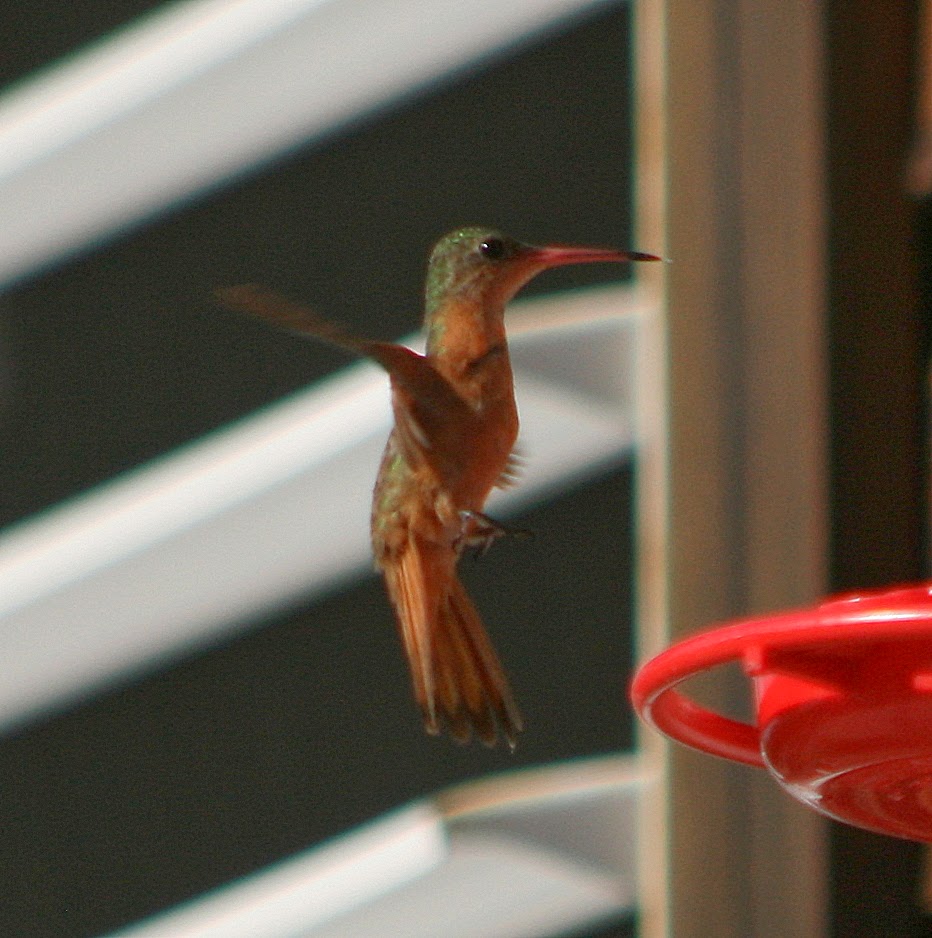
The lovely Cinnamon Hummingbird is the feature of today's post.  The Cinnamon was the first hummingbird I took a photo of at our place here in Belize.  It was just a fuzzy speck perched on a leafless twig atop a small tree, but the completely cinnamon-colored underside is not found on any other hummingbird around here.  
Over the last 7 years, the Cinnamon has been a continuous  year round resident that we see and hear feeding on the hibiscus flowers in front of our veranda.  They give a single cht before each flower visit, and a series of chts as it flies from bush to bush.  
You can just see a little pale tongue-tip sticking out. 
Before we started living here full-time December of 2012, the Cinnamon was easily spooked by us when we would try to get a better view of it.   Once we had been here for a while it got more used to us and, while still wary, didn't fly away if it saw us on the veranda.  Now that the feeders are up, it (they, actually) is (are) bolder still.  I took these photos of the Cinnamon at the back feeder on 3 different days.  I was only 15-20 feet away, with Max (the cat) at my side, and none of the hummers seemed deterred by our presence.
At 4.25 inches, the Cinnamon is noticeably larger than the 3.5 inch Ruby-throated. 
Notice the black-tipped red bill.
The tail is also cinnamon-colored from above and below, and is bordered with a dark charcoal band.

Still wary, but the allure of the feeder is too strong to resist.
The sexes are indistinguishable.
Its head and back are a shiny greenish-gold color.
From the back you can see the cinnamon-colored tail with tis darker border and the iridescent greenish-gold of the back and head.  Unmistakable and lovely.
Next up will be the dashing Rufous-tailed Hummingbird.


18 February, 2014

Hummingbird Update - Part One

I had a couple of posts a few months ago about the hummingbirds we have seen at the feeder we put out at the front of the cabana near the hibiscus where they feed (here and here).  
A hummingbird approaches the "ocean view" feeder just off the front veranda
We put up another feeder on the back deck in a more sheltered spot that just happens to be right outside our bedroom window.  :-)  Once the ruby-throated hummers started coming, it took about 2 weeks for the cinnamon hummingbirds, that feed on the hibiscus flowers year 'round, to realize that the feeder was also a good source of food.  Then the floodgates opened and we got 2 more species as regulars at the feeders - the green-breasted mango and the rufous-tailed hummingbirds.  Today's post is the first in a series and it highlights our old friends, the ruby-throated hummers.
You can see the post-ocular white spot that is characteristic of the ruby throats. Notice the drying laundry in the background.  :-)
As you can see, it is also adjacent to our clothes line, which makes for a handy perch at times.
They fan their tails out for aerial maneuvers and displays.
This female ruby-throated hummer is showing its characteristic outer three white-tipped tail feathers.
Nice profile view.
There are at least two other species of hummingbirds in Belize with similar looking females, but the ruby-throated is the only one with a totally black bill.  The others have black upper and red lower.  Whewwww - that saves me a tough session of keying out the other species.  Just in case you are wondering, the other 2 are the female white-bellied emerald (larger and with dingier greyish-white tips) and the female Canivet's emerald (smaller and with a post-occular white streak instead of spot).
Sometimes they take a quick sip without perching.
We have seen at least 2 immature males (photos in a previous post) and numerous females, but no adult males with their stunning ruby throats.  Not sure why that is.  The adult males have a slightly different migration schedule than the females and the immatures, so maybe they just haven't found our feeders listed on the hummingbird equivalent of Trip Advisor yet.  Surely we must have a good rating for abundant, fresh nectar, choice of ocean view or sheltered seating, and the featured local cuisine of hibiscus and flamboyant tree flowers!
And sometimes they sit and stay for a while.
We get lots of return business, too.
They always keep on alert for predators and competition at the feeders.  These birds may be small, but they are feisty.
Stay tuned for the next installment featuring the lovely cinnamon hummingbird.

14 February, 2014

Saturday Trip to Placencia

Last Saturday Dennis and I made a little trip to Placencia to meet our friend, Dena, and her friend, Peggy, for a visit and lunch.  We made a brief stop in Monkey River Village before driving to Placencia.  On the short boat ride to the village, we noticed waterspouts out at sea and I managed to get some photos while we were in the village.
Dramatic sky with sun beaming through dark clouds and a waterspout in the distance.  I took processing liberties using a function called "HDR-ish" in Picasa to highlight the drama.
We saw as many as seven waterspouts at a time.  They usually don't last too long, maybe 20 minutes, and their winds max out at about 100MPH - nowhere near as destructive as their tornado cousins.  Still, you don't want to be near them when you are in or on the water.
They were fairly far away, but you can make out the water spray at the sea's surface under the leftmost spout. 
Soon we were on our way up the Monkey River Road in the Subaru.  We had plenty of time and stopped to take a few other photos.  Like the gorgeous blossoms of the Provision Tree below.  The blossoms on these large trees are as big as your head.  The very phallic buds peel open like a banana and the long red-tipped stamens fan out. The fruit is roughly the size and shape of a football (American football, that is.  Not soccer) and contains edible nuts.  I haven't tried them yet, but will if I get the chance.

Pachira aquatica, Provision Tree.

We also saw what I at first thought was a bird-of-paradise flowering at the edge of the jungle.  But I am not so sure now.
Bird-of-Paradise?  Probably not - it looks different than most that I see growing in the wild round here. Maybe it is a Canna flower.  They are in the same order (Zingiberales) as the bird-of-paradise and the gingers. Another mystery to solve!


After having a delightful lunch with Dena and Peggy at Dragonfly Moon Restaurant in Placencia (which we highly recommend, also see more about them here), we had coffee at Above Grounds Coffee House (also highly recommend).  Drinking our coffee (or, in my case, a caramel macchiato) on the deck, we were approached by a Maya woman selling wooden bowls.  I bought a bowl to use as a bread bowl. It is a lovely thing, made of tamarind wood.  As you can see in the photo below, I soon put it to good use, making French-style baguettes and southern biscuits (aka "scones" or "johnny cakes", depending on what part of the world you are in).  Tamarind, which is called tambran around here, is a very hard wood and takes a nice natural polish to its surface.
The tamarind wood bowl is the perfect size for mixing biscuit or bread dough.
From waterspouts to wooden bowls, you can never tell where the road in Belize will take you.

29 January, 2014

Sold!

Yea!  Our Rochester home of 20 years has now been sold to the delightful Dawn.  
Look at the snow-covered ground and the flag flapping in the 20 mph wind!
I have been in Rochester these last few weeks to finally wrap things up.  Moved the furnishings that we did not sell into storage until we have them shipped to Belize, changed mailing addresses, canceled utilities, and the million other things moving entails.  

Of course all this had to happen during some of the most brutally cold weather to hit Minnesota since the winter of 1993-94, which coincidentally was our first winter in Minnesota.  The actual low temperatures were in the -20s F (-30s C), with dangerous windchills that can give unprotected skin (like faces) frostbite in less than 10 minutes making it feel at east 15 degrees colder!  Got all the moving done with the help of good friends - thank you Darren, Kurt, Coleton, Vivian, Gloria, and Ken for risking frostbite in my time of need! And thanks also to our wonderful Realtors, Cyndee and Ray Neis, who kept such a good eye on the house while we were out of the country and found the perfect person to buy it.

It has been sad to leave this lovely home in which we enjoyed living for 20 years; I shed a few tears as I packed mementoes, sold family heirlooms, and took last looks onto favorite vistas.  But the sadness is mitigated by Dawn's enthusiasm for and appreciation of the house and our improvements to it.  Dawn - we hope you enjoy it as much as we did.

I won't be sad to leave winter behind (perhaps forever) and return to Belize tomorrow.  I am looking forward to rejoining Dennis and thawing out my popsicle toes in sun-warmed sand.  

Regular blogging will resume next week.  :-)