Traces of Iris (2001) Remain
It is appropriate that thoughts of hurricanes past are in my mind at the moment since it was this time last year that we experienced Hurricane Earl. Fortunately for us here in Englishtown, Earl barely glanced us as it tracked to our north. That was not the case for Hurricane Iris in 2001. Category 4 Iris made landfall right here in Monkey River Village and Englishtown. Iris was second only to Hurricane Hattie (1961) as the most destructive hurricane to hit Belize in recorded hurricane history.
 |
| Tracking map of Hurricane Iris, 2001. The left-most orange dot is right over Monkey River Village and Englishtown (from Wikipedia). |
Hurricane Iris had a change of course and strengthened unexpectedly, resulting in only a 23 hr advance warning for Belize. According to Wikipedia "
On reaching the western Caribbean Sea, Iris rapidly intensified into a Category 4 on the Saffir–Simpson scale. A small hurricane with an eye of only 7 mi (11 km) in diameter, Iris reached peak winds of 145 mph (230 km/h) before making landfall in southern Belize near Monkey River Town on October 9." Hurricane Iris generated a 15 foot storm surge and had wind speeds of 145mph when it made landfall. It took the lives of 24 people in Belize, 20 of whom were onboard a scuba diving boat docked at Big Creek, 12 miles north of Monkey River. Most of the houses in Monkey River Village were completely destroyed and all suffered damage. Amazingly there was no loss of life in the village. We had visited Monkey River Village and the area for the first time in 1999 and we bought our property in 2004, after Hurricane Iris. The Village had been largely rebuilt by then, but the property we bought was still a mess of tangled downed trees and smaller plants growing in thick profusion.
As Nolbert, Barnie, and I walked along the coast, signs of Iris are still evident, 16 years later, in the form of old trees surviving after being toppled over.
 |
| Strangler fig, still growing and flourishing 16 years after Iris. |
This strangler fig must have been a grand old thing when Iris uprooted it. But it, like many tropical species, is a survivor that adapts to drastic changes in circumstances. This tree is probably 30 or 40 feet tall now, with many minor trunks that had been side branches pre-Iris. You can see in places where it has dropped adventitious roots that wrap around the old trunk and continue down into the soil. It is hard to be accurate, but it appears that the diameter of the original tree at what had been the soil line was at least 5 feet.
 |
| Nolbert and Barnie in front of the strangler fig for scale. Look at that happy dog. |
This sea grape growing nearby looks superficially similar to the strangler fig. But it doesn't have the strangling growth habit of the fig. Again, the pre-Iris side branches became minor trunks after the tree fell over. Where the old trunk touches the ground, it has developed new roots.
 |
| Nolbert and Barnie in front of a toppled sea grape tree. |
The storm surge from Iris pushed sea water over the land; only plants that are tolerant of salt water inundation survived. But the jungle renews itself quickly. Tropical plants recover quickly and new plants grow in any opening.
One of the very common new plants is this sea hibiscus (or close relative). It is not so much a tree as it a large shrub. It can grow with the waves lapping its feet and is often mixed in the mangroves.
 |
| Sea hibiscus flower. |
Its quite attractive flowers, like other hibiscus flowers, last only a day, getting darker as the day progresses.
 |
| Insect in hibiscus flower. |
Not sure what this insect is. I actually had to lift the camera over my head to get the shot, so I didn't get a good look at it.
Tamarindo-Tamarind-Tambran Small mystery solved - they are cousins! Mitchell at
"Mitchell is Moving" blog had posted a couple of times about a tree called tamarindo planted as an urban ornamental tree in his town in Spain. He described them as having pompom-type flowers. But that is nothing like the tamarindo trees I am familiar with here in the Caribbean, which greatly confused me (but then I can be easily confused). However I recently learned of another tree around here called tamarindo that does have pompom type flowers, the
Cojoba rufescens tree. I had been calling it the "hair scrunchy tree" (your will see why in one of the following photos). It has a cousin,
Cojoba aroborea, also called tamarindo, that is used for furniture. If that is not confusing enough, it is also called
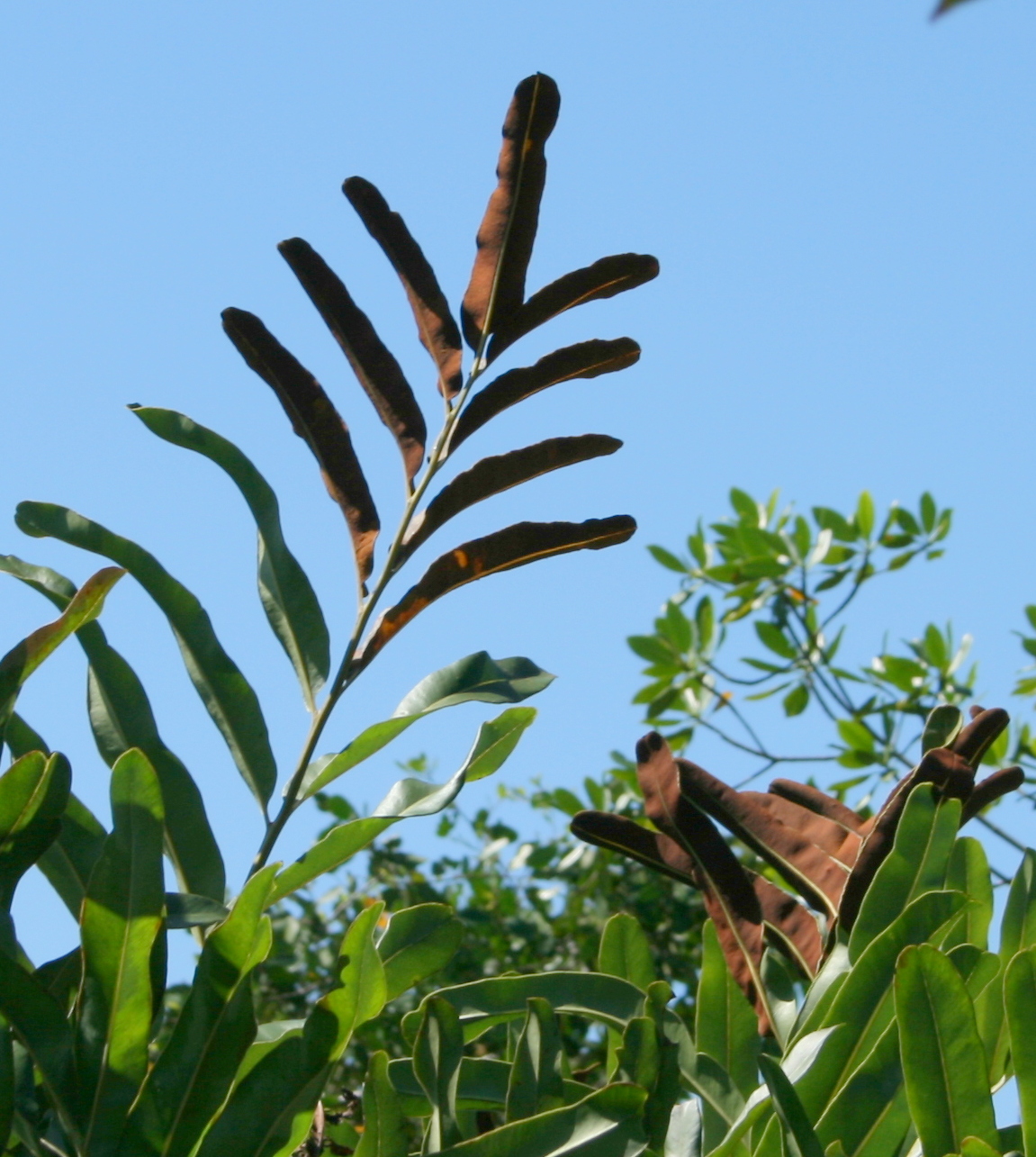
"Barba de Jolote". More detail in Wikipedia. Although the flowers of hair scrunchy tree (Cojoba) and the tamarind tree we grow for its sweet/tart fleshy pods don't look anything alike, the leaves do. And they are in the same taxonomic family that Mimosa trees are in. Compare the next 2 photos to see the resemblance.
 |
| Cojoba rufescens tree with its pompom flowers. |
 |
| Tamarind tree (see Wikipedia entry here). |
 |
| Hair scrunchy! And pompom flowers of the Cojoba rufescens tree. |
 |
| Orchid-like flowers of the Tamarind tree. |
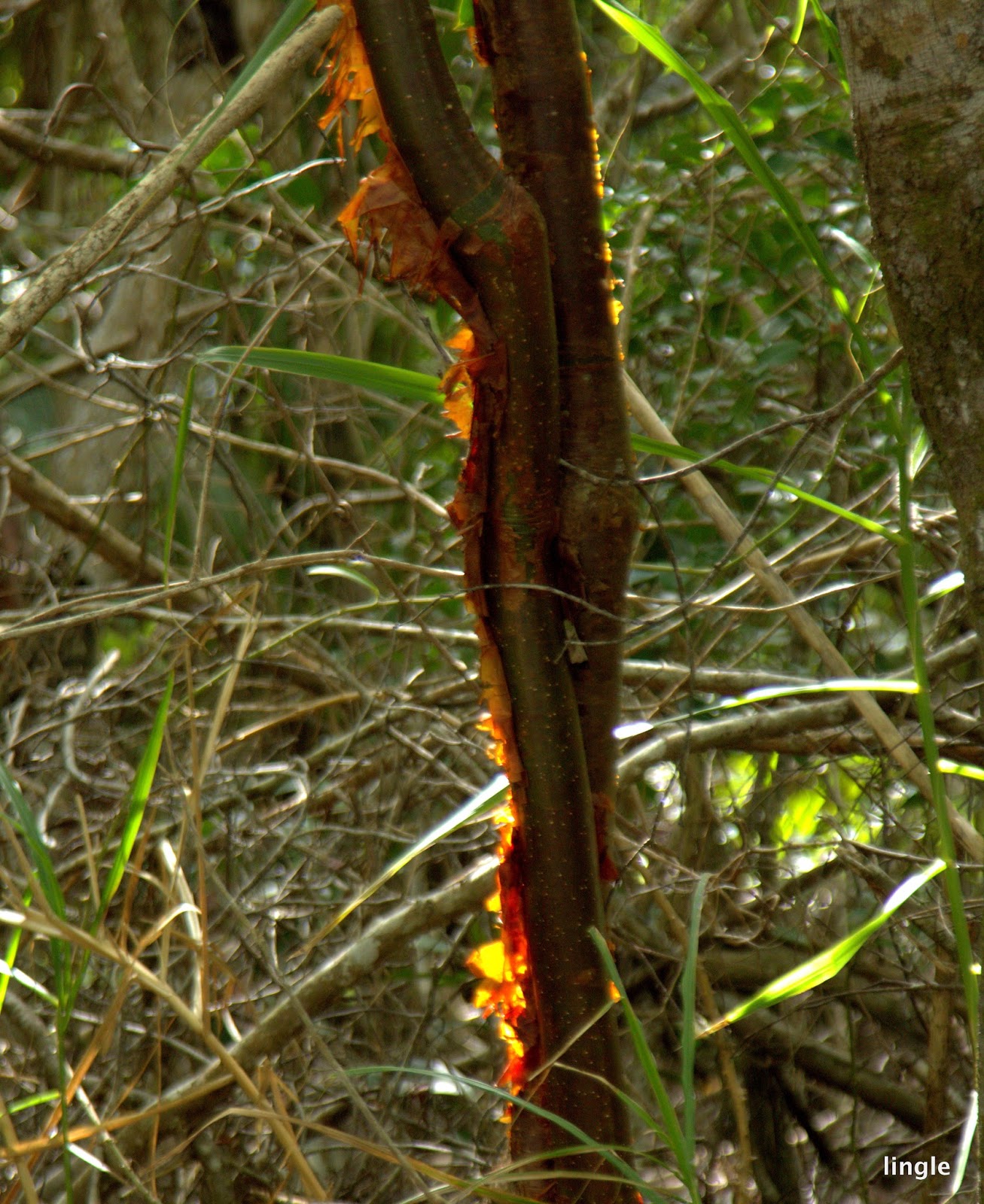
We planted the Tamarind tree, but the Cojoba grows wild. Another tree growing up in the Iris-devastated area is Gumbo Limbo, AKA tourist tree due to peeling red skin. Gumbo limbo trees can grow to quite a large size and we have 3 of various sizes that survived Iris on our property. I love these gumbo limbo trees; their fruit attract lots of birds and they have a high open canopy atop large gracefully curving trunks.
 |
| Young gumbo limbo tree with shedding red skin. |
Our neighbors had several Coral Trees that survived Hurricane Iris. We intend to plant several during this rainy season. Coral trees (Erythrina) are a great choice for hurricane prone areas; they have buttress roots that help keep them upright in high winds and they can tolerate salt water inundation. Another plus for us is that they actually thrive in low swampy areas like we have. They have the most incredible complex blossoms that attract many birds. Apparently, all we have to do get them started is to stick a young branch in the ground! How easy is that?
 |
| Characteristic spiny trunk of a a young coral tree. As the trunk expands, the spines fall off. |
And that brings us back to hurricane season. This time last year we had held our breath as the wrath of Earl passed to our north. We lost a big fig tree a day after Earl as the the shallow roots pulled out of the saturated ground. It will be replaced with a Coral bean (Erythrina sp). We were able to salvage the orchids growing in the fig, and they are blooming beautifully as I write this post.
We moved our bedroom into the new addition of our cabana as Earl was approaching last August, and so have been here a year now. During that year, we took the opportunity to redo the original bathroom and kitchen in the old cabana. That project was completed a couple of weeks ago. Interestingly, the wood for the cabinets is wild trambran, AKA "Barba de Jolote", which we now know is related to the tamarind tree we grow for the pods, the "hair scrunchy" tree that grows wild here, and the tamarindo tree used in urban plantings in Spain that Mitchell wrote about.