Showing posts with label ruby-throated hummingbirds. Show all posts

31 March, 2015

Hummingbirds of South Englishtown, Toledo, Belize

Since we put up our first hummingbird feeder in September of 2013 (read about it here), we have witnessed a remarkable insurgence of hummingbirds all around our property.  We started with just one feeder off the front veranda after we had seen a female ruby throated hummer visit the hibiscus in front of the cabana.  We knew it must have recently arrived from North America and that it would winter around here or perhaps fly even farther south.  It didn't take long at all for the little female to start feeding on the sugar-water nectar we provided.  We eventually saw juvenile male ruby throats that year (check it out here) and adult males the following year.
Ruby-throated hummingbirds - they started it all here in Englishtown.
The resident cinnamon hummingbirds didn't know what to make of the hummingbird feeders, but kept a close eye on the ruby throats.  The cinnamons made attempts to feed, but it took them a while to figure out how to get the nectar.  But once they learned, there was no going back. Soon they even learned how to sit on the perches while feeding.

We soon added more feeders off the back veranda (see it here).  The new feeders were positioned much better for photography and I was able to get decent shots of cinnamon hummers (here), rufous-tailed hummers (here), and green-breasted mango hummers (here).  So the migrant ruby-throats, that are so used to feeders in the US, taught the resident cinnamons to use the feeders and soon the resident rufous-tails and green-breasted mangos also learned.  They are smart little birds!

I don't know about you, but I can never have too many hummingbirds, so here are some newer photos.
Female green-breasted mango hummingbird.  She has a white-tipped tail and white underparts with a distinctive irregular  teal-green stripe down the midline.  Can't mistake her for anyone else!
Females and males have black, decurved bills. 
Just look at that teal-green stripe!  It just looks dark, almost black, when it is not reflecting light.  It is a challenge to capture this coloration; I was quite happy to get this shot!
You can just make out some of the bronze-colored tail feathers here.  But look at how dull and black looking the mid-line stripe is from this angle.  You would never suspect how gorgeous it can be.
The male green-breasted mango hummingbirds are a little more skittish than the females, so I had to stay a little farther away and really crop the photos.
You can see how the color changes from head to tail, getting a little more golden toward the tail.  And you can just see the edge of the coppery tail feathers.
Just look at that color on the breast!  Such a magnificent teal next to emerald green.
The tail feathers are dark copper with transmitted light.
Look at the magenta iridescence of the tail when the sun shines on it!
I still have some work to do for better photos; gives me something to strive for.  :-)  I am going to rig up a little blind/hide close to the feeders at the right orientation to the sun and spend some time just waiting to get the right shots.

I also am playing with flash to try to get the iridescence.  Here is a flash photo of a rufous-tailed hummer.
Rufous-tailed hummingbird.  I think this is either a female or a juvenile.  The sexes are very similar in this species, although the adult males tend to be a bit more intensely colored.
I like how it turned out, except for the feeder being in the way.  But I think I am onto something. 

11 May, 2014

Hummer Wars!

As promised in my last post, here are photos of hummingbirds fighting over access to our feeders.

This first series is between a Cinnamon (perched) and a Rufous-tailed that is trying to drive it off.   And then comes a Green-Breasted Mango to get in on the action.  The Cinnamon just hunkers down and stays put, after giving the Green-Breasted Mango a word or two!

Looks like the Cinnamon senses the Green-Breasted Mango off to the left.

"Hey!  I was here first.  Wait your turn!"
"That's right.  You had better back off!"
"Just get on out of here."
Now the fight is between a Rufous-tailed and a Green-Breasted Mango.  Lots of displaying and posturing.


'Round and 'round they go until the Green-Breasted Mango goes for the nectar.
This calls for reinforcements!
"The big guy won't have a chance with both of us Rufous-tails here."
"Where'd he go?"

Time out for a quick drink on both sides.
"Go away.  I'm not finished yet."
Now the 2 Rufous-tails fight each other once the Green-Breasted Mango has gone.


My favorite ones to watch are the little Ruby-throated hummingbirds.  They are small but fiesty!


They must have watched Stars Wars and The Matrix too many times...

Dedicated on this Mothers' Day to my Mother, who loved hummingbirds and never tired of watching them.

22 February, 2014

Hummingbird Update - Part Two

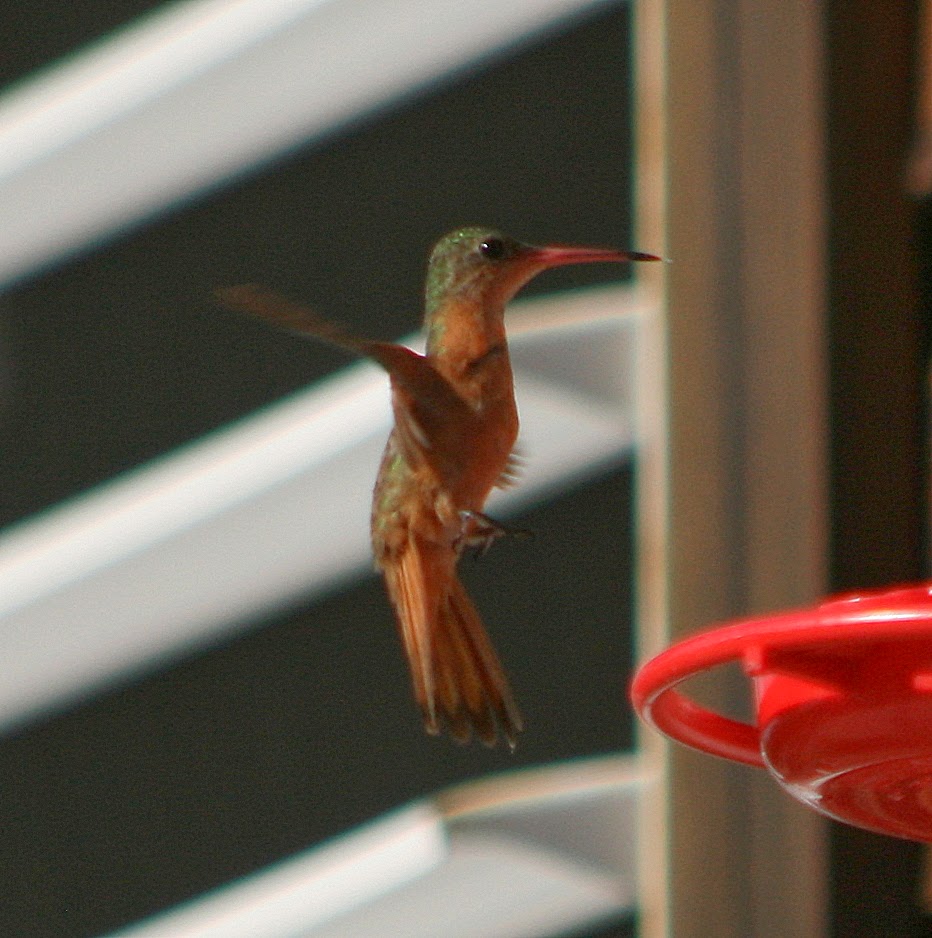
The lovely Cinnamon Hummingbird is the feature of today's post.  The Cinnamon was the first hummingbird I took a photo of at our place here in Belize.  It was just a fuzzy speck perched on a leafless twig atop a small tree, but the completely cinnamon-colored underside is not found on any other hummingbird around here.  
Over the last 7 years, the Cinnamon has been a continuous  year round resident that we see and hear feeding on the hibiscus flowers in front of our veranda.  They give a single cht before each flower visit, and a series of chts as it flies from bush to bush.  
You can just see a little pale tongue-tip sticking out. 
Before we started living here full-time December of 2012, the Cinnamon was easily spooked by us when we would try to get a better view of it.   Once we had been here for a while it got more used to us and, while still wary, didn't fly away if it saw us on the veranda.  Now that the feeders are up, it (they, actually) is (are) bolder still.  I took these photos of the Cinnamon at the back feeder on 3 different days.  I was only 15-20 feet away, with Max (the cat) at my side, and none of the hummers seemed deterred by our presence.
At 4.25 inches, the Cinnamon is noticeably larger than the 3.5 inch Ruby-throated. 
Notice the black-tipped red bill.
The tail is also cinnamon-colored from above and below, and is bordered with a dark charcoal band.

Still wary, but the allure of the feeder is too strong to resist.
The sexes are indistinguishable.
Its head and back are a shiny greenish-gold color.
From the back you can see the cinnamon-colored tail with tis darker border and the iridescent greenish-gold of the back and head.  Unmistakable and lovely.
Next up will be the dashing Rufous-tailed Hummingbird.


18 February, 2014

Hummingbird Update - Part One

I had a couple of posts a few months ago about the hummingbirds we have seen at the feeder we put out at the front of the cabana near the hibiscus where they feed (here and here).  
A hummingbird approaches the "ocean view" feeder just off the front veranda
We put up another feeder on the back deck in a more sheltered spot that just happens to be right outside our bedroom window.  :-)  Once the ruby-throated hummers started coming, it took about 2 weeks for the cinnamon hummingbirds, that feed on the hibiscus flowers year 'round, to realize that the feeder was also a good source of food.  Then the floodgates opened and we got 2 more species as regulars at the feeders - the green-breasted mango and the rufous-tailed hummingbirds.  Today's post is the first in a series and it highlights our old friends, the ruby-throated hummers.
You can see the post-ocular white spot that is characteristic of the ruby throats. Notice the drying laundry in the background.  :-)
As you can see, it is also adjacent to our clothes line, which makes for a handy perch at times.
They fan their tails out for aerial maneuvers and displays.
This female ruby-throated hummer is showing its characteristic outer three white-tipped tail feathers.
Nice profile view.
There are at least two other species of hummingbirds in Belize with similar looking females, but the ruby-throated is the only one with a totally black bill.  The others have black upper and red lower.  Whewwww - that saves me a tough session of keying out the other species.  Just in case you are wondering, the other 2 are the female white-bellied emerald (larger and with dingier greyish-white tips) and the female Canivet's emerald (smaller and with a post-occular white streak instead of spot).
Sometimes they take a quick sip without perching.
We have seen at least 2 immature males (photos in a previous post) and numerous females, but no adult males with their stunning ruby throats.  Not sure why that is.  The adult males have a slightly different migration schedule than the females and the immatures, so maybe they just haven't found our feeders listed on the hummingbird equivalent of Trip Advisor yet.  Surely we must have a good rating for abundant, fresh nectar, choice of ocean view or sheltered seating, and the featured local cuisine of hibiscus and flamboyant tree flowers!
And sometimes they sit and stay for a while.
We get lots of return business, too.
They always keep on alert for predators and competition at the feeders.  These birds may be small, but they are feisty.
Stay tuned for the next installment featuring the lovely cinnamon hummingbird.