Showing posts with label Coral Tree. Show all posts

05 March, 2022

The Coral Tree Cafe

The coral tree (Erythrina fusca) is in full bloom right now, and it is a busy place!  All the birds, from the small hummingbirds to the large Montezuma oropendolas seem to love it.  Even the insectivorous woodpeckers are drawn to it to feast on the flies, bees, and wasps that adore the flowers.  Here is the view of it from our back veranda.

This particular tree has orange flowers.
About 5 years ago, when the tree was only about 15 feet tall, and surrounded by taller, weedier trees, one of our workers pointed it out to me.  I had no idea it was there because it had never bloomed.  
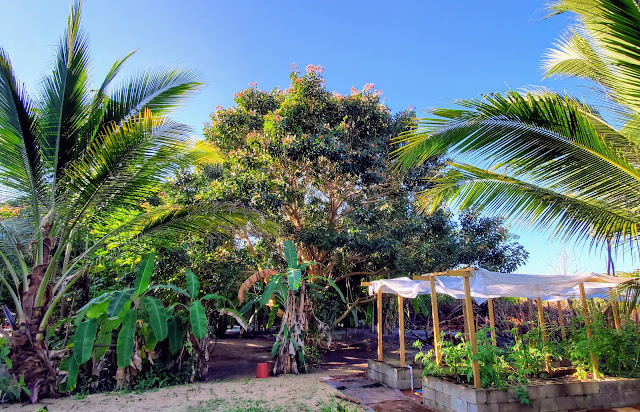
It has a full canopy with lots of room to grow even more.  That's it behind the small banana plants.  You can see the tomatoes in our raised beds, plus some coconut palms.
So we cleared its competitors away to give it some space.  Two years later, it had a few blossoms, the next year it had more, and now, well - just look at it!  
Multi-trunked tree.
Fortunately, it can tolerate a high water table of brackish water, which is what we have here - most of our vegetables are in raised beds to keep their roots  happier.
A few spent blossoms on the ground.
I don't have a good photo of the inflorescence on the tree - they are way too high - but I do have a close-up of a single fallen blossom.
A very complex structure.  I think some insects get trapped in it.  
Hummingbirds swarm the tree in the early morning hours and then later on other birds come.  No photos of the woodpeckers or brown jays, but I did get some shots of Montezuma Oropendolas.
That's a Montezuma Oropendola in the center of the image with the blue patch on its face.

And here it is showing off its yellow tail.
Larger than an American crow, smaller than a raven, these oropendolas are the largest member of the New World Blackbird family.

For a few more weeks yet, the birds will feast at the Coral Tree Cafe.

05 September, 2017

Goodbye Old Fig Tree

It was a good tree.  Although you couldn't call it pretty, you could call it pretty awesome; it provided shade for the generator shed and the garden beds below it, fruit for many species of birds and bats, and home to the most massive Myrmecophila orchid I have ever seen.  Below is the homely fig tree 13 months and 1 week ago as seen from the sunset balcony.
The fig tree, still suffering from a bad trim job that we gave it when it was interfering with our satellite internet reception.  It needed to have dead branches cut out too.
Then, on 4 August, 2016, Hurricane Earl hit northern Belize.  We felt some of it - high winds and lots of rain on the order of a tropical storm rather than a hurricane for us here in southern Belize.  The fig tree weathered the winds of Earl, but not the rain - the day after Earl came through the fig slowly tipped over in the dead calm.  Its shallow roots just pulled free from our sandy soil.
Fallen fig tree behind the gen shed.  It considerately slowly rolled off the roof, leaving some slight bends in the metal. 
Such a shallow root system just couldn't hold it up in the water saturated sand.

Over the next week, we started trimming the tree into smaller pieces.  I learned just last week that locally this process is called "junking up".  There are people who make a living "junking up" trees.  
Richard, junking up the tree.  But saving as much of the big orchid as possible.
Orington, AKA Tiger, standing next to the large orchid in the partially junked tree.

After we cut off the limbs with the orchids, we put those limbs under the cashew tree next to the old fig tree.  They are doing well, and even bloomed this year after a substantial post-Earl die-back.  The main trunk and the roots were too big and too hard for our chainsaw to make a dent.  So we let the remain portion rest in place, hoping that with time rot would set in and make it easier to finish junking up the tree.  Last week, we tried again.
Orington and Pascal attacking the roots with a machete. 

In the meantime - look at that Agave flower stalk soaring to the left of Orington.  The guys had never seen an agave bloom before.  I had to break it to them that after it bloomed, the main plant would die, but that the young agaves around it would take its place.

Slow going with a machete.
 Time to get the chainsaw out once the little stuff is dealt with by the machete.
Roots trimmed of with the chainsaw.
But our chainsaw still could not make a dent in the big trunk and main roots, even after a year.  We had to call in a professional to junk up the tree. Enter Godwin and his big chainsaw.
Godwin going at the tree.
 No one touches Godwin's chainsaw except Godwin.
He made several girdlings of the trunk with moral support from Orington, Clinton, and Pascal.

Clinton giving it the machete test to see how much more needs to be cut with the saw.
First section gone, working on the second.

Clinton trying to help push apart the sections while Godwin wields the saw.

The last section.
Trimming through the roots.

Flipped back with the roots down to get a better angle for cutting.

We can finish this part with our smaller chainsaw.
The fig tree was a good one and we have some fig seedlings to set out in places that aren't so close to our various buildings and structures.  Near this spot, we will plant a Coral Tree, which is much better suited to the high water table.  More on it next time.