The coral tree (Erythrina fusca) is in full bloom right now, and it is a busy place! All the birds, from the small hummingbirds to the large Montezuma oropendolas seem to love it. Even the insectivorous woodpeckers are drawn to it to feast on the flies, bees, and wasps that adore the flowers. Here is the view of it from our back veranda.
 |
| This particular tree has orange flowers. |
About 5 years ago, when the tree was only about 15 feet tall, and surrounded by taller, weedier trees, one of our workers pointed it out to me. I had no idea it was there because it had never bloomed.
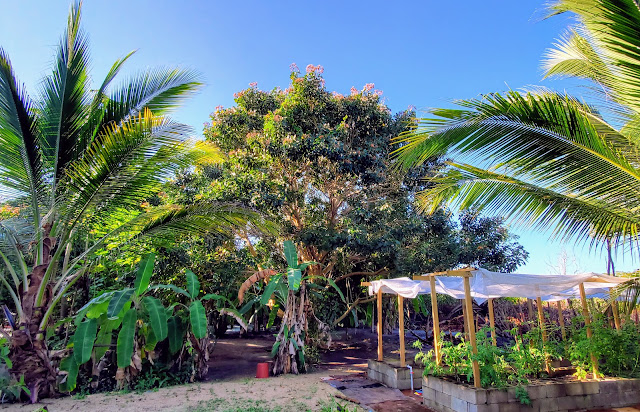 |
| It has a full canopy with lots of room to grow even more. That's it behind the small banana plants. You can see the tomatoes in our raised beds, plus some coconut palms. |
So we cleared its competitors away to give it some space. Two years later, it had a few blossoms, the next year it had more, and now, well - just look at it!
 |
| Multi-trunked tree. |
Fortunately, it can tolerate a high water table of brackish water, which is what we have here - most of our vegetables are in raised beds to keep their roots happier.
 |
| A few spent blossoms on the ground. |
I don't have a good photo of the inflorescence on the tree - they are way too high - but I do have a close-up of a single fallen blossom.
 |
| A very complex structure. I think some insects get trapped in it. |
Hummingbirds swarm the tree in the early morning hours and then later on other birds come. No photos of the woodpeckers or brown jays, but I did get some shots of Montezuma Oropendolas.
 |
| That's a Montezuma Oropendola in the center of the image with the blue patch on its face. |
 |
| And here it is showing off its yellow tail. |
 |
| Larger than an American crow, smaller than a raven, these oropendolas are the largest member of the New World Blackbird family. |
For a few more weeks yet, the birds will feast at the Coral Tree Cafe.
