17 February, 2012

Mystery Bird?

This fine-looking bird was sitting along side the path through the mangroves behind our cabana that leads to Black Creek.  It let me approach quite close before it flew into the mangrove roots.


By size, shape, neck length, and habitat, it keys out to be a green heron.  But it is the wrong color and has a darker beak than green herons usually have.  After much searching, the most likely ID is a dark form of green, striated, or green-backed heron.  Some sources lump all those 3 into one species, Butorides striatus.  I hope to see and photograph this individual again during different seasons.  Any insights into the ID will be greatly appreciated!

Posted by Picasa

15 February, 2012

A Bit of Belize: Land, Sea, and Air

A small selection of photos from two of my Belize kayak trips back in October and November; mostly to bring to mind a warm,sunny place on these cold February days when we are so ready for spring.  Spring is still a few months away for us in Minnesota.  :-( 
The two "land" photos were taken along the canal where I was surprised to see a couple of ferns growing just above the water line.  
I haven't keyed this fern out yet.  It appears to be a climbing fern that was growing profusely on the banks of the canal. I need to get photos of its spore-bearing leaves to help ID it.
Actually, I am not positive that this one is a fern, but I think it may be in the genus Ophioglossum (adder's tongue ferns) or maybe a tongue fern.  
I will have to go back to take a closer, more definitive look.   hmmm... a good mystery to work on next time I'm in Belize.
Seeing the ferns along this part of the canal made me realize that I was upstream of the tidal portion and in an area that is fresh water.
Back out into the salt water, I saw this sting ray making its way along the shallows.  This is a medium sized individual.
Closer to home in Belize, this little whelk was grazing in the shallows.  I love the way the sunlight is refracted by the little ripples on the water; you can see how clear the water is.
While paddling back in the mangrove marsh, I heard this  frantic flapping of a flock of birds that I disturbed as they went crashing through the trees.  When I was finally able to see them, I was surprised that they were doves.  There is no solid ground below these mangroves, and I am more used to doves that like to hang out on the ground.


They wouldn't sit still for a second so my shots are not very good.  But they were good enough for me to identify them as Pale Vented Doves, which are known to prefer mangrove habitats.  I would like to get some better shots of them.
Looks like I have work my cut out for my next trip.  :-)

12 February, 2012

Minnesota Winter Dawn

This winter season here in southern Minnesota has been unusually warm, punctuated by only a couple of super cold spells and not very much snow.  We figure nature is trying to make up for last year's brutal winter.  Today is the last day of a short cold snap that started Friday.  This morning the temp was 6F (-14C) at 7:00am.  It has warmed up to 13F (-11C); we'll make up to the 20s before the day is done.  Oddly, we have very little snow on the ground because most of what we did have melted during the warm weather at the beginning of February.  Below are some views of a beautiful dawn from the front of our house taken Jan. 31 when there was still snow on the ground.


As lovely as that dawn was, this dragonfly is what we would prefer to see when look out the front door.
Dragonfly on dead hibiscus stem, South Englishtown, Toledo District, Belize.


We are now one step closer to that reality; Dennis has officially declared his date of retirement - November 30, 2012.  I added a retirement countdown widget to the blog.  As of today, he has 291 days to go ...Posted by Picasa

11 February, 2012

A Couple of Winter Mushrooms: One Edible and One Deadly

In my last post, I had some photos of the edible wood ear fungus, Auricularia auricula, that I spotted in the woods next to Lake Russell in Georgia over the Christmas holidays.  There were a couple of other mushrooms out, too.  The oyster mushroom, Pleurotus spp., shown below is another good edible that is easily identified and has no poisonous "look-alikes". 
Lovely, pale yellow Pleuortus growing on a fallen pine tree.  You can see the gills of the specimen on the left.


That is not the case with the mushrooms in the next two photos.  These are an Amanita spp., either A. phalloides, known as Death Cap  or A. bisporigera, known as Destroying Angel or Death Angel.  You get the idea.  These are deadly mushrooms, the ones that have given wild mushrooms a bad rap as a food source.
This young specimen still has a closed cap, but you can see some of the volva, or full veil, on the right of the base of the stipe, that used to cover the entire mushroom before the stipe began elongating.   After I took the photo, I dug down and found the underground part of the volva that encapsulated the mushroom like an eggshell at an earlier stage of development.  I neglected to get a picture of that.  :-(
If you enlarge the photo by clicking on it, you can see flecks of the volva on the left side of the cap.


I took photos of a more mature specimen in which the cap had expanded a bit and the stipe had elongated even more.The slightly yellowish color of the cap and top of the stipe make me think that this might be A. bisporagera instead of A. phalloides, which is usually solid white.  But A.p. has some color variability and also some of the color on the cap of this one is probably just bruising.  In all practicality, it doesn't make too much difference, as both are deadly poisonous.  This website has good descriptions and photos.
Here you can see the annulus or ring around the stipe which is a remnant of the partial veil that covered the gills before the cap opened.  You can also see part of the volva at the base of the stipe where I pulled back part of the leaf litter.
As described here, most cases of deadly mushroom poisoning in North America are due to confusion of these 2 species of Amanita with the wonderfully edible padi straw mushroom.   The main reason is because Asian immigrants to North America are very familiar with collecting padi straw mushrooms from the wild and these poisonous Amanitas do not grow in the same habitat.  When they move to North America, they are not aware that poisonous Amanitas are common, so they pick the "impostor" padi straws without looking at them carefully.  If they had looked carefully, they would have seen a partial veil, which that is not present on the padi straws.  Normally, padi straws are collected when they are quite young; the partial veils of the Amanitas are hidden at this stage, so you have to look for it deliberately.  It is an easy difference to see - if you know to look for it.  Read here for an interesting account of surviving a poisoning that occurred this way.


Posted by Picasa

09 February, 2012

Blame it on the computer, or Revisiting Christmas 2011 in Georgia

My computer problems kept me from posting a blog for several months, including the holiday season.  So I am just now getting around to showing some photos that I took over Christmas; that's my story and I'm sticking to it!  ;-)


My family gathered again this year, as we have for many years now, at a state park in Georgia at Lake Russell.  The park has lakefront cottages for rent at reasonable rates.  There are some hiking trails and swimming area - it wasn't quite warm enough for swimming, but was perfect for walking - or waddling, as was the case after our various Christmas feasts.
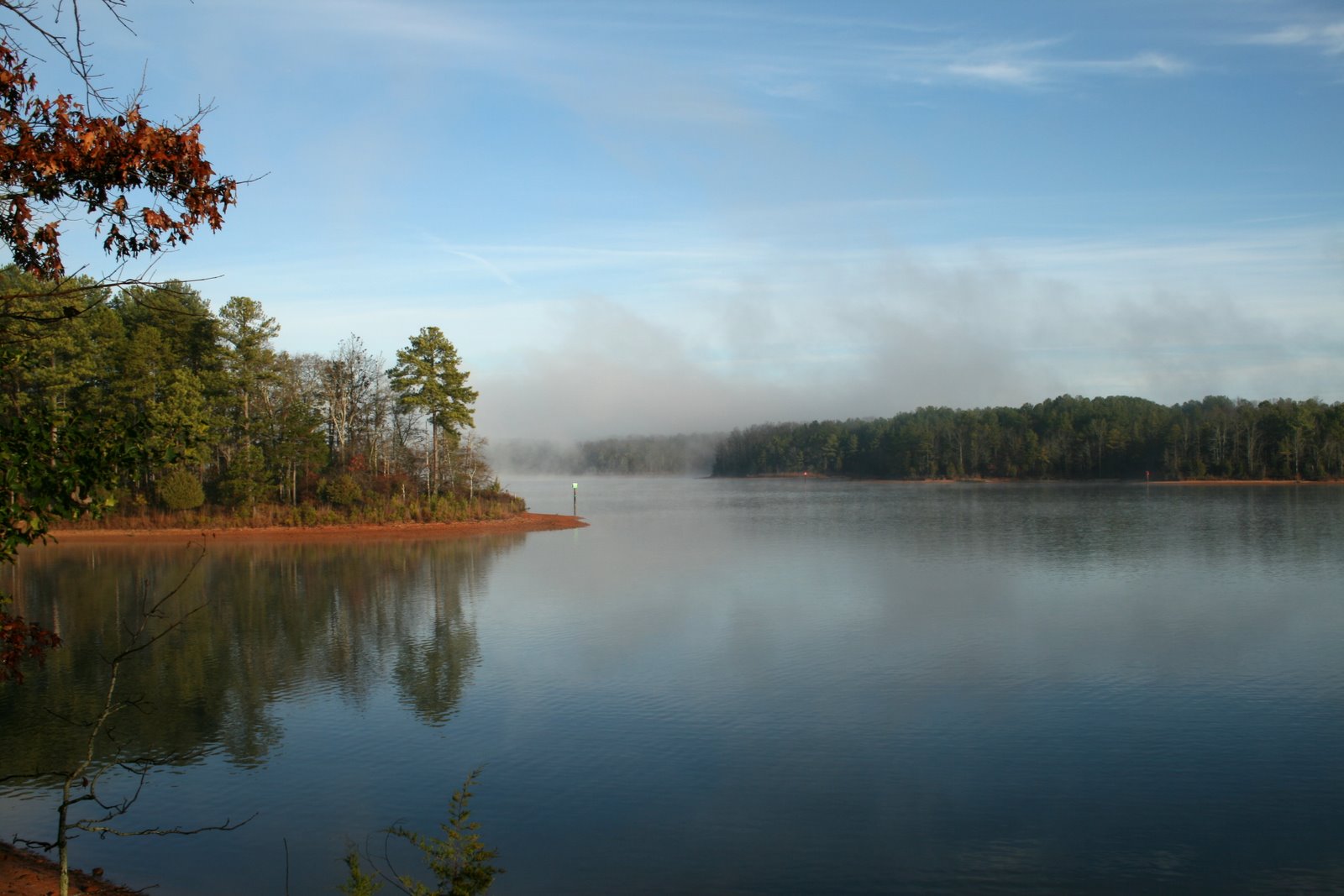
Mist floating over the lake.  The far side is in South Carolina.


Several mornings there was a wonderful mist rising off the lake that nicely diffused the light from the rising sun.
This cottage has a ramp that leads down to the boat dock.


Great views from the cottages look across this small part of this huge lake that is actually a reservoir formed after construction of the Russell Dam across the Savannah River which is the border between Georgia and South Carolina .


Inside, the cottages are basic, but nice.  As you can see, we had the requisite chimney by which to hang our Christmas stockings.
It was just cool enough to enjoy a fire all day long.


In those stockings were little airplanes to assemble, along with candy, trinkets, oranges, games, etc.
Each little plane was a different Christmas=themed name like the "North Pole Airlines".
Outside, were the hiking trails
A little bit of the lake is visible toward the left of the photo.


with lots to see and photograph.


A lovely lichen, don't know the name.


Young sporocarps on this moss.
The recent rains brought out nice, fresh wood ear fungus, Auricularia auricla.
We had a wonderful time eating, playing, eating, hiking, eating, talking, eating, drinking.  This is a great place for family and friends to meet and enjoy each others company.
Posted by Picasa

06 February, 2012

Almost Tropical

I am in Georgia, visiting my Mother again.  I was a day late getting here because my flights out of Minnesota were canceled on Friday due to fog!  It has been so warm during the day that all the moisture in the air from melting snow condenses into heavy fog during the night.


It is unseasonably warm here, almost tropical, today.  There are daffodils blooming everywhere.  My friend, Nancy, and I went for a walk and I took my camera and long lens hoping to spot the great blue heron again in the park.  It wasn't there today; I'll try again tomorrow.  But it wasn't a complete wash for the camera as you can see from the photos below.
A lovely Eastern Bluebird on a cherry tree.

Many Japanese Magnolia trees are in full bloom.
This large Japanese Magnolia, also known as Magnolia liliiflora, is putting on an extravagant show.


Also blooming are the Camellias.
The fallen red petals keep their color for quite a while, often carpeting the ground beneath the shrub with gorgeous color for a week or more.
This bush is just starting to bloom and has only a few fallen flowers.


.
Normally, I prefer single flowers, but I like how the the center of this type has tightly packed petals in multiple rosettes.


Now for something completely different ...


I love the name of this church.  The "Free For All Deliverance Church" - it doesn't get any better than that.  Oh, and did I mention that the church is located in the former Coca Cola bottling plant?
Plus they have this lovely yard art available to the side of the church .  The three wise men, not visible in this shot, are over next to two frogs playing golf just to the left of the mushrooms ...
Posted by Picasa

05 February, 2012

Waking up in Paradise: Making Do in Belize

Another lovely day begins in Belize as I look out from the veranda beyond the south beach toward the mangroves that bracket the mouth of Black Creek.  
This is one of my favorite views, so you may have seen this before. :-)


We  eat our breakfast on the veranda every morning and ease into the day as the sun rises into the sky.  I saw this little spider, maybe a jumping spider, on the veranda   screen and decided to take its photo. 
A hairy little thing, isn't it?


A moth up higher above the screen caught my eye, so I thought I would photograph it too.  It was way over my head, so I had to improvise something to stand on to get close enough to it.
A chair, an ice chest, and 2 kitty litter buckets were my
improvised platform.  Ugh - look at all those ugly patches on 

the screen.  We need to replace it the next time we are 
there.  Dennis just reminded me that all holes got there 
from little birds clinging to the screen to catch insects.
I guess it is worth it to have birds around!
I crept up on the moth as much as possible considering I had to step onto the chair then to the 2 plastic buckets and quickly distribute my weight between the buckets  so they didn't collapse.   You can see the moth up at the top of the  screen.  Dennis handed my camera to me once I got in place.  
It was about 2 inches long.


And had a slightly furry thorax. 


Here is another example of making do in Belize - electric cord spaghetti.  We use a diesel generator to charge a battery bank that stores electricity for us.  But the inverter that converts electricity from the batteries to indirect current creates "dirty" power that can be hard on sensitive electronic things, like computers, mobile phones, chargers for camera batteries.  We need to charge all of our electronics during the 2-3 hours in the mornings and evenings when the generator is running to avoid the dirty power that can damage them.  The electrical outlet is inside and we run the power cords out through the window to the veranda so we can use our computers, etc while on the veranda.
You can see the top of Dennis' head out the window on the left.  He has a power cord going to his mobile phone and another to his computer.  Through the window on the right is the cord is to my mobile phone.  The cord to bottom is for the little fridge to the right.


Got to keep those camera batteries charged so I don't miss any good photo ops like the one below!
This tree trunk has 2 kinds of orchid growing on it; the one with the small 
white flowers on the left (Brassavola sp.) and another one to 
the right that is too young to bloom but has nice green leaves on yellow-green rhizomes.  Two years ago the leaves of the young one were only about
1/4 inch
 long!  Wonder what its flowers will look like?

Not a bad place to have to make do.
Posted by Picasa