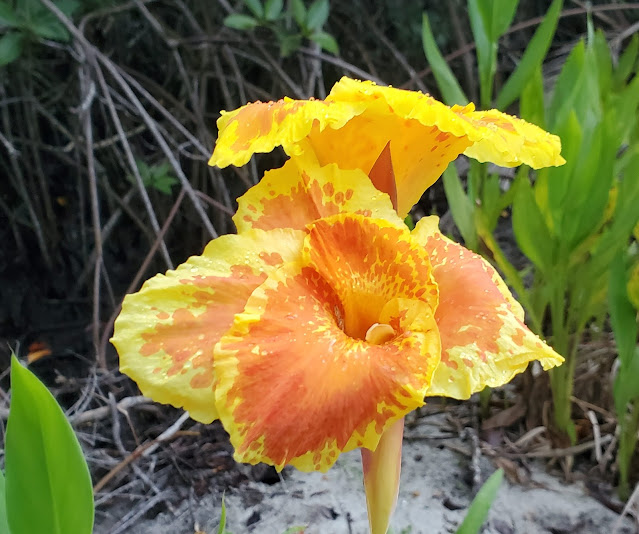
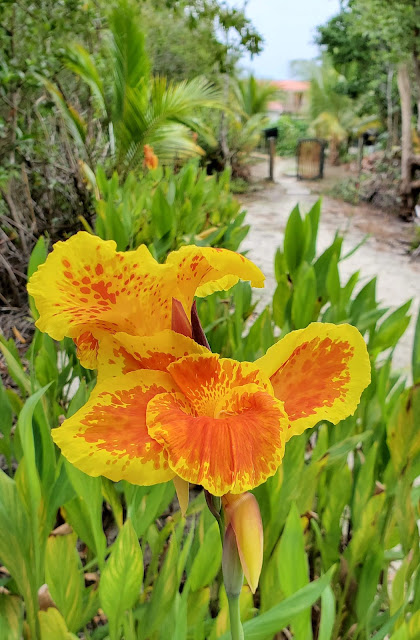
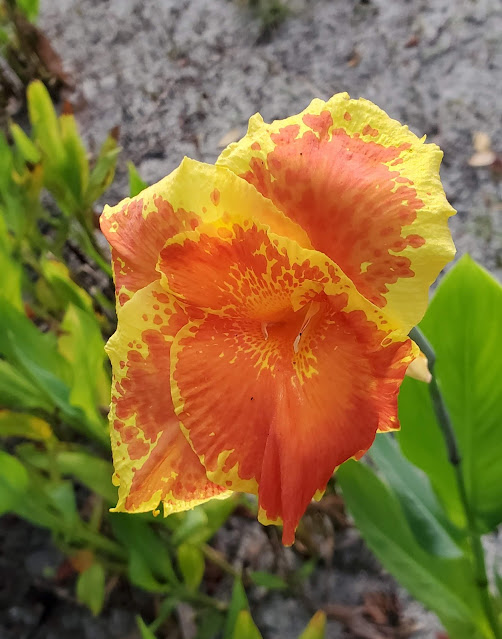
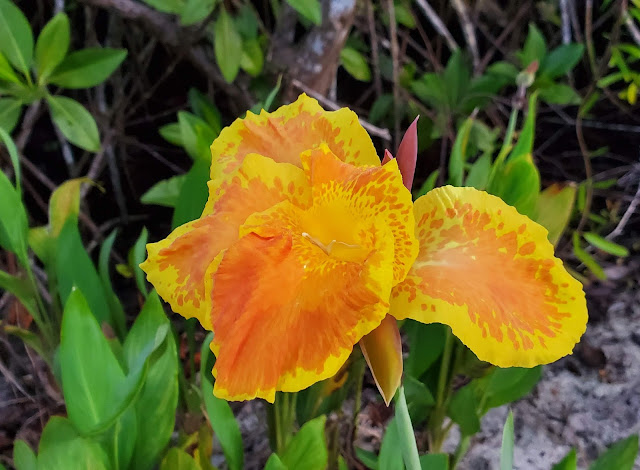
A little orientation today, and all because I wanted to show off the first of this season's Canna Lily flowers!
We planted the canna lilies years ago along the path we made to our boat landing on Black Creek.
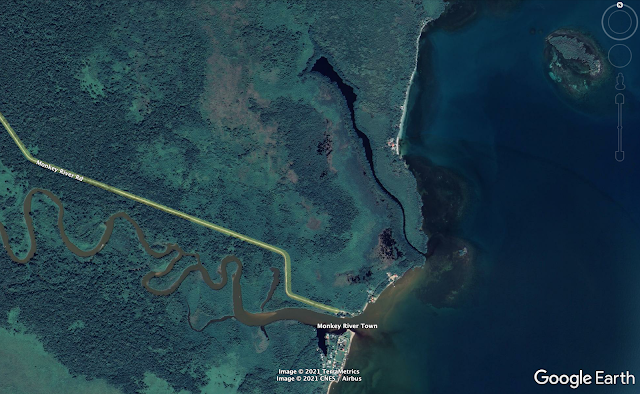
Google Earth photos will help you get your bearings. The first image is an overview that shows the Monkey River and Monkey River Village (incorrectly labeled a "town" by Google Earth) at the mouth of the river. The yellow line is the Monkey River Road, an 8-mile long dirt track leading from the Southern Highway (not shown) and ending on the north side of the mouth of the river. Black Creek is the long, black, semi-lagoon north of the road. Our place is situated in splendid isolation between Black Creek and the sea. You can see it in the upper right quadrant of the image below. No road to our place, you can get here only by boat - unless you want to get wet!
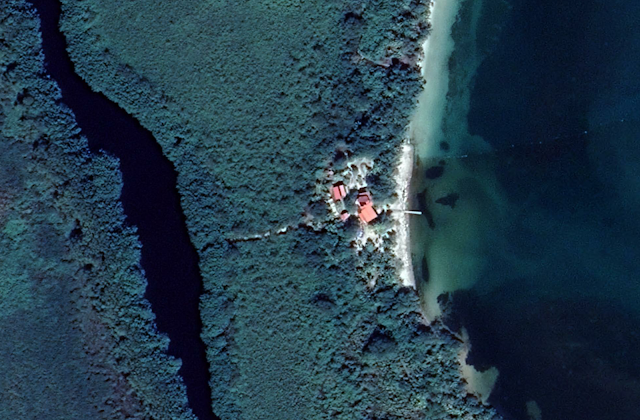
Our place is in the sea-side clearing at the south end of the stretch of white sand.
In a closer view of our place you can see the dock jutting into the sea to the right (east) and also a faint line heading west toward Black Creek. We made a landing on Black Creek for our boat since it is more protected from the weather.
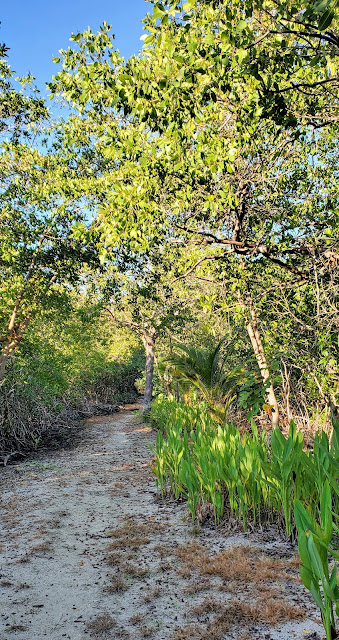
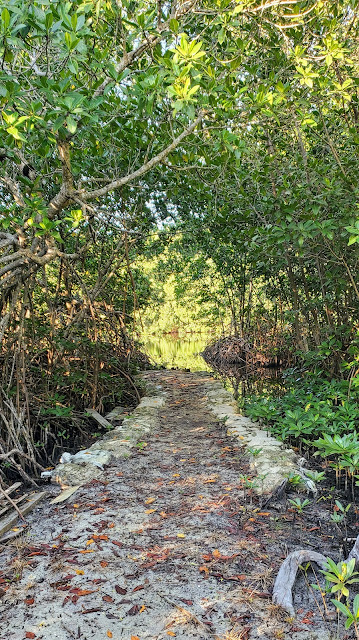
The path to Black Creek goes through Mangrove Swamp. We built the path up with sand so that it is above water (except brief periods during the height of the rainy season).
The canna lilies are along the right side of the path. They are just starting their blooming season, which will last until the weather is dry for about a month.
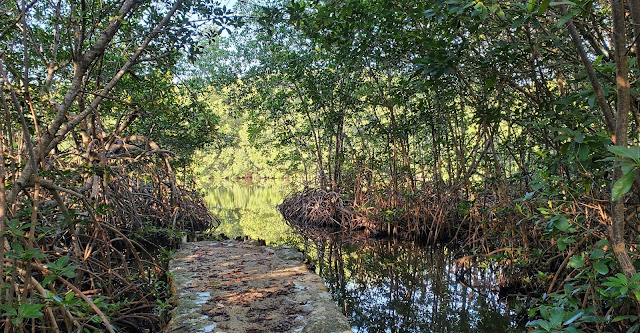
The landing itself is lined with sand bags to hold the sand in place.
We tie the boat up in the slot on the right.
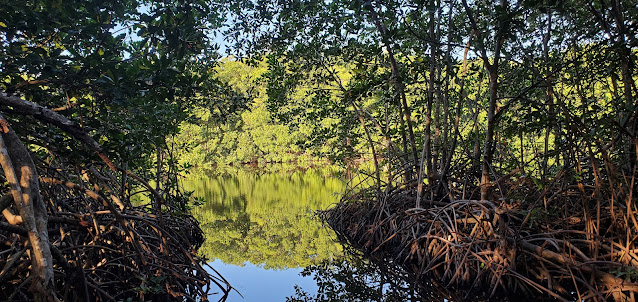
We did our best not to disturb the mangroves - there is barely enough room to get the boat in.
After all that, here is a selection canna lily photos from previous years.
Such an easy chore to take out the trash - NOT! At least not here in Englishtown. Oh, it's easy to take it out of the cabana. We bag it up and then stack the bags underneath the cabana until it's time make a trash run. And we hope that no dogs find it before we can make the trash run. It's the trash run itself that can pose problems. We like to take the trash to the nearest landfill about twice a month. Sometimes that frequency is just not possible. The most recent "sometimes" lasted from October through January; 4 months of trash! It is such a relief to have the trash cleared out of our house (click to listen).
Four months worth of trash loaded into our work boat.
Trash accumulates when you are in the midst of a construction project. So much packaging for supplies, especially for the things that are shipped from the US. Boxes inside boxes, taped up for shipping, untaped and retaped by Customs. Fortunately, our shipping agent, Easy Shipping to Belize (highly recommended - very professional and helpful), consolidates many items to minimize boxes. But still we accumulate trash faster than we can get rid of it. A big, perhaps even the biggest, source of our trash is what we collect off the beach. Mostly plastic shoes, bottles, toothbrushes, etc. An unending source of trash that is sometimes more than we can handle. It hasn't been too bad lately.
Yesterday was the first day that we (read "Dennis and Nevan") were able to make a trash run since October. Various events conspired to keep us out of the landfill. The main thing was the deplorable state of the Monkey River Road (MRR). Other things that keep us from making the trip are rough seas that keep us from getting the trash to the MRR and the car being in for repairs. Below is the route we take to get to the landfill with the MRR in red.
The route to the landfill from WilDen (our place). The sort of cross-hatched areas between the MRR and the sea are shrimp farms.
We compost all our food waste and lots of paper waste. But we are still left with cardboard, plastic, glass, metals - all of which would be recycled in the US, but not so here. The first thing to do in preparation for making a run to the landfill is to make sure the bags are still intact and closed. The strong UV light degrades the plastic bags in short order; nothing worse than picking up a bag of trash and having it fall apart on you, literally. Then you load the bags and loose items into the boat for the short ride (in purple on the Google Earth image above) from WilDen to the beginning (or is it the end?) of MRR. Then off-load the bags into the car or truck. Our car is being repaired, so we sought the use of our neighbor Nevan's truck for this trip to the landfill. Good thing since it would have taken at least 5 trips in the car. It took about 40 minutes to drive the 12 unpaved miles of MRR and then just a few minutes on the Southern Highway to reach the landfill. Once at the landfill, you carefully make your way along the pot-holed track back to one of the "big holes" into which you throw your bags. As the "big holes" get filled, they are burned to make room for more trash to be thrown on top. Eventually the "big hole" is no longer even a small hole and new "big hole" is dug. Sometimes they scrape the track to make it easier to get to the big hole and sometimes they even scrape dirt over the old big holes. It's not a very sophisticated operation. But it is free and fairly close by. Since there is no other option, that pretty much settles it.
The view from our house is so much nicer with no trash bags in the boat.
I never tire of looking at this.
The greater yellowlegs don't care about the trash as long as it is not in the water.
Two of the three greater yellowlegs that have been visiting our house this winter.
A dusky-capped flycatcher hangs out in the tropical almond tree in front of our house.
The view to the west of our house is pretty nice, too. You can see why those are called the Cockscomb Mountains. They are also called the Sleeping Giant. I think he is having a good dream ...
The 2015 Hurricane Season in the Atlantic is officially over. As much as we complained about the El Nino wreaking havoc on our beach and plants, it did prevent the formation of hurricanes in the Atlantic Ocean by disrupting tropical depression off the west coast of Africa before they developed into storms and hurricanes. Dodged another bullet this year.
I've been gone a long time Lost in the seven seas. Sail on, don't you come back Until you learn the birds and the bees. Who will you find waiting for you, Squeeze blood in the wine. Left to call my preacher And my very lovely wife.
[Chorus 1:] I said, hey now, knocked down, why'd you do it, Roll me like a hurricane. All is a bust and I'm numb, like novocaine. Who done it, what's up, you said, Sell me out why don't you boy, I'm alone, severely broken, I'm a dislocated boy.
We take hurricanes and hurricane preparedness very seriously here in South Englishtown for good reason. There is only one road to Monkey River Village and it is a dirt road that roughly parallels - wait for it - yes, the Monkey River. And when the river floods, so does the road. As it has for most of November. Check out this Youtube video posted by our neighbors Nevan and Cheryl who own and operate "The Monkey House" on the north side of the mouth of the Monkey River. Cheryl filmed while Nevan drove and Lloydie provided commentary as they braved the road when the waters began to recede a bit.
The little building in the video is the pump house for the village water supply. The pump has to be turned on and off manually every day or so to fill the water tower. Last week the only way to get there to turn on the pump was to take a motor boat up the road! Nevan said that the road looked like this for about 5 miles and that in places the water was 3.5 feet deep. In fact, water came inside their big GMC Sierra truck. No way our 14yr old, lower riding Subarau Outback would have been able to get through. Like most villagers during this wet November, we have been going by boat to Independence and Placencia for our food and other necessities. Back in 2013 I posted here and here about making a routine trip by boat for shopping.
So, you can see that it is very easy for bad weather to isolate us and we go to great lengths to be self-sufficient. We have evacuation plans in place for when a hurricane is bearing down on us and we will evacuate until it passes. But then we will get return (by boat) as soon as possible to salvage what we can and to start rebuilding if necessary and if possible. We have to make sure we can survive on our own for up to a month (perhaps longer) with no outside source for water, food, or shelter.
I mentioned in an earlier post that we prefer to learn hard lessons by evaluating the experiences of other people. And there are some unfortunate occurrences in recent history from which we can learn - Hurricanes Katrina and Sandy in the US and Iris and Mitch in Belize come to mind. What can we learn? 1. EVACUATE IN TIME. That is one nice thing (the only nice thing?) about hurricanes - they won't sneak up on you. You have time to lock things down, pack things up, and then get the hell out of the way. We have friends on higher ground in Independence who have given us a standing invitation to stay with them if a hurricane is headed our way. We will drive the car and also take one of the boats up a creek near their place. The cat has a carrier into which she will be coerced and the car will be filled with things we dare not leave behind. It will take some logistical planning to get it done and we update the details of the plan each season.
2. SECURE YOUR PROPERTY against damage from wind, rain, storm surges, flood water, and vandalism. Our construction design incorporates many security features and during the next months we will be doing more along these lines. That is for another post.
3. PROVISION YOURSELF to be self-sufficient for an indeterminate recovery period. Clean water, shelter, and food are the big three. We have been focusing on this for the last year and this is the main topic for this post.
Water - We have 24 rainwater vats plumbed into a central water supply for us and for the caretaker's cabana. Each vat holds 2500 liters of water and has a shutoff valve at the base. We have invested in new caps for the vats so that they can sealed off from a saltwater storm surge.
Rainwater vats under the cabana. They are all connected via the pipes you can see in the trench, but they also have shutoff valves to isolate them independently. We have caps to trade out for the caps that have the rainwater downspouts inserted. The caps screw down and if the tanks are full very little salt water will be able to get in.
We are well set for water. We also have a couple of solar powered personal-size water purifiers if the vats get contaminated by organic material. A cupful of bleach added to each vat and allowed to sit for 3 days will also purify the water. We should have enough water for drinking, cooking, and sanitation for ourselves and for our neighbors.
Shelter - I will do another post on shelter because it is such a big topic. Let me just say here that we have tarps, tents, staple guns, window screen, mosquito nets, DEET, duct tape, space blankets, emergency medical supplies, and lots of other useful items set aside in our hurricane supplies.
Food - we tried out a new strategy this year for food and it looks like it will work for us without being too onerous to manage. Here is our list of considerations for feeding ourselves in survival mode:
non-perishable food items - in case we have no refrigeration
organized storage - don't want to be scrambling through a messy hodgepodge when trying to cope with disaster
heavy on calories - we'll be burning those calories
plenty of no-cook items - especially for the early days when getting re-established
plenty of "grab and eat" items - we may not have much time or daylight for meal prep or clean up
plenty of variety - life will be tough enough without having boring food
plenty of taste - again, life will be tough enough
balance of veg, protein, carbs, and treats - the situation could last quite a long time
Dennis found a great little book called "The Storm Gourmet" that has recipes for meals that don't require cooking. We got some great ideas from this book.
Basically we invested in some large plastic storage bins (Sterilite brand are very nice, but there are others, too) with gasket seals to store food in. We have 4 "weekly" bins that each have a week's worth of breakfasts, lunches, and dinners inside, 2 "staples" bins with items like salt and powdered milk, a cat food bin, and 3 smaller "condiments and treats" bins.
Gasketed plastic bins. The large bottom bin can hold a week's worth of food for 2. The smaller bin holds an assortment of treats like cocoa mix, crackers, cookies/biscuits. The book was very useful; it helped us think some things through in a new way. The Camelback water purifier is small; we also have 2 other small water purifiers.
But we want to be able to cook too, so if our regular butane stove/oven doesn't survive, we invested in a small butane stove, along with small fuel cylinders, to include in the hurricane bins.
Our regular stove/oven with 6 burners! Love this stove. We will be able to light it manually if we don't have power for the builtin electric striker. As a back up, we have a little portable gas burner. It fits in a plastic bin.
Back in the spring, before the start of the 2015 hurricane season, Dennis made some online purchases of items for us to test. Items like self-heating entrees, meals to eat straight out of the package, dehydrated meals with a long shelf-life, dried fruits. We made local purchases of canned veg, fruit, powdered milk (we use that pretty often in day-to-day cooking since fresh dairy is hard to find), dried soup mixes, jars of pasta sauce, rolled oats, rice, dried lentils and beans, instant no-cook desserts, jams, jellies, canned butter (which we also use day-to-day), instant coffee, peanut butter, ramen noodles (I know it is weird, but Dennis and I both enjoy instant ramen noodles, the kind in pouch, not a styrofoam cup). We divided it into four bins, each holding food for a week.
There is a trick to this, two tricks really. First, you have to make sure that the food is tasty enough to eat and second, you have to manage it by expiration date. We had a lot of fun earlier in the summer taste-testing the self-heating meals and "eat straight out of the container" meals. One flavor of self-heating meal, while edible, is not something I would choose to eat again. We will use what we purchased, but not replenish that flavor. Several other flavors were pretty good and one was excellent. The "eat out of the container" meals were very good. So good that we included one of them on our Thanksgiving menu - the French Bistro Three Bean Salad that Weaver asked about! It has lentils, flageolet, kidney, and cannellini beans along with sweet corn and carrots. Now that hurricane season is over, we have sorted through the bins and pulled out all the items that will expire before this time next year. We have a bonanza of food to eat in the coming months.
To make it easy to manage, I made a spreadsheet (I do love a good spreadsheet. Really, I get into spreadsheets.) to track what is in each box and what has been removed from each box. It will be an easy matter in the spring to restock the boxes.
This part of Belize is tucked away in the south, protected somewhat by Honduras and Nicaragua. Since 1864 only 4 hurricanes with windspeeds greater than 100 MPH and 7 with windspeeds between 70-90 have made landfall within 50 miles of Englishtown. 150 years, 11 hurricanes - those aren't bad odds. I'll be adding pages to this blog layout with more details on hurricanes. Dennis has assembled some great data worth sharing. (First I have to figure out how to use blogger "pages" function.)
Depending on how hard a hurricane hits us, we could still have local food such as coconuts, available at South Englishtown. We have what we consider reasonable risk mitigation and contingency plans in place, but we could have a cabana with no roof or no solar power.
Coconut palms of various ages. Well away from the cabana where the coconuts pose the least risk as damaging projectiles in a hurricane. You would almost think we planned it that way.
Or we could have nothing, absolutely nothing; no house, no beach, no water, no land. No guarantees in this life!
Life is moving along slowly here in South Englishtown. On Tuesday, Dennis and I made a trip to Belmopan, the capitol of Belize. We had unknowingly picked what was to be a day of record setting heat across all of Belize, indeed across the entire Yucatan Peninsula, for our excursion. It was Real Hot in the Shade; click here to chill out to the music of Third World Reggae - one of my favorite reggae bands - as you read the rest of this post. We needed to arrange for phase 2 of the solar power installation in May or June and to pick up some hardware supplies and food items that we can't find more locally. The trip takes about 3 hours each way, so we made an early start in order to get back home before dark.
We drove along the Monkey River Road (red) to the Southern Highway (yellow) to the Hummingbird Highway (purple) to get to Belmopan, about 100 miles there and another 100 back. Plus what ever driving around for the errands. The thin grey lines are the boundaries between the 6 districts in Belize. We live in the Toledo District and Belmopan is in the Cayo District.
We were on the Monkey River Road (dirt road through jungle and orange orchard) by 7:30. Although the road was quite dusty, it was in very good shape - it only took about 30 minutes to travel the 12 miles to the Southern Highway. The Southern Highway takes you through the low coastal flats of orange groves, banana farms, and other agricultural endeavors surrounded by jungle and open savannah. We made our usual stop at the Shell Service Station at the beginning of the Hummingbird Highway to buy a chicken and bean johnnycake (for me) and chicken torta and coffee (for Dennis). The Hummingbird Highway is breathtakingly beautiful. It passes through the jungle-covered Maya Mountains which rise up steeply from the coastal flats; the scenery and vistas are stunning. Equally breathtaking, in a very scary way, are the 7 just barely single-lane bridges that cross over creeks and rivers cascading down the mountains. In theory, you take turns with oncoming traffic to cross over the bridges. In theory. Click here to see what happens when somebody isn't paying attention. It is not as grizzly a scene as it could have been. Of course the big tanker trucks carrying crude oil from the oil fields in the town of Spanish Lookout get the first turn every time. The tanks clear the bridge rails by mere inches on either side. Major chunks of concrete have been knocked off the guard rails where drivers have mis-judged the clearance. We don't drive this road after dark. I'm sure you can understand. We did our business with ProSolar to get on their installation schedule, did some window shopping for a new gas generator in the event ours needs to be replaced, took a quick look at Hummingbird Furniture (nice, but too expensive for what you get), and got all our shopping done at Builders' Hardware all before lunch. For lunch we split a warm brown rice salad and fajitas del mar at Blue Moon restaurant; both were excellent. I had a tamarind juice to drink, which was quite refreshing. The day had gotten hotter and hotter; it was up to 104F (40C) by the time we had finished lunch. With the AC blasting, we drove to our next stops - a new-for-us hardware store called Gallardos, a Chinese grocery store, Brodie's Supermarket (it actually is a supermarket, although on the small side by US standards), and a produce stand. We were back on the road by 2:00 and back to Monkey River by 5:00. Elan picked us up at the river's edge in his brother's boat and helped us get our various purchases over to our seaside dock at Englishtown. Fortunately, it doesn't get as hot here on the coast as it does in the interior of the country - the high was only(!) around 96F, but it was still real hot in the shade and it stayed real hot well after sunset. Lucky for us, it did cool down some during the night and while the next day was hot, it was not real hot. I will close with a handful of photos that I took when it wasn't too hot to take a slow stroll around.
Crinum lilies with a visiting bee of some sort.
Moon flower. They are open at night for one night only; I caught this one early in the morning before it closed.
Orange flowers on an unidentified tree. The color is so intense that the camera can't quite cope with it.
Weed with yellow flowers.
Small butterfly, not phased by the heat.
Orange spiny caterpillar. I believe this will be a Gulf Fritillary butterfly, Agraulis vanillae.
The heat has broken several days ago. Didn't even need to use a fan last night.
Such an exciting
life we have here in the Toledo District of Belize. The Monkey River Road dried out enough for us
to attempt a road trip to … wait for it …
THE DUMP! Why are we so anxious
to get to the dump? Keep reading.
Dennis and I noticed
that we see the same damn blown-out flip-flops and other lonely single shoes; the
same empty plastic bottles that formerly contained sodas, booze, shampoo, motor
oil, or bleach; the same plastic remnants of personal hygiene products like
deodorant, toothbrushes, combs, brushes, nail polish, toothbrushes,
toothbrushes, and more toothbrushes; plastic cutlery and to-go boxes when we
walk on our beach or up the each to visit our neighbors.The common denominator of 90% (99%?) of the
trash is plastic.We (humankind, that
is) are finally witnessing the consequences of the truth in Mr. McGuire’s
advice to Ben (Dustin Hoffman) in the movie The
Graduate:
McGuire: I
just want to say one word to you. Just one word.
Ben: Yes,
sir.
McGuire:
Are you listening?
Ben: Yes, I
am.
McGuire:
Plastics.
Plastics, alright, on the beach just a few feet north of our property.
Plastics in a plastic bag; a work in progress.
One person's trash is another critter's trailer home. I have seen several hermit crabs making do with plastic caps instead of shells. We have very few shells large than 1.5 inches, except for large conch shells, around here for hermit crabs to inhabit.
Just enough room to retract into. And in the always fashionable color black.
I do believe this crab may have outgrown his home. But it is hard to give up this bright orange cap that matches the carapace!
Plastics.They have been a boon to improving the
quality of life of people (and hermit crabs) worldwide – plastic syringes and other medical devices
that make modern healthcare possible, plastic components that create affordable
consumer goods thus making life easier and better for a greater portion of the
population, and so on.Plastics have
also been the bane of the environment – increased oil production to supply the
raw material from which plastics are made, increased pollution from plastics
that never disintegrate, increased exposure to molecular components of plastics
that adversely affect our health, and so on. I could go into a rant about the evils of
plastic, but that is not what this blog is about.
No, this blog is
about our life in Englishtown, Toledo, Belize.
And we are seeing all kinds of plastic trash wash up on our beach. So, Dennis and I recently have been on a 2-person campaign to clean the drift trash off not only our 400+ feet of beach front (which we have been doing for years),
but also another 400 feet or so to the north of us. This is the path we take to visit our
neighbors at SteppingStones and Craig at the north end of Englishtown and we
would like to enjoy the walk rather than be irritated by the trash. For a couple of weeks now, we get up and
first thing (even before breakfast or coffee, but after toothbrushing!) we walk up the beach and work on
collecting the old beach trash and the fresh new arrivals in huge plastic (!)
garbage bags. We have filled 8 bags so
far. I was actually amazed that removing
just 8 bags worth of trash would make such a noticeable difference in how the
beach looks. That amounts to 39 gallons of trash per 50 ft of beach front for the first pass of our clean-up efforts.
Because the Monkey
River Road had been flooded and impassable for our Subaru Outback stationwagon
since mid-October (see my previous posts about the flooding here and here), we
had 2 months of our normal trash plus the 8 big bags of beach trash to get to
the dump.
We loaded the first
bit into the boat and Richard took us to the Monkey River dock on the north
side of the river near where we keep our car.
The boat-load #1 at our Black Creek dock.
The car parked at at Mr. Horace Coleman's place. Not bad-looking for 2001 model.
We brought our car around to the dock and transferred the bags to the car (and some to Chris’ truck – thanks Chris!) and off we went up the Monkey River Road. The rest of the photos are a mashup of 2 separate trips to the dump. I got some photos related to the post about boating through the farm and down the Monkey River Road to get to the Pumping Station for the village water supply.
This the driveway to the farm, the same driveway that was flooded enough to accommodate an outboard motor boat a few weeks ago.
The Pumping Station with the generator and the well head.
The water tower at jungle's edge.
The only reason the road was passable at all for a car, as opposed to a truck or SUV, was because the Toledo District Road Department had been hard at work. By the time we drove up the road, 3 or more loads of rock and gravel had been dumped at strategic spots and now the back hoe was digging deeper ditches at each side of the road. The deeper ditches are great when there is a heavy down pour, but not very effective if the river itself floods. All of Belize has been inundated this year. Dave Rider at Belize -Adventures in Paradise has a nice series of blogs about the road issues up in the Corazol District.
This had been a car-swallowing mud pit. Seriously - the pit was about 3 feet deep and 6 feet long across the width of the road.
After I took a few photos of the action, one of the crew very kindly walked through the mud ahead of me, moving big rocks to the side. We made it through without mishap.
The second time we made the trip even more gravel, rocks, and what I will call "boulders", had been dumped on the road and the crew had moved to a new site.
You need to choose your route very carefully through this mess. Sometimes it has to get worse before it gets better.
On the first trip up the road, Dennis drove and then I made the return down the road. On the next trip, 2 days later, I drove up the road and managed to really hit bottom a number of times on the stretch of road in the photo below. Of course the photo below was taken after they had "scraped" the road, moving the boulders to the side; I drove it before, while the road was still edge-to-edge boulders.
See those big light colored chunks on the left of the road? The entire road surface was covered with boulders that size earlier in the day.
For perspective, that is my foot on the rocks in the foreground of the photo one above.
You can see where this story is headed, can't you? Yes, I busted a hole in the oil pan. :-( Things were still OK when we stopped at the dump, but by the time we parked in Indy, there was an obvious oil leak.
But first -- THE DUMP!!! We had heard that the dump had been improved and didn't know quite what to expect other than there was a gate and someone to open the gate for you.
Once past the gate, I took this photo looking back toward the gatehouse, trying to capture the landscaping, OK, the 2 or 3 trees that had been planted along the road.
The road into the dump is just off the Southern Highway. Formerly, you just turned onto the dump road, took a deep breath, opened the car door and threw your trash out right there, and then got back into the car, hopefully without breathing. And the flies were horrendous. You didn't want to risk driving into the dump area because of all the crap that could destroy your tires. All of that has ben covered over, new roads have been made, and there are giant pits for you to throw your garbage into. They periodically bulldoze stuff into the pits and then burn it down.
Sadly, there are families who survive by sorting through the garbage for things to salvage. They like to go through your stuff before you toss it into the pit. Dennis spoke with the mother who was there with her young pre-school kids and learned that she can profit from aluminum cans and maybe glass bottles. He told her we would start sorting our trash so we could just give her bags with the things she can trade for.
For a a dump, this place was pretty nice. The smell wasn't too bad (I guess we have to give it time to build up), and it seemed to be laid out with a thought to the future. They had planted trees here and there along the roads. Dennis spotted a fork-tailed flycatcher that I was able to photograph.
Fork-tailed flycatcher at the dump.
I guess a dump is a good place for a flycatcher to catch flies!
After the dump, we went in to Indy to stop at the hardware store and run some other errands. While at the hardware store, Nelson, the taxi driver we normally use when we go to Indy by boat, came in to let me know that oil was leaking from the car. I told him about the road and he volunteered to make the repair for us while we did our other errands. So we bought the patch kit, followed him to his house. left the car there while he drove us back into Indy. Two hours later, after we had done all our errands and eaten an early lunch, Nelson took us back to get the car. He charged us the exorbitant price of $30 BZ (=$15 US) and while the patch had been setting up, his daughter washed the car inside and out. We paid the $30 and gave them each a nice tip. Not a bad deal.
We decided to road test the patch on paved roads before going back down the Monkey River Rd by making a trip to a plant nursery near the town of Dangriga. Eleven plants later, we were ready to head home. Below are more scenes from the Monkey River Road.
The parked along the road so I can take some photos. (This was 2 days before the oil pan incident, so the car was still pretty dirty.) The road is in good shape here.
The jungle comes nearly to the edge of the road. In the days before the power line was put in, it did come all the way to the road.
Another section of jungle-edged road, rough, but easily passable.
There is so much wildlife along the Monkey River Rd. We saw a small fox (no photos), all kinds of birds, butterflies and other insects, and lizards. I'm sure if we had gotten into the bush we would have seen lots more including snakes, scorpions, and spiders. There are not infrequent jaguar sitings along the road. I am anxious to make an excursion on the road and into the bush once its gets cool enough to wear long pants, long sleeves, and shoes.
This Common Black-hawk posed beautifully in the late afternoon sun.
It was not at all intimidated by our presence in its domain.
Soon we were back at the dock to load the 11 plants (more on those in another post) and other purchases into the boat and get back to our sweet spot on the sea.
Looking from the south edge of our property along the mostly trash-free beach.
Since we got back on Friday (2 days ago as I write this) it has poured rain during both nights and also rained some during the days. Don't know when we will venture onto the road again, but at least the river hasn't flooded.