10 September, 2011

Moths in the Garden

A flash of emerald green caught my eye as I was walking though the garden last month (when it was still summer...sigh) and it was this beautifully colored moth resting on a Liatris flower stalk.  
Fine, straight vertical white lines drop down from the roughly horizontal zigzag line to the bottom edge of the wing.
I have tried to identify it and I think it may be Chlorochlamys appellaria, one of the emerald moths in the US. 
The underparts seem to be either white or pale green, although I did not try to  move the moth to get a better image.  At any rate, I can't see any flashes of orange or yellow that some green moths have.
I submitted an ID request to BugGuides which you can see here.  I hope to get a response soon.  They are very good at providing IDs and have a superb website for North American insects, spiders, etc.
If you double click on this image you can see the fine green fur on the thorax.
In July, in lovely, warm late afternoon light after a thunderstorm, I saw this fuzzy caterpillar denuding before my very eyes an appletree shoot that keeps coming up from rootstock of a tree we removed several years ago.
There are rain droplets still caught in the hairs of this caterpillar.
This is probably a yellow woolybear caterpillar of the Viginian Tiger Moth.  I found an adult moth about 3 weeks later.
Hard to tell if they are coming or going until you see them eating (or pooping, I suppose).  This one has eaten the leaf right down to the petiole.
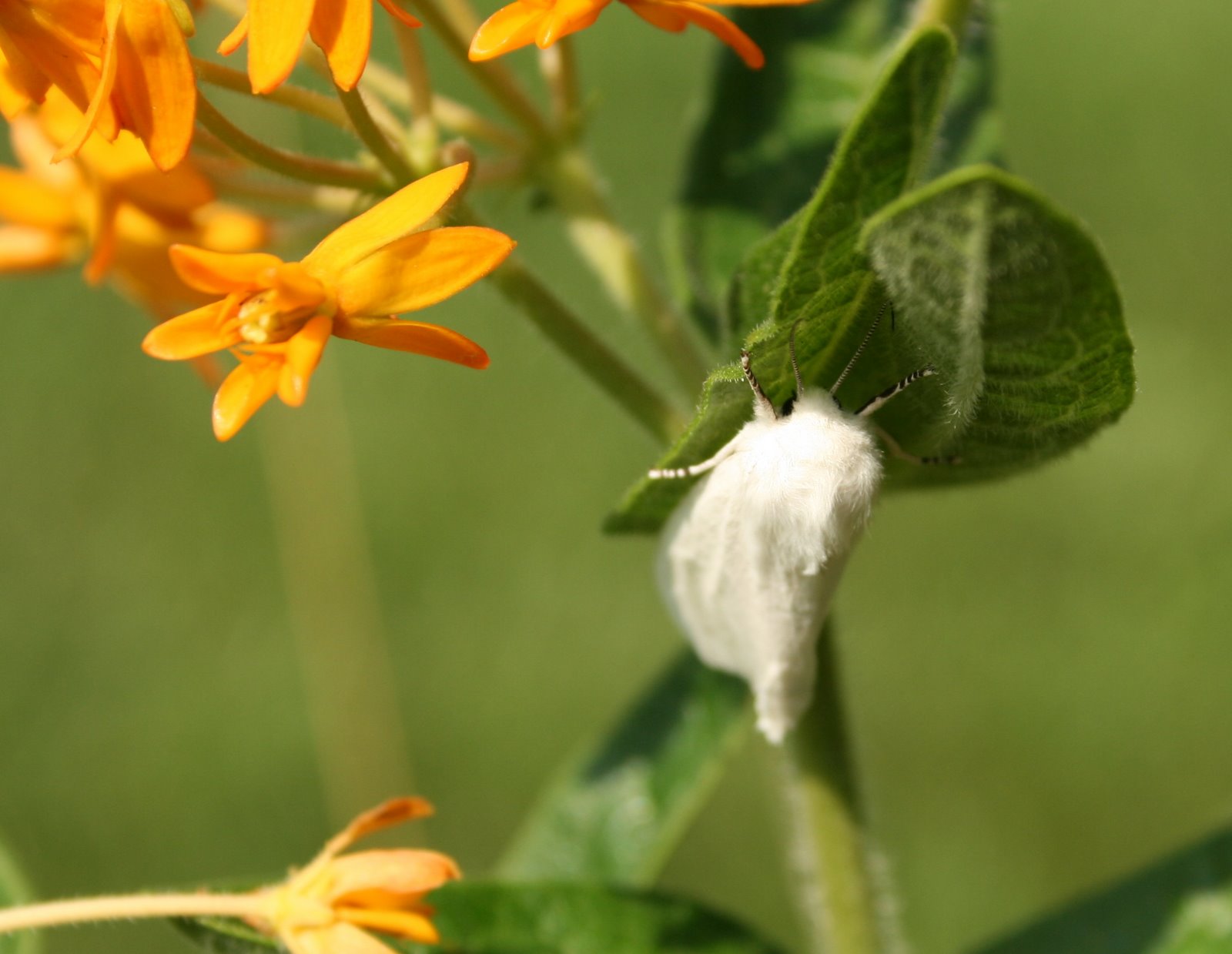
I believe this is the adult Virginian Tiger Moth that may have come from that caterpillar or one of its siblings.
Taking shelter on the underside of a butterfly weed leaf.
It is mostly white with a dot or two of black on the wings.
It has a mane of white fur on the thorax.


Again, I didn't disturb it to get a better view of the underside.  
The legs are white with some black markings.
The eyes look quite dark.
To wrap things up today, is a shot of the first of the milkweed seedpods in our garden to explode into a mass of dazzling cotton to carry the seeds to new territories. 
 In this sign of autumn is the promise of spring and summer yet to come.

07 September, 2011

Swallowtails and Mimics in the Garden

Back in August I featured the gorgeous Eastern Tiger Swallowtail Butterfly, Papilio glaucus.  They have been more numerous this summer than I recall them being in past years.  A result of global climate change?  I don't know, but it surely could be.  I can't resist posting a few more photos of these beauties.
A female with the blue on the hindwing that males lack.
She is focused on nectaring on purple coneflower.  The blue shows on the upper and lower hindwing.
The 2 shots below are views of the underside and topside of an individual butterfly that looks quite dark.
It is a little tattered, but still most obviously a swallowtail of some sort.
Turns out this is a female dark phase of the Eastern Tiger Swallowtail,  Papilio glaucus.
It seems that there are only female dark phase specimens, there are no male dark phase individuals.  When viewed from the right angle, you can see hints of the yellow stripes on the forewings.  These can be confused with the Black Swallowtail (Papilio polyxenes), except the blue on the black swallowtail is almost fused into 1 large blotch.  


Below is another dark swallowtail.  It is the Giant Swallowtail (cresphontes).  
Not very colorful from above, but the underside makes up for it.
I was not able to get a shot of the underside, but if you follow the link above, you can see that the underside is more colorful.  These are the largest butterflies in North America.


What about the underside of the dark phase Eastern Tiger Swallowtail?  You can see some nice orange spots along with some yellow and blue on the dark background.


This one is missing one tail and other pieces, too.  Amazing how well they can fly when tattered like this! 
The butterfly below also has orange and blue on a dark background.  But this one, a Red-Spotted Purple, Limenitis arthemis astyanax,  lacks tails.  This is a subspecies of a White Admiral and can hybridize with White Admirals.  It is considered a mimic of the toxic Pipevine Swallowtail.  
This one was so intent on drinking on the damp mulch I had uncovered while working on the garden path that it allowed me to move a piece of mulch that was stuck to its wing without even a flick of an antenna!
With its wings open, it is easy to see how worn it is.  Don't you love that blue iridescence of the hindwing?  I wonder if the blue looks more purple and the orange more red in fresh specimens?

04 September, 2011

Hummingbird Moth Caterpillars, the Garden Path, and an Unexpected Avian Visitor

Two weeks ago I blogged about the Snowberry Clearwing Hummingbird Moth laying eggs on a little honeysuckle plant that had volunteered in the garden.  Some of the eggs have hatched and i have tried to follow the little caterpillars. 
This just hatched caterpillar was so small that I didn't know it was there until I looked at the photos  Of course I ran back out to find it and photograph it on purpose.  Tiny little thing, isn't it?
Here is another fresh one.  You can see a clear eggshell in the background.
The little black "tail" makes them look like dachshunds.
I took these next 2 photos  today.  This one is growing larger; you can gauge its size in comparison to the tip of my index finger. 
It still has a long way to go, size-wise.
My project for today and tomorrow is to finish the garden path section that had been removed 2 or 3 years ago when we put the patio in.  I got a fair amount done today. First I weeded that section of the garden and spread shredded bark mulch that had been sitting there in a pile for 2 or so years. I know, I know - I put the "pro" in procrastinate.  ;-)  I rough-prepped the ground and was able to get about 15 feet of stone positioned and settled in place.
Here is the part of the path I did today starting from the patio and going toward the side to meet up with the path that goes around the side and across the front to the driveway.
I have about 7 feet left to do.  It will be sort of like the meeting of the Union and Pacific railway lines.  No one to blame but myself if they don't line up.  
That was hard work because most of the stone was in the back yard and I had to haul it up the steps to the side yard.  I also spread 7 wheel barrow loads of mulch, which Dennis very kindly loaded and wheeled to me, and did a lot of weeding.  But prepping the ground for the path was the hardest.  I was inside taking a break while reading my favorite blogs when I heard this loud commotion outside.  It sounded sort of like the blue jays when they imitate a red-shouldered hawk, but much louder and really carrying on for some time.  I ran outside to see what it could be and saw this in a tree in the woods behind our house:
A bald eagle!
These are huge birds - up to 40 inches tall with a wingspan of up to 90 inches!
It is not unusual to see eagles soaring overhead around here, but I have never seen one in a tree except along the Mississippi River or one of the other rivers around here - certainly never in our woods!
Too bad the light was against me, but with some tweaking - OK, a lot of tweaking, the photos aren't too bad.  And  what a thrill!
It was not spooked by me and the camera or even by me calling to Dennis to come and see.  It hung around for about 10-15 minutes (enough time for me to take 93 photos, most of them too poor to keep) before flying off.  I tell you, it made my day.
Posted by Picasa

02 September, 2011

A Sign of the Times


Finally, and six months later than we had hoped, our house is on the market.  We have spent a lot of time (not to mention money) getting it as perfect as possible in hopes it will sell in today's uncertain financial climate.  We would love for it to sell before the end of the year, but are prepared to wait longer if need be.

01 September, 2011

Nymphalis antiopa - Mourning Cloak Butterfly AKA Camberwall Beauty

A couple of weeks ago I saw my first Mourning cloak of the summer.
It seems to be licking the petals of the coneflower.
So many butterflies are attracted to coneflower.
Bug Guide tells me that it is known as the Camberwall Beauty in the UK.  It is a beauty, sure enough.  Don't you love those blue dots along the wing margins?
It is in the genus of Tortoiseshells.  The adults mostly feed on tree sap and rotten fruit.  Occasionally, as seen here, they do partake of nectar.
It has an odd life cycle, at least in my limited experience.  It overwinters as an adult, quite a feat for an insect in this climate.  Eggs are laid on young twigs of host trees like willow, river birch, and cottonwood that are found along rivers. The caterpillars live in communal webs and eat the young leaves of the host tree.  The first generation adults emerge in early summer, feed briefly, and then estivate until autumn.  I am pretty sure that the individuals I have seen are the re-emergent adults trying to fatten up before over-wintering.  They may even have a short migration south to over-winter in a less drastic climate than what we have here in Minnesota.  Not a bad idea at all.  ;-)
Posted by Picasa

31 August, 2011

Yellow Parasol Mushroom, Lepiota lutea

In mid-July, a flush of these lovely yellow parasol mushrooms, Lepiota lutea, came up in a pot of fragrant Jasmine that I have on the patio.  These come up fairly frequently in a number of pots and don't seem to harm the plant they share the pot with.  
I like the combination of yellow and blue.
You can see the annulus (ring) left around the stalk.  The annulus is the remnant of the veil that covered the gills before the cap expanded.  The shape of mushroom in the foreground  definitely lives up to  its name.
I think this is a record for the number of mushrooms in one pot.
I googled Lepiota lutea and learned that is very common in flower pots and does not affect the green plant, which did relieve me since it is in many of my pots.  This particular pot has had several flushes of mushroom this summer.  You might see little yellow egg-shaped mounds for a day or so that then rapidly expand to the mushrooms in these photos.  By the next day, the mushrooms have withered and collapsed into what looks like a dried mushroom.  In another day or 2 even those will have disappeared.  I look forward to them as an unexpected flash of color.
Posted by Picasa

29 August, 2011

Reflections on Light and Shadow

The shots of the Question Mark butterfly with its reflection that I posted here a few days ago reminded me of some pictures I took in 2009 at Victoria Bryant State Park in Georgia.  I took these photos while standing on a dock in a lake, looking down into the water.  I was fascinated by the way the depth of the slightly turbid water was illuminated by shafts of sunlight shining down between the boards of the dock.
If you double click on this image to enlarge it, you will be able to see some small fish  in the upper right-hand corner.  Along the bottom of the picture are the boards of the dock  and then the reflection of the dock and me.  Along the top of the photo is the shadow of me and the rail of the dock.  But it is those parallel planes of sunlit water that I was trying to capture; the other things were by accident.
In this simpler image below I cropped out everything except the shafts of sunlight, my reflection and the reflection of a vulture soaring high above.
  I call this one "Self-Portrait with Vulture".


Posted by Picasa

28 August, 2011

Libellula pulchella - Twelve-spotted Skimmer

I took these photos on July 31.  This dragonfly was in the garden and let me get pretty close to it with my camera.
It is a Twelve-spotted Skimmer, Libellula pulchella. 
The 12 spots are the dark spots of which there are 3 per wing. Both males and females have the 12 spots.  
Only the adult males have the powder blue spots on their wings and the bluish coating on their abdomens.
It is holding onto a Liatris flower stalk  (blazing star).
I think it is just soaking up the sun, giving me a nice photo op!
All the descriptions of this dragon refer to the white patches on the wings.  They sure look blue to me, even in the photos  where they are referred to as white.
I have seen several females during the summer, but they were never still enough to  photograph.
Beautiful thing to behold, unless you are its dinner target.


Posted by Picasa