Showing posts with label epiphytes. Show all posts

07 February, 2022

Tamarind Tree Community

Before we even moved here, we planted, among other things, a tamarind tree.  Probably in 2008.  It settled in was growing pretty well when we finally moved here in 2012.  When we added the new part to our cabana, we designed its footprint to leave space for the tamarind and its neighbor, the cashew, because we didn't want to try to move them from a spot they seemed to like.  Since then, both trees have thrived and grown quite robust.  

Tamarind tree in the foreground with the cashew behind it to the right.  And, yes, the cabana is lurking there behind all foliage!
The top of the tamarind was at the same height as the back veranda of the addition when we built it in 2015, so easy to reach out and pick the fruit.  Now, 7 years later, the tree is level with the upper veranda, making the tree about 30 feet tall in 12 years.
View from the upper veranda - we used to be able to see the Maya Mountains in the distance!
My favorite thing about the tamarind is not its fruit, which are delicious, or its flowers, which are delicately beautiful, but that it is home to many epiphytic plants.
You can hardly see the bark for all the plants growing on it.  (That is Barnie's old dog house/mansion which she used during the year or so before we had her fleas under control.  No fleas now that both dogs are treated monthly with a chewable tablet called NexGuard.)

Climbing fig was the first to grow on the tree and covers the most territory by far.

Mixed in with the climbing fig is resurrection fern, seen here in its un-resurrected state. 
And here it has been resurrected after some rain last night.  Shiny and fresh, good as new.

Lots going on in this shot - the climbing fig, a dog-tail cactus, and what really got my attention - a small bear's paw fern (Polypodium aureum)!

You can see its fuzzy little golden paw in the center near the top of the photo

I think this one grew from spores on a fern I had growing on the veranda just above.  There are also lots of mosses on the tree, too.  I think the rough nature of the bark encourages the epiphytes to take root.
If this little fern is from spores on the plant I brought down here to Belize and which has since died, then it is a continuation of a fern that I have had since about 1980.  And that makes me happy.

08 May, 2015

Orchids and Ants - It's the time of the season to feel the love

It's that time again - the end of the dry season that has so many plants and birds around here focusing on procreation.  Is this the season the Zombies had in mind when they recorded "The Time Of The Season"?  Click here to listen while you read about these ant-loving Cow Horn Orchids.

(A little aside - our friend and former neighbor at SteppingStones, Chris Harris, went to school at St. Albans with members of the Zombies.  He knew Zombies before they were cool!)

For weeks I have been watching as the slender green inflorescent spikes on the orchids get longer and longer, almost like watching asparagus grow.  Nothing happens for ages and then suddenly, boom like that, there they are.
Impressive, no?  You might even say hard to miss.  But you would be surprised.
Most of these orchids, which are epiphytes, are way up high in the tree canopy and the clusters of blossoms can get lost in sheer mass of vegetation.
High overhead, the flowers are easy to pass under without noticing.  The flowers on the right are on a long stalk coming out of the dense green plant on the left.
You have to actually look for them at the right time of the season, then you wonder how you could have possibly overlooked them before.
I was using my zoom lens and also cropped the photo to get this image of the flower that was way over my head.  Look at the curlicue petals.  According to various references I consulted, the curly petals are what gives it the common name of cow horn. No, I don't see it either.  
I know of some plants that are closer to the ground and are amenable to ladder-less photography.  The flower stalks are overrun with ants!
Ants are on all the flowers; the dried ones, the fresh ones, the buds.  They get nectar from the green patches on the flowers.  
Myrmecophila, the genus of the orchid, means "ant lover" (myrmex is Greek for ant and phila is Greek for love).  Easy to see that the ants might love the orchid, after all they get sweet nectar from it.  But what do the orchids love about the ants?
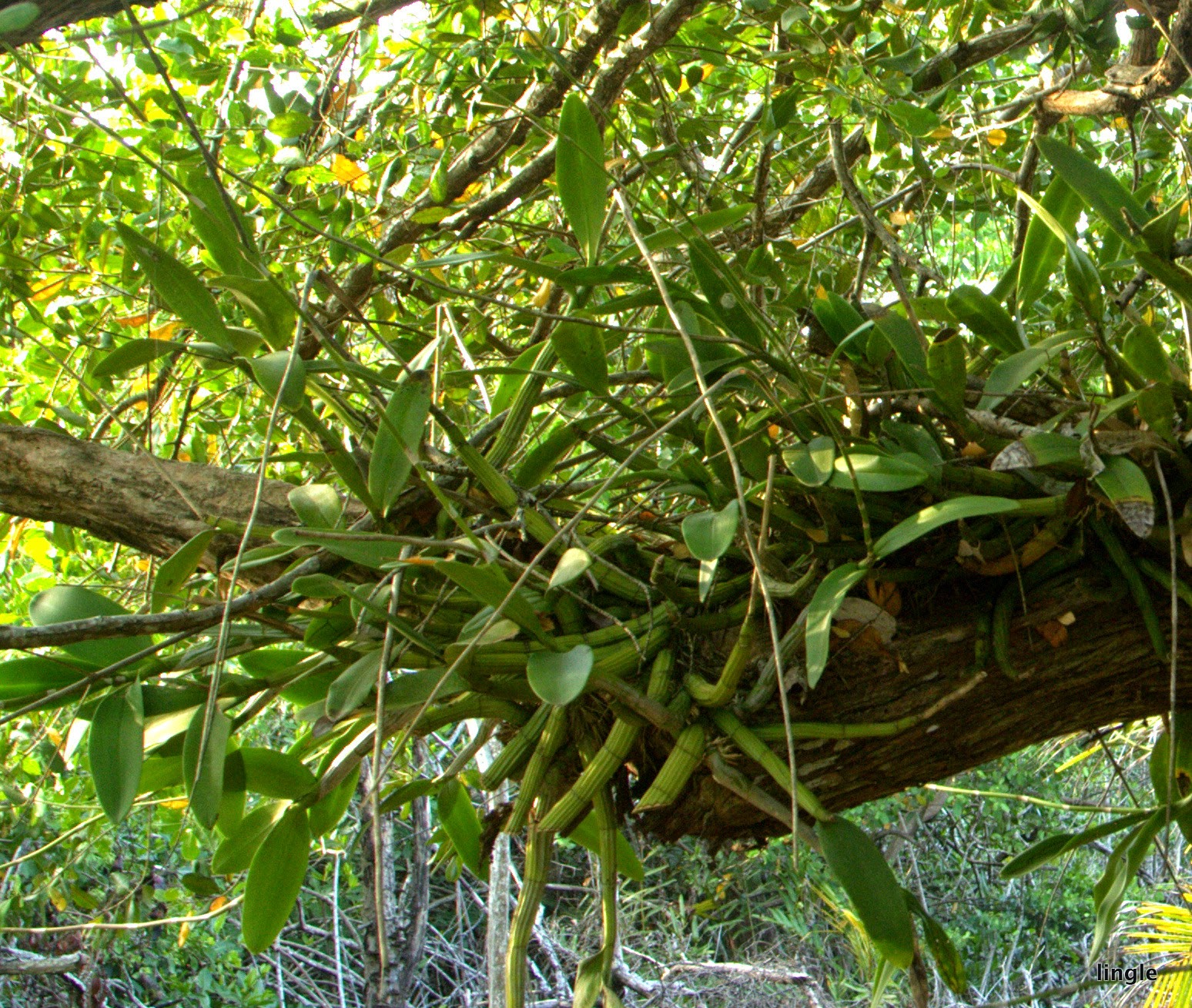
The big(ger) picture - This is a small portion of a huge mass of orchids behind our generator shed.  The flower stalks are so long that they are out of the frame.  What I want you to see are the cylindrical pseudobulbs from which the leaves emerge.  They are the key to the ant/orchid relationship.
The ants live in the hollow pseudobulbs.  They pack the pseudobulbs with all kinds of stuff - dead ants and other insects, dirt and sand, plant debris and seeds.  I bet there is ant poo in there, too.  In other words, they provide and deliver a sort of soil to the orchids up high in the tree branches.  They deserve their love.


Whose your daddy?


You can read more about Cow Horn Orchids and see a few photos of other orchids here and here.

30 November, 2013

Thankful

We celebrated our first Thanksgiving in Belize Thursday the 30th by hosting a small dinner party for our nearest neighbors, who are all American, and also Richard and Joy who live on site here and help us manage the place.  The guests included Craig who lives about 3/4 mile up the beach from us, Laquita and Bill who are housesitting at SteppingStones about 1/4 mile up the beach, and Chery and Sam who recently bought the MonkeyHouse about a mile to the south of us.  It was also the first Thanksgiving in Belize for Laquita and Bill and for Chery and Sam.  Everyone brought a contribution to the table and we did it up right with turkey, gravy, dressing, roasted root veggies, cauliflower soup, broccoli casserole, homemade bread stuffed with cheese, cranberry sauce, peach cobbler, pecan pie, and pumpkin cookies. Of course accompanied by lots of fine liquids.  Dennis and I certainly enjoyed it, and it seems our guests did as well.

November is almost at its end and this is only the second post I have managed to make.  Who knew retirement would be so busy?  I have plenty of things to blog about, like this gorgeous moon.  For the full moon and the next 3 nights it had a distinct pink cast to the color that was quite unusual.  It just looks plain orange in the photo, but in person it was a lovely salmon color.
Night after November's full moon (the Beaver Moon).  I wasn't able to quite capture the distinctly pinkish tinge to the color. 
Some of the other things to blog about are the plants that can be seen along the jungle trail we made.  The photo below is of the trunk of a dead tree that is supporting all kinds of epiphytes.
Tree along the jungle path.
Lots of birds have been passing through, too.  And there has been new activity at the hummingbird feeders.  
Juvenile Male Ruby-Throated Hummingbird.  The next photo shows how I know it's a male. ;-)
He's getting the first of his ruby feathers!  They really glow like that when the light is at the right angle; I didn't enhance the color at all.
All kinds of interesting things going on.  I'll do my best to post more frequently.

In the meantime and in the spirit of the holiday I will simply say that I am thankful that Dennis and I can enjoy our new life in Belize; I have never been happier or more contented.  Here's wishing the same for each of you.
Posted by Picasa

01 February, 2013

An Orchid and Two Mystery Ferns

I took a stroll this afternoon along the path we are making to our nearest neighbors' house not quite a quarter mile away.  The path goes from the back of our property and heads north along the edge of (and sometimes into) the marsh that borders Black Creek.  There is still much evidence of Hurricane Iris (2001) in the twisted and downed trees.  Not many trees are very tall.  The largest trees were decapitated by Iris.  It is sad to see the magnificence of these large trees reduced.  But what was bad for the trees has provided an opportunity for other plants.   The more open canopy and abundant amounts of dead wood are good conditions for many epiphytes including orchids and at least 1 fern species.  The photo below is of an orchid called Catasetum integerrimum. Its roots grow up; the thought is that they catch detritus for nutrients.  It is a common orchid whose flowers are fertilized by bees.  I haven't seen any blossoms yet, but will keep an eye out for them.  
See the roots growing up?  And the big seed pod in the foreground is at least 6 inches long.
I think showed photos already of a huge fern that is over 7 feet tall.  The fern below is a little smaller, only 4 or so feet tall. 
Growing tips of new frond.
Fiddle head unfurling.
The spore-bearing sori are on either side of the mid-rib of the leaflets.  This will help me key it out when I get my books down here.
Another fern I saw is an epiphytic fern, that, like the orchids, is taking advantage of the downed wood.
The rhizomes are twining around the tree root that is growing over a fallen tree.
The fronds of younger plants are not as elongate.
Older specimens had spore-bearing fronds with sori arranged in pairs of dots, one on each side of the  mid-rib.
It seems I have my work cut out for me. 
Posted by Picasa