28 April, 2011

Once Every Thirteen Years: The Great Southern Brood of Cicadas

I am visiting my Mother in Georgia this week.  Spring here is verging on summer; the azalea blossoms  have already come and gone.  While I am sorry to have missed them, I did arrive for an event that happens only once every 13 years – the Great Southern Brood of cicadas is emerging!  The first clue of the emergence that I saw was a large number of exuvia along the trail I was walking with one of my oldest friends and her sister.  Amazing that I noticed them at all because it was dusk and we were busy catching up on each other’s lives.  But, as often seems to be the case, once my eye caught one, there were exuvia everywhere.  The next few days I was ready with my camera and took hundreds of shots.  Lucky for you, I ruthlessly culled them and am presenting only the best of the best here.  ;-)

First up are the exuvia, or shells, of the last larval stage from which the adult emerges.  When I was a kid we would hook them on our clothes as decorations.  Using their specialized front legs, the larvae dig their way out of the ground (where they have lived for the last 13 years) and climb up vegetation or the occasional handy fence post and latch on.
The exuvia are very tough.


Look at those front legs!


Then the case splits open and the adult emerges pretty quickly.  They are a pale cream color when they first emerge and their wings are small.  Sometimes they don’t manage to emerge all the way, but when they do, they usually hang from their exuvium as they their wings unfurl and their exoskeletons harden.  This one just below hadn't latched on securely enough and it fell to the ground almost at my feet, the exuvium popped open, and the adult flopped out.  I moved it over to the grass and it quickly crawled away.
"Hey!  What happened?"

"This is not my beautiful home."


"This is a little better."


I love their big red eyes.  They also have 3 small red eyes that are most obvious before the exoskeleton darkens.  Their wings are gorgeous fairy wings while they are still pale.  They wear their small, dark, wing covers as epaulets.  


Folks around here call these cicadas “locusts” although they are not at related to the grasshoppers.  Cicadas are more closely related to flies.  As I mentioned earlier, this is part of the “Great Southern Brood” in the genus Magicicada.  Each cicada brood is synchronized for the year of its emergence.  The Great Southern Brood is the largest in North America.  It emerged last in 1998. 
They do cause some damage to trees and shrubs because they lay their eggs in slits they make in young stems.  But what gets most people’s attention is the deafeningly loud noise they make; the hotter it gets, the louder they sing.  Only the males sing.  As I was out walking today, someone asked me what that loud noise was.  I told them it was the cicadas and they looked at me blankly.  When I said locusts, they knew what I meant.
The trees and shrubs are covered with cicadas.
There are thousands and thousands of them in a single residential block; you can hardly take a step without crunching a cicada or its shed case.  They are a feast for some birds, and in many part of the world, the larvae are considered a delicacy for human consumption.


See you again in 2024.

17 April, 2011

In our continuing efforts to make our house salable, Dennis and I undertook the “Great Closet Makeover” this weekend. We ordered the kit from a company called EasyClosets. They have a website where you can enter the dimensions of the closet and choose the components you want to use, then they ship it all to you. Our closet kit arrived less than a week after we ordered it. It came in 13 boxes with a total weight of over 400 lbs. We took out the old shelves and rods on Thursday, patched the holes, and put up one coat of paint. Saturday morning we started with the kit. The kit has vertical pieces that hang off a horizontal rail. Dennis was excited because he got to use his new laser level for the first time.

You can just barely see the red laser line on the wall and Dennis' hand.

It is a little easier to see the laser when it is stationary.
The level worked like a charm and we soon had the marks on the walls to get the rails mounted at the right height. Once we figured out how the parts worked together it went quickly – until we got to the longest wall. I had measured that wall 3 times before we ordered the kit, and each time got 101.5 inches. It may be 101.5 inches at that spot, but the walls aren’t perfectly plumb and we had about a quarter of an inch too much shelving to fit along that wall. It should be a simple matter to just cut some off, but this is a pretty complicated system with cam screws that tighten adjacent pieces together. But we were able to substitute one of the 3 sections along the long wall with a section that was an inch or so shorter and it worked well.
Tightening the cam screws.
Adjusting the troublesome shelves on the long wall.
Dennis had to use a hacksaw to cut 2 hanger rods a bit shorter. 

Notice the lovely wheelie bin worktable.
I seemed to spend a fair amount of time on the floor getting the cams on the bottom shelves tightened up.
Then we were able to use the longer section with a few adjustments. I think Dennis was secretly pleased that we had to make the adjustments because that gave him an excuse to use his fancy new Forstner drill bits to create new holes for the cams I mentioned earlier.
The Forstner bit ...

Drilling out the hole for the cams.  A factory-made cam hole was drilled out to use as a template.  The black line on the shaft marks the desired depth.

On the floor again ...
Dennis also had to shorten the cam screws used on the top shelves that link the corners of the room.  This was due to poor planning on our part, but we got it to work in the end.
Dennis wore out one hacksaw blade on this project.
With some creativity and adaptability we got the closet installed and it looks great. I love the shoe shelves. We even got some of our things back in the closet. 

We put a little piece of carpet on a shelf for Max.
Dennis has the righthand third and I have the lefthand two-thirds.


Not a bad weekend's work at all.

11 April, 2011

Almost Earless

(again - apologies to Christine for messing with the title of her blog Almost Fearless)

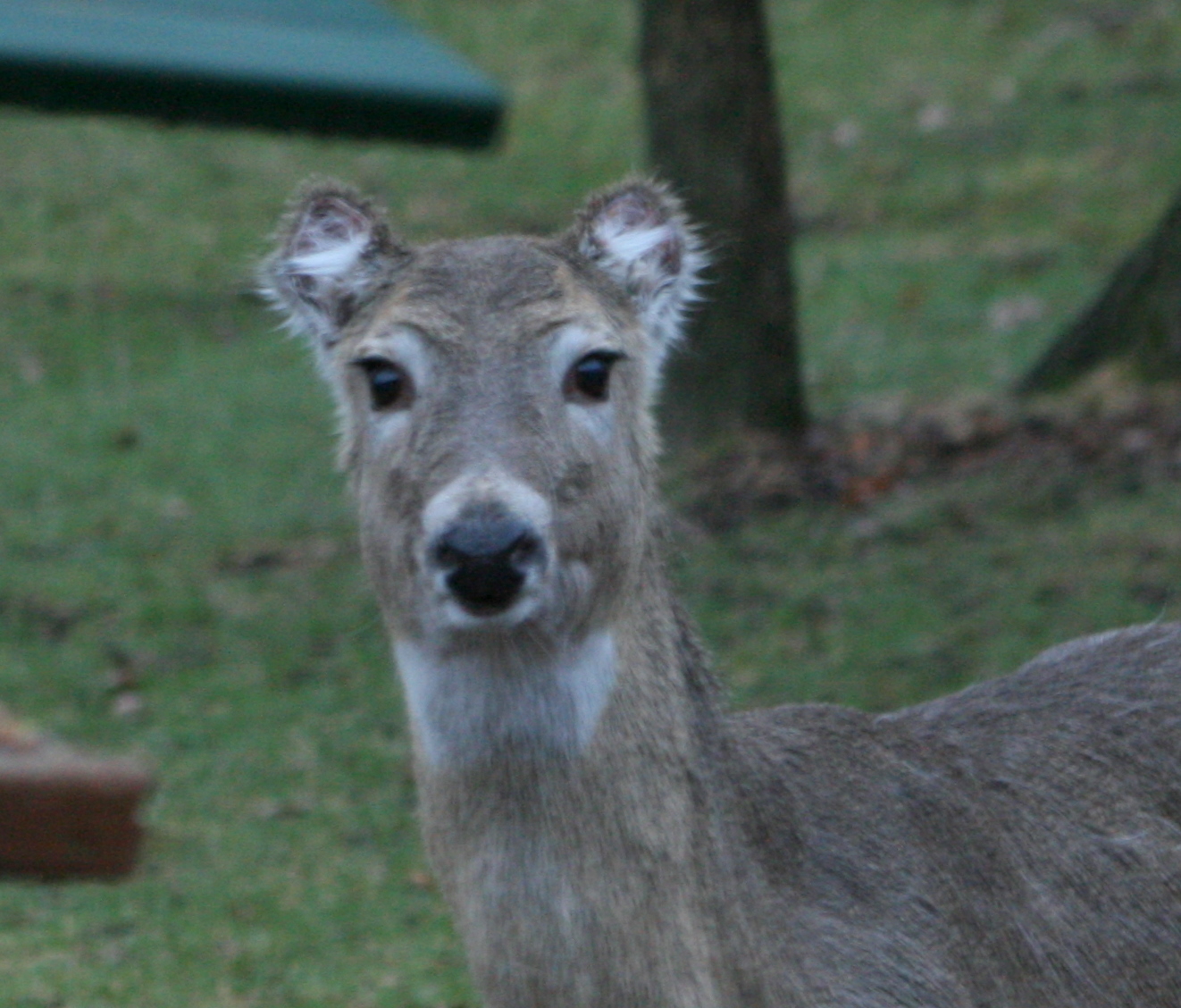
Back in February, we noticed a white-tailed doe that had one ear shorter than the other among the deer that come to raid the bird feeders.  Then last week I saw this one with 2 bobbed ears.  What is going on?  Were they injured?  Is some crazy person taking deer ears as trophies?  Is there a mutation generating bob-eared deer?  Finally it was still light enough when I got home from work for me to get a couple of barely passable photos.  She looks kind of sweet from this vantage.
The light was fading, so the shots are not sharp.  But if you click to enlarge the photo below you can see sore spots on the ears.

I believe what I had thought were 2 does is really just one slowly losing bits of her ears.  Perhaps her ears were badly frost-bitten during those bitter cold weeks we had and the dead parts are falling off.  Otherwise, she looks healthy.  Has anyone else ever seen anything like this?  I will keep an eye on her this spring to see how she fares.

10 April, 2011

Almost Ironic (with apologies to Christine)

Ten loads of wash, 8 big boxes of clean and neatly folded clothes, 3 boxes of “rags”, 1 bag of trash, and 2 trips to Salvation Army were yesterday’s culmination of an ongoing effort to get rid of unnecessary clothes prior to getting our house ready to sell so we can move to Belize next year. I didn’t realize I had so much. I had filled at least 30 feet (!) of hanging space with my clothes; some were 20 years old, some were older. Most things from the 2 spare bedrooms were pretty musty, so I washed and dried everything before I sorted through it all. I was heartless; my wedding dress – into the rag bag! That slightly too-small silk blouse of the most beautiful blue – into the box. The lovely long green skirt my sister made for me that matches the skirts she made for my other sister and herself one long ago Christmas – into the box. The black satin dresses that were my grandmother’s – into the rag bag. The Santa Claus suit that was hand made for my Father when we lived on Okinawa in the early sixties – into the trash bag (sniff). The gorgeous, semi-formal dress hand made for my Mother when we lived on Okinawa – into the trash bag. Well, I did salvage the fabric from the skirt; 3x10 ft of a beautifully hand-embroidered fabric that I entertain a notion of making into pillow covers if it isn't too rotten. The “keepers” still occupy 8 feet of hanging space, but some of that is taken up by winter cloths that I will need for next winter. Anybody need any clothes hangers? ;-)

This morning the title of an older post on Christine Gilbert's blog Almost Fearless caught my eye “10 Unexpected Costs of Owning Things”. I read it and some of the comments it had elicited. Still in the heady post-cleaning out state from yesterday, it resonated strongly with me and I resolved to rethink the many boxes of books I was planning on taking to Belize. But before I reviewed the book inventory on my computer, I made the mistake of reading my emails first. Oooh - here’s one from Amazon. There are some 400 thread count sheets at a very good sale price and lots of good colors to choose from. Quickly --  delete, delete -- no more stuff! It was a close call, but I managed to resist the temptation and decided to write this post instead.

Nearly 2 yards of embroidered tafetta, more than 50years old that I will try to salvage. 


13 March, 2011

Never Say Die, Part Two

But an attempt to fly off with the squirrel proves that the hawk doesn't have it after all.
Looks at those wicked talons! Very impressive, even if they didn't hold on to the squirrel.  If you double click on the photo you can see a little blood on one of them.  Hmmm, hawk or squirrel blood, I wonder?
And there the poor squirrel lies in the snow where it was dropped by the hawk.  The hawk perched in tree only 15 feet away to keep an eye on the squirrel.  And that is how things stayed for an hour ...


I wondered why the hawk didn't go back for the squirrel.  I still wonder.  I fully expected to look out and see the hawk back on the squirrel eating it before it froze.  But instead I saw that the hawk stayed on its perch and the squirrel
manages to get the tree it tried for earlier and climb to the lowest branch.  You can see the wounds on its head and shoulder.
By this time the temperature was dropping from the high of 5F (-15C) to 3F (-16C) on its way down to -9F (-23C) during the night.  


The next morning, when I put out the birdseed, I fully expected to see the frozen carcass of the squirrel still in the notch of the branch.  Or perhaps on the ground at the base of the tree, but that was not the case.  I walked up to the site of the original capture and saw only a few drops of blood on the snow.  The site of the second capture and the drop had no visible blood at all.  


Three weeks went by with no sign of an injured squirrel showing up at the bird feeders (which could just as accurately be called squirrel feeders.)  I assumed the worst of all possible scenarios -- a squirrel dying a long drawn out death and a hawk going hungry. 


I left the country (for Belize, but that is another series of posts) on February 14th and returned February 26th.  Back into the weekend routine of armchair birding on Sunday February 27th, I was watching the usual assortment of birds and squirrels at the feeders when I saw a squirrel dive off the bird feeder and head for a tree faster than I have ever seen before.  Then all the birds and squirrels flew, hopped, or ran for cover as a red-tailed hawk flew over and landed in the neighbors' yard.  I kept an eye on the fast squirrel as it made a false start or two to come back to the feeder.  It seemed to have some injuries.
There is an area on its head with some puncture wounds.  Made from talons?  Maybe.
Is it the same squirrel?
i would like to think that it is, if only to have some symmetry to this tale.  But even if it isn't, this squirrel never said die.

Never Say Die, Part One

Here in upper Midwest of the US, we will remain snow-covered for at least the next few days.  I sincerely hope all the snow disappears as the temperatures warm next week.  But before we ease into spring, I want to share the following mini-drama that unfolded outside our windows in the cold, cold, heart of winter. 

January 22 dawned a cold bright day.  During the night the temperature had dropped to -22F (-30C).  As usual, I had ventured out soon after waking up to replenish the birdseed at the feeders.  When the air is this cold, each inhalation freezes the moisture on your nose hairs -- not a very comfortable sensation; I try not to breath at all when I go out.  The official snow depth at the airport weather station was 18 inches.  Being a child of the south and more suited to the tropics, I am a real wuss about winter; it freaks me out that you could die just from being outside too long.  I don’t know how the wildlife manages to survive the winters here in Minnesota.

Anyway, Dennis and I were cozy inside with a fire in the fireplace, relaxing on this Saturday afternoon.  My camera was handy for my usual winter weekend armchair birding.  Dennis got up to do something and I heard him calling from the bedroom which looks out onto the hillside behind our house for to me to grab my camera and come quickly.  A hawk was manteling over its prey.  It was a red-tailed hawk, but we couldn’t see the prey.  The view from the bedroom window was partially blocked by shrubs, but the hawk was also visible from the den window.  That is the window I fixed for photography by removing the screen and also the mini-blinds that are situated between the double panes of glass.  This window looks out directly over the side yard, but I could manage shots of the hawk with the camera aimed through the double layers of glass at an extreme oblique angle.  It doesn’t make for the best optical setup, but it is what I had to deal with.  Here is what we saw:
It sat there, motionless for a bit, then rearranged itself, bent down toward the prey and came back up with 
something dangling from its beak.  Whatever it had was struggling to escape.  Now we can see that it is a grey squirrel.  If you enlarge the photo below you can see the talon around its head.
The squirrel is not going to give up easily.
Meanwhile life goes on as usual, with deer passing through the yard, oblivious to what is happening 30 feet up the hill.
The hawk, however, is vigilant and surveys the surroundings frequently.
It seems to hear the ultrasonic focus on my camera, and gives me a good stare.
All of this has happened in only 5 minutes.  I took a break from the window, and when I returned 2 minutes later I was surprised to see this:
The hawk has let loose of the squirrel and fluttered to the side.  The squirrel is motionless in the cold snow.   
The hawk stays focused on the squirrel, at the ready to make a move.
Looks up at me as if to say "Got it!"

End of Part One