Three years ago today, Max and I arrived in South Englishtown Belize, a permanent move for us. We left Rochester, Minnesota and in fact we left Dennis there to tidy up some loose ends. He joined us in Belize 10 days later on Christmas Eve, 2012.
The beautiful home where Dennis and I lived for 20 years (and have since sold) - beautiful in the spring and summer.
View from our neighbor's perspective.
The flowers at their peak.
Looking from our garden across our neighbors' manicured lawns to the farm fields and wooded hills across the road. Hard to beat this view.
Another hard to beat view.
Our shaded patio and back garden.
But too often, the views included snow.
Rosy dawn after overnight snowfall.
Pretty sure I took this shot in late March; there are some disappointed daffodil leaves in that flower bed at the lower right. Way too much snow and cold for 5 months of the year.
Max in the sunroom on a winter's day, trying to stay warm. Her strategy was to insulate with fat! She is much slimmer in her new home.
Fed up with cold weather - just look at Max's face in the photo above - we needed to live where the weather suits our clothes (click to listen to Harry) while you see why we made the move.
Happy Max, looking out over the sea in her new home.
Our first photo (scanned in from a 35mm negative) of the property we ended up purchasing in 2004. It starts waaaaay down the beach just after the palm that is leaning over the sea in the center of the photo and goes for 430 feet.
Rosy dawn over smooth sea. Way better than over snowy field.
Look at how the sunlight hopscotches along the undersides of the clouds.
Black Creek in our new backyard.
Our new view to the south.
The vacation cabana before we expanded the veranda and started the addition.
Racing home against the rain.
A fine day for a sail.
Another sunrise - happens every day.
Backyard birds - adult and juvenile little blue herons.
Hey look - the sun came up again!
Local caterpillar.
Local veg for roasting.
Neighborhood birds - brown pelicans.
Kiskadee vs tiger snake. Kiskadee wins. This time.
Mellow Max.
Basilisk lizard.
Nutmeg fruiting
Peppercorns.
Tropical color.
A glimpse of what brought us here 3 years ago. More to come in part 2.
Poor quality telecommunications is a frequent fact life here in Belize. Early on when we complained to various providers of mobile phone and satellite internet services, the one answer we could count on getting was atmospherics; atmospherics is the cause of all the problems. It got so that we used it as a catch word for all of life's travails. Burned dinner? It was atmospherics! Stubbed your toe? Atmospherics. Generator on the fritz? Obviously atmospherics! Five years down the road and the answer is still atmospherics. This blog is about good atmospherics and you can listen here to some of the best. Seriously, follow the link right now, listen to the radio; you won't regret it.
Lately, the atmosphere has hosted some intriguing cloud formations.
If we had seen this in Minnesota, we would have headed to the basement in fear of a tornado! No worries about tornadoes here.
Late yesterday afternoon, Dennis called to me to come see the flock of white birds out over the sea. It was terns going wild for what must have been a large school of little fish. They were soon joined by a flotilla of brown pelicans. While I was getting the camera, the most fantastic double rainbow appeared.
Double rainbow. The barely visible specks are pelicans floating on the water near the base of the less intense rainbow at the right.
The rainbow arced without interruption over Greater Monkey Cay toward Craig's Barebones Beach Bar to our north.
That is Greater Monkey Cay at the left.
Meanwhile, swallows flew in to feast on the mosquito-laden atmosphere.
Swallows in the air and pelicans on the water.
The atmosphere was thick with swallows.
Swallows somewhere over, under, and through the rainbow.
The north end of the rainbow at Craig's place.
Three Greater Yellowleg birds flew north, illuminated by the setting sun. The yellowlegs have been hanging around our shore for a coupe of weeks now. They come through each winter. This year they seem to be lingering longer than they usually do. They must like the atmospherics this year.
Yellowlegs headed to the other end of the rainbow.
From up on the balcony I could see that the pelicans were still out on the water, although the terns had mostly continued south.
Birds on the water.
Also heading south to their evening roost on Little Monkey Cay were some white ibises.
White ibises up high and terns down low with rainbow.
Some good atmospherics for a change. I could get used to this. I think I'll listen to the radio and enjoy it.
The 2015 Hurricane Season in the Atlantic is officially over. As much as we complained about the El Nino wreaking havoc on our beach and plants, it did prevent the formation of hurricanes in the Atlantic Ocean by disrupting tropical depression off the west coast of Africa before they developed into storms and hurricanes. Dodged another bullet this year.
I've been gone a long time Lost in the seven seas. Sail on, don't you come back Until you learn the birds and the bees. Who will you find waiting for you, Squeeze blood in the wine. Left to call my preacher And my very lovely wife.
[Chorus 1:] I said, hey now, knocked down, why'd you do it, Roll me like a hurricane. All is a bust and I'm numb, like novocaine. Who done it, what's up, you said, Sell me out why don't you boy, I'm alone, severely broken, I'm a dislocated boy.
We take hurricanes and hurricane preparedness very seriously here in South Englishtown for good reason. There is only one road to Monkey River Village and it is a dirt road that roughly parallels - wait for it - yes, the Monkey River. And when the river floods, so does the road. As it has for most of November. Check out this Youtube video posted by our neighbors Nevan and Cheryl who own and operate "The Monkey House" on the north side of the mouth of the Monkey River. Cheryl filmed while Nevan drove and Lloydie provided commentary as they braved the road when the waters began to recede a bit.
The little building in the video is the pump house for the village water supply. The pump has to be turned on and off manually every day or so to fill the water tower. Last week the only way to get there to turn on the pump was to take a motor boat up the road! Nevan said that the road looked like this for about 5 miles and that in places the water was 3.5 feet deep. In fact, water came inside their big GMC Sierra truck. No way our 14yr old, lower riding Subarau Outback would have been able to get through. Like most villagers during this wet November, we have been going by boat to Independence and Placencia for our food and other necessities. Back in 2013 I posted here and here about making a routine trip by boat for shopping.
So, you can see that it is very easy for bad weather to isolate us and we go to great lengths to be self-sufficient. We have evacuation plans in place for when a hurricane is bearing down on us and we will evacuate until it passes. But then we will get return (by boat) as soon as possible to salvage what we can and to start rebuilding if necessary and if possible. We have to make sure we can survive on our own for up to a month (perhaps longer) with no outside source for water, food, or shelter.
I mentioned in an earlier post that we prefer to learn hard lessons by evaluating the experiences of other people. And there are some unfortunate occurrences in recent history from which we can learn - Hurricanes Katrina and Sandy in the US and Iris and Mitch in Belize come to mind. What can we learn? 1. EVACUATE IN TIME. That is one nice thing (the only nice thing?) about hurricanes - they won't sneak up on you. You have time to lock things down, pack things up, and then get the hell out of the way. We have friends on higher ground in Independence who have given us a standing invitation to stay with them if a hurricane is headed our way. We will drive the car and also take one of the boats up a creek near their place. The cat has a carrier into which she will be coerced and the car will be filled with things we dare not leave behind. It will take some logistical planning to get it done and we update the details of the plan each season.
2. SECURE YOUR PROPERTY against damage from wind, rain, storm surges, flood water, and vandalism. Our construction design incorporates many security features and during the next months we will be doing more along these lines. That is for another post.
3. PROVISION YOURSELF to be self-sufficient for an indeterminate recovery period. Clean water, shelter, and food are the big three. We have been focusing on this for the last year and this is the main topic for this post.
Water - We have 24 rainwater vats plumbed into a central water supply for us and for the caretaker's cabana. Each vat holds 2500 liters of water and has a shutoff valve at the base. We have invested in new caps for the vats so that they can sealed off from a saltwater storm surge.
Rainwater vats under the cabana. They are all connected via the pipes you can see in the trench, but they also have shutoff valves to isolate them independently. We have caps to trade out for the caps that have the rainwater downspouts inserted. The caps screw down and if the tanks are full very little salt water will be able to get in.
We are well set for water. We also have a couple of solar powered personal-size water purifiers if the vats get contaminated by organic material. A cupful of bleach added to each vat and allowed to sit for 3 days will also purify the water. We should have enough water for drinking, cooking, and sanitation for ourselves and for our neighbors.
Shelter - I will do another post on shelter because it is such a big topic. Let me just say here that we have tarps, tents, staple guns, window screen, mosquito nets, DEET, duct tape, space blankets, emergency medical supplies, and lots of other useful items set aside in our hurricane supplies.
Food - we tried out a new strategy this year for food and it looks like it will work for us without being too onerous to manage. Here is our list of considerations for feeding ourselves in survival mode:
non-perishable food items - in case we have no refrigeration
organized storage - don't want to be scrambling through a messy hodgepodge when trying to cope with disaster
heavy on calories - we'll be burning those calories
plenty of no-cook items - especially for the early days when getting re-established
plenty of "grab and eat" items - we may not have much time or daylight for meal prep or clean up
plenty of variety - life will be tough enough without having boring food
plenty of taste - again, life will be tough enough
balance of veg, protein, carbs, and treats - the situation could last quite a long time
Dennis found a great little book called "The Storm Gourmet" that has recipes for meals that don't require cooking. We got some great ideas from this book.
Basically we invested in some large plastic storage bins (Sterilite brand are very nice, but there are others, too) with gasket seals to store food in. We have 4 "weekly" bins that each have a week's worth of breakfasts, lunches, and dinners inside, 2 "staples" bins with items like salt and powdered milk, a cat food bin, and 3 smaller "condiments and treats" bins.
Gasketed plastic bins. The large bottom bin can hold a week's worth of food for 2. The smaller bin holds an assortment of treats like cocoa mix, crackers, cookies/biscuits. The book was very useful; it helped us think some things through in a new way. The Camelback water purifier is small; we also have 2 other small water purifiers.
But we want to be able to cook too, so if our regular butane stove/oven doesn't survive, we invested in a small butane stove, along with small fuel cylinders, to include in the hurricane bins.
Our regular stove/oven with 6 burners! Love this stove. We will be able to light it manually if we don't have power for the builtin electric striker. As a back up, we have a little portable gas burner. It fits in a plastic bin.
Back in the spring, before the start of the 2015 hurricane season, Dennis made some online purchases of items for us to test. Items like self-heating entrees, meals to eat straight out of the package, dehydrated meals with a long shelf-life, dried fruits. We made local purchases of canned veg, fruit, powdered milk (we use that pretty often in day-to-day cooking since fresh dairy is hard to find), dried soup mixes, jars of pasta sauce, rolled oats, rice, dried lentils and beans, instant no-cook desserts, jams, jellies, canned butter (which we also use day-to-day), instant coffee, peanut butter, ramen noodles (I know it is weird, but Dennis and I both enjoy instant ramen noodles, the kind in pouch, not a styrofoam cup). We divided it into four bins, each holding food for a week.
There is a trick to this, two tricks really. First, you have to make sure that the food is tasty enough to eat and second, you have to manage it by expiration date. We had a lot of fun earlier in the summer taste-testing the self-heating meals and "eat straight out of the container" meals. One flavor of self-heating meal, while edible, is not something I would choose to eat again. We will use what we purchased, but not replenish that flavor. Several other flavors were pretty good and one was excellent. The "eat out of the container" meals were very good. So good that we included one of them on our Thanksgiving menu - the French Bistro Three Bean Salad that Weaver asked about! It has lentils, flageolet, kidney, and cannellini beans along with sweet corn and carrots. Now that hurricane season is over, we have sorted through the bins and pulled out all the items that will expire before this time next year. We have a bonanza of food to eat in the coming months.
To make it easy to manage, I made a spreadsheet (I do love a good spreadsheet. Really, I get into spreadsheets.) to track what is in each box and what has been removed from each box. It will be an easy matter in the spring to restock the boxes.
This part of Belize is tucked away in the south, protected somewhat by Honduras and Nicaragua. Since 1864 only 4 hurricanes with windspeeds greater than 100 MPH and 7 with windspeeds between 70-90 have made landfall within 50 miles of Englishtown. 150 years, 11 hurricanes - those aren't bad odds. I'll be adding pages to this blog layout with more details on hurricanes. Dennis has assembled some great data worth sharing. (First I have to figure out how to use blogger "pages" function.)
Depending on how hard a hurricane hits us, we could still have local food such as coconuts, available at South Englishtown. We have what we consider reasonable risk mitigation and contingency plans in place, but we could have a cabana with no roof or no solar power.
Coconut palms of various ages. Well away from the cabana where the coconuts pose the least risk as damaging projectiles in a hurricane. You would almost think we planned it that way.
Or we could have nothing, absolutely nothing; no house, no beach, no water, no land. No guarantees in this life!
Our third Thanksgiving in Belize and the first one that we have not hosted a large gathering. That makes this the first Thanksgiving in our retirement that is not frenetic and harried; for that I am thankful. We do have a feast for two in the works:
French 3 bean salad in Belizean avocado boats
roasted butternut, onion, jicama, and tofu
grilled chicken breast
mashed potatoes
cheesy biscuits
caramelized ripe plantain (from our plants) in port reduction topped with mascarpone for dessert
prosecco to accompany all courses
We are also thankful that our beach is recovering, and thankful that we had the wits and means to stop the erosion.
Lots of sand under the end of the dock again.
I estimate that we have gained back about 1/3 of what we lost. A rough calculation is that we recovered about 72 cubic yards of sand. And we still need to recover another 144 cubic yards to be back to where we started.
You can walk on the beach again. Some of the sandbags still show, especially where we piled them high under the tropical almond tree, but most have been covered by new sand.
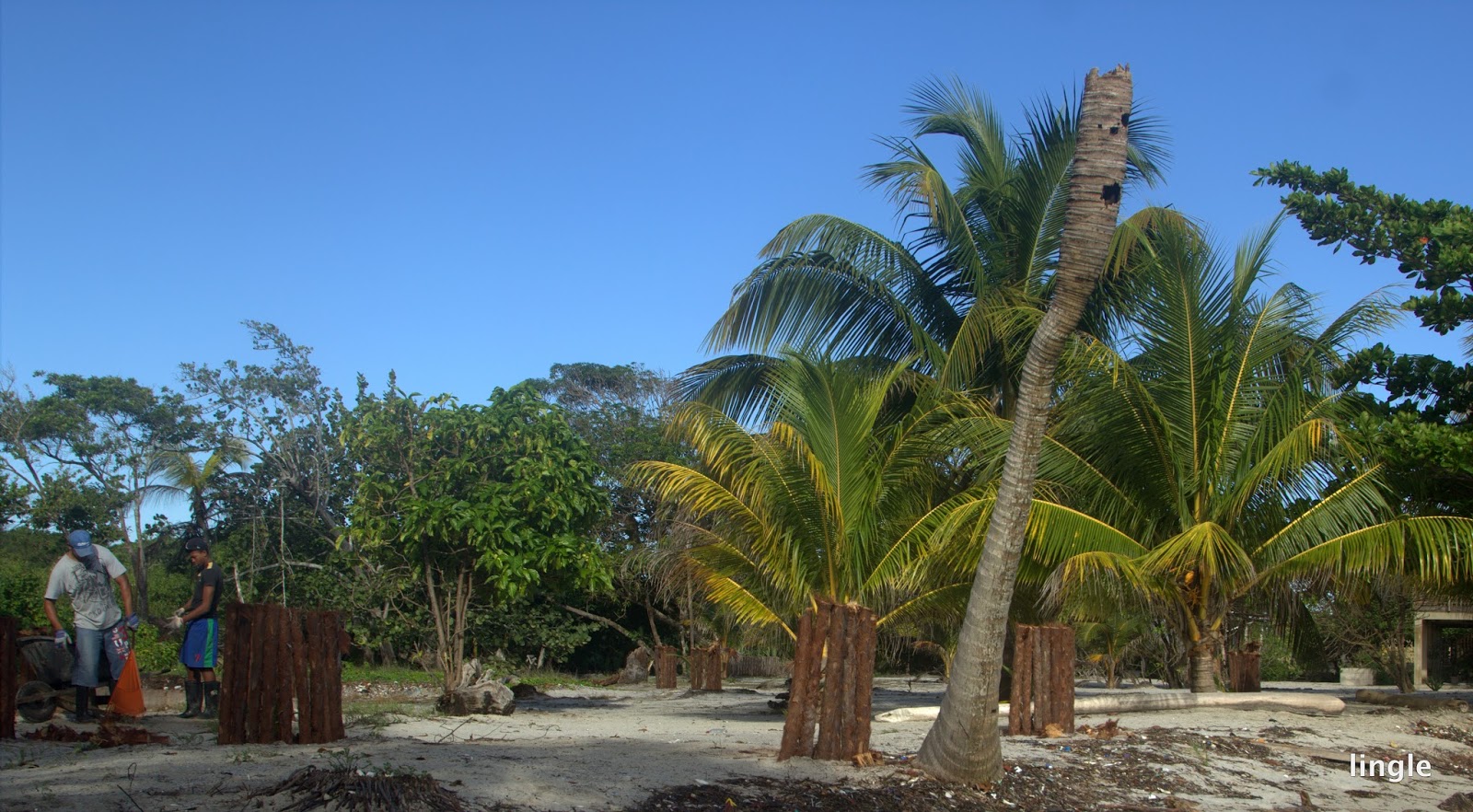
Last year we planted 25 palm trees and almost all of them died in the fierce and unrelenting east winds that lasted for about 6 months. We are trying again. Another 25 planted and this time we are putting little windbreak fences in front of each one.
Mason and Jovanie working on the windbreaks.
The windbreaks are made from palmetto trunks. Palmettos grow very quickly and their trunks are quite straight; perfect for sustainable harvest for fences, etc.
Nine or so palmetto stakes pounded into the sand 3 feet and 3-4 feet above the sand to protect the young palm trees.
We planted some very close to the water and some a little farther back.
A few more palmetto stakes to add.
Once they get established, the palms close to water's edge will be another line of defense from the crashing waves. And all palms will be good windbreaks, too. The nice thing about the palms is that we started them from our own yellow dwarf coconuts, so we didn't have to buy them - the first time or the second time!
Dennis did some research and found that cocoplums, which grow wild along the seashore and are prolific in nearby areas, are also good at stabilizing the beach and providing shelter from the wind. You can't find them at plant nurseries, so we got a friend to pick a bunch of fruits for us and we are trying to start them from seed.
Grow little Cocoplum seedlings, grow!
We hear that the success rate for the seedlings is low, so Dennis planted about 100 seeds from fruit that we cleaned. We'll see how it goes. They are in a raised bed so we can tend to them and get them to a nice size before we set them out. We will probably make palmetto windbreaks for them too. The palmetto stakes should last several years, plenty long for the cocoplums and the palms to get established.
We finally had a break from the rain, but the Monkey River Road is well and truly flooded after 35 inches of rain in November. The Monkey River was more than 16 feet above flood level for several weeks, which totally floods the unpaved road. Yesterday was the first day land vehicles managed to get through for at least 2 weeks. But the road is still too bad to get our wood flooring delivered by road. So we used 2 of our boats to bring it down from the contractor's place of business in Placencia.
Look how low the boat is riding in the water! It is full of very heavy Santa Maria tongue and groove flooring.
Normally, the trip from Placencia takes about 30 minutes, even less when sea is this calm. With this heavy load, the trip took about 3 times that long. But now the flooring is here and as soon as the flooring crew can get here, next week probably, they can start installing the floor in the addition. Good timing since Dennis has almost completed the wiring.
Do you ever see things your pictures that you didn't expect when you took the picture? At first glance this looked like a big shark fin!
Did a shark photobomb me? No, but a swallow did. I was just taking a shot of the pink clouds sailing on the sea at dusk when this swallow flew by.
And here is another unexpected sight - a Mayan ruin in the distance. Make that Mayan ruin-shaped cloud.
Mayan castle in the sky.
Sunset yesterday was a real beauty.
The black speck at the bottom of the blue sky is a little commercial plane flying south to Punta Gorda. The last flight of the day since none of the airstrips have lights or radar for night flights.
I'll end this post with one last sunset photo.
Very dramatic!
Happy Thanksgiving to all our American family and friends, and to everyone who is thankful for the wonderful things, large and small, in this world.