20 August, 2011

Monarch Butterflies

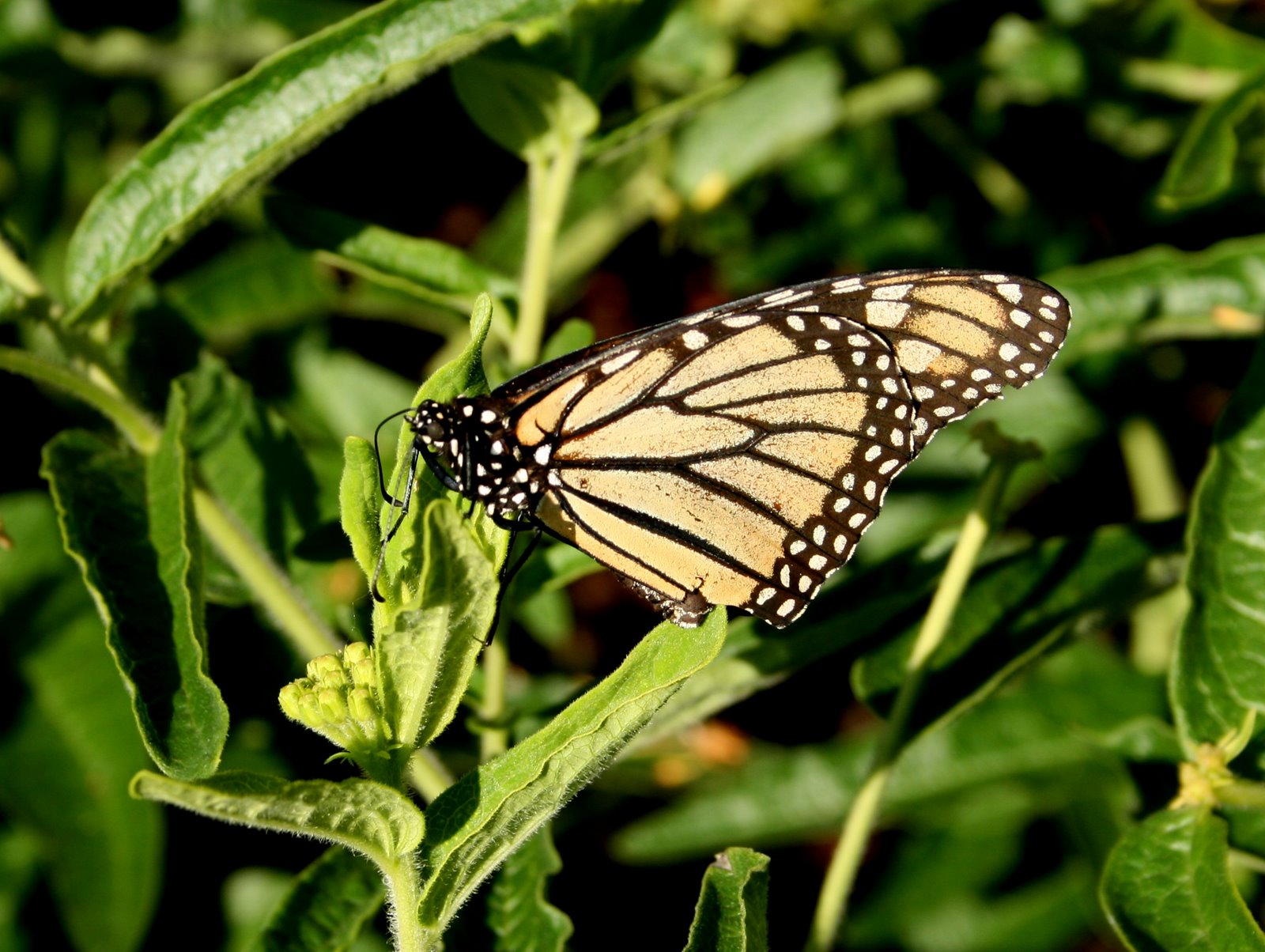
These butterflies are a marvel.  Amazingly, they are migratory!  They overwinter in Mexico and southern California, and in February start to migrate north.  They breed and lay eggs in the southern USA.  The progeny from those individuals fly farther north and the process is repeated , with monarchs coming as far north as southern Canada.  In August, they turn around and head south.  The generation that overwinters lives up to seven months, while the others live only 2-3 months.  This is explained much more clearly in Wikipedia at this site.  Please click on the images to see the details.  
Monarch Butterfly nectaring on purple coneflower
This large butterfly feeds mostly on milkweed, Aesclepias spp.
Aesclepias spp., especially this A. tuberosa, have toxins that the Monarchs accumulate in their tissues.
Most butterfly predators are sensitive to the toxins and have learned to avoid these brightly colored butterflies and their equally brightly colored caterpillars.
Look at this impressive wingspan - 4 inches and then some.
This female is trying to find the perfect spot to lay her eggs.
They always lay them on butterfly weed.
You can see the tip of abdomen just starting to curl inward.
Curling even more.
curling so much that she tips forward almost onto her head!
Whatever it takes to squeeze out an egg.
Here she lays one on the bud of butterfly weed florette.
I came back later to get this photo.
And here is an egg laid on a leaf.
With a close up look here you can see  stripes and even the hint of a caterpillar face at the tip of the egg.
A face like this one.
After munching on butterfly weed leaves, they get bigger.
and bigger (double click to see it REALLY BIG!).
Finally they will form a chrysalis, but I have not been fortunate enough to find one.  


We specifically planted the butterfly weed to support these butterflies. It has been such a great pleasure to see and photograph the monarchs at the northern extent of their range.  Butterfly weed has been included in many wildflower projects in these parts of the US, so on this end of the migration, things are pretty good.  Unfortunately, on the southern end where they overwinter, deforestation is putting monarch butterflies at risk.  It thrills my soul each year to see the monarchs arrive and further the species for at least another year; and this year has been a banner year indeed.
Posted by Picasa

12 August, 2011

Butterfly and Moth

After a slow, cool start to summer here in Minnesota, our garden came into its own in late July and early August.  The flowers, birds, and insects have been a delight to watch in their splendid glory.  Even though we have been busy getting the house ready to sell, I have managed to take lots of photos of the flora and fauna.  But I haven't been able to manage posting a blog entry, until now.

One of the lovely insects that has been flitting around is the Eastern Tiger Swallowtail (Papilio glaucus).  This female is feeding on butterfly weed; in fact she was holding on for dear life as the wind blustered around.   The blue on the hindwing is seen only on the females.

I have seen her or other females in the garden for several weeks now.  They are quite
large with a wing span of around 6 inches (165 mm) for the females and a little smaller for the males. 


These swallowtails have lovely colors on the upper and undersides of their wings.

The blue (first photo)is more visible from above and the orange is more visible from below.
I find the Eastern Swallowtails to be one of the most beautiful butterflies in North America.
On the other extreme is this moth, Palthis angulalis - Dark-spotted Palthis.  It is in a subfamily called the "litter moths", which reflects their usual habitat.

It is fairly small; that is an oregano leaf it is on in the photos.  And at first glance, it seems drab.  But look at that structure sticking out from its head!  What is that?

From a different perspective, you can see the interesting shape of its wings.  

From above it looks to me like an F16 fighter plane.

In fact, that was how i keyed it out.  I did a Google search on "moths that look like F16s" and found the genus in the 3rd item.


That took me to http://bugguide.net/node/view/15740, a great site that I use pretty often.
  Now if I could only figure out what is going on with that funky schnoz ...


22 May, 2011

Daffodils and Wildflowers

You may remember last autumn I wrote about digging up the daffodil bulbs at the front of the house and then replanting them at the back along the edge of the woods.  It was a huge success.   
Daffodils at the edge of the woods on a southeast facing hill.  I love how the late afternoon sun shines through the still-bare branches of the trees to illuminate the blossoms from behind.
View from the woods toward our neighbors' house a week or so after the previous photo.

View toward "The Grove", a large house owned by Assisi Heights Convent.
 I had dug up about 8 bushells of bulbs from the front to move to the back.  I though I had recovered at least 80% of them, but look at was is left in the front!  I think I will let them stay where they are.  :-)  I seem to have plenty at the edge of the woods.
Lots of bulbs were still in the bed at the front of the house.  They are such a welcomed sight in early spring.
The bumblebees were all over them.
They just glow in the spring sunshine.
There have been lots of wildflowers out, too. I was too late to catch the bloodroot flower. 
The lovely single leaf of the bloodroot plant, one of my favorite wildflowers.
Last spring I looked high and low for trout lilies in bloom, but did not find a single flower.  I did find a seed head late in the fall, but that was it.  This spring I found quite a few with flowers. 
These are the white trout lilies.  They also come in yellow.
These lilies mostly propagate vegetatively. The first year plants have a single leaf. Older plants have 2 leaves and may flower.
If you look in the background, you can see that the forest floor is almost a uniform carpet of trout lilies.


Mixed in with the trout lilies are loads of blue violets.
The ramps are doing well.  Unlike their European relative, rampsons, they will not flower until after the leaves have died back.

Some of the jack-in-the-pulpits have a dark spathe that surrounds the spadix, and others have green spathes.  Not sure what the difference is.
These early woodland wildflowers emerge long before the trees begin to leaf out. They get in almost an entire year's worth of growth in the weeks before they get shaded by the trees. Their foliage often dies back even though flowers and seed heads develop and mature in the later months of summer. They rely on energy stored in corms, bulbs, and roots.


This photo of the jack-in-the-pulpit is from 2008.  It shows the very colorful developing seeds and exposed surface of the spadix where the seeds have fallen off.
Amazingly beautiful, isn't it? 

20 May, 2011

Odd and Ends: Deer Ears, Book Ends, Book Beginnings


A number of weeks ago, I had a post about the deer with the shrinking ears and I promised that I would give an update if I learned anything. Well, my inquiries bore some fruit and the consensus is that it was probably frostbite, although there is a possibility that it could be nematode larvae Elaeophora (arterial worm). The nematode larvae are a big, often lethal, problem with sheep, elk, moose, and goats to the west of us. But infected white-tailed deer usually do not have symptoms. I do hope that it is frostbite, because there shouldn’t be any lasting problems. Since our weather has gotten warmer, the deer are finding natural food instead of raiding the bird feeders; I haven’t seen them for a while.  She may show up again with her latest fawn in a month or so.

Speaking of getting odds and ends out of the way – I am ecstatic that I have gotten rid of 300 books! Tracey, who does my hair (yes, it is true that hairdressers know everything!) , gave me the name and email address of a person in town who has a business selling books on eBay. I sent her an email and 4 days latter she (actually her husband and father-in-law) came and picked up all the books. A weight off my mind. ;-) I had roughly 350 books of fiction. Originally I had packed up about 150 of them to take to Belize. But I had second thoughts about the expense of shipping them and the practicality of keeping them in such a humid climate when we will not have air conditioning. So I tried a little experiment – I bought my self a Kindle to try out. I got it about 2 months ago and love it! I had to make a deal with myself, though, so that I don’t spend too much money buying eBooks – for each book I purchase and read, I have to find at least one free eBook that I download and read. This makes me explore lots of options rather than solely relying on Amazon. And Amazon also has tons for free eBooks.  So far I am reading far more free books than books I have to pay for.   So, I unpacked 3 boxes of books and selected only 50 to take with me.

The reject pile:  300 hardback, paperback, mysteries, historical fiction, chick lit, science fiction, oldies, post-modern - a little bit of everything.
Most books I read just once and then try to pass along to another reader.  But somohow they keep finding their way back to me!  I hope that through the eBay site they can find their way to new readers. 
50 keepers: they all have special meaning to me.
If you look at the titles in the photo above, you can see that my reading taste is fairly ecclectic.  One of my favorite new finds is the author Neal Stephenson.  He wrote a series of 3 novels (almost 1000 pages each) plus a related novel that I keep trying to get my friends to read.  So far, none of them have been as taken with these books as I have been.  Please let me know if you like them!  Another author whose works mean a lot to me is the enigmatic James Tiptree Jr, the nom de plume of Alice B. Sheldon.  She took a masculine pen name to get her science fiction published in the 1970s.  Most of her writing is incredibly thought provoking with a somewhat sad yet optimistic undercurrent.  As a young woman coming of age at that time, her writing struck, and still strikes, a deep chord in me.  One other book that resonates with my up-bringing in the deep south of the United States is "Praying for Sheetrock".  Anyone who has a desire to understand the people of the southern US in middle to late1900s would benefit from reading this book; I know because I am one of those people.  "Last Chance to See" is the only book of Douglas Adams, who also wrote "Hitchhikers Guide to the Galaxy", that I have.  He is one of the most remarkable authors, with a fresh perspective on life and being human.  He was also quoted as saying that he loves deadlines, especially the whooshing sound they make as they zoom past him.  I can sure identify with that!  The world is a sadder, poorer place for his early death.  Armistead Maupin is another author represented in my pile of "keepers".  His series "Tales of the City" was made into a public TV series.  It loosely revolves around misfits who find their place in a very bohemian San Francisco and is funny, endearing, uplifiting, and sad.  But mostly, it, too, is thought provoking.  Gregory Maguire wrote a series of books that are alternative takes on "The Wizard of Oz" and other books written by Frank Baum.  The most well-know of his books is "Wicked"; it was a long-running play on Broadway.  He explores different ways of thinking about things and how context differentiates between wickedness and goodness, uglyness and beauty, bravery and cowardice.  And how could I get rid of Monty Python's "All the Words"?  If there ever was an alternative way of looking at things, the Monty Python crew showed us how to do it.  Rounding out my keepers are books of historical significance in science fiction and mystery.  As I looked over my collection of keepers, my first thought was how diverse they are, but after reflection I can see that they all illustrate alternative points of view that bring us out of ourselves and into a bigger, more versatile, less constrained, and richer world.  Even if I never actually read these books again, for now I will be a more contented person if I know that I have them.  There may be some point in the future that I will be able to let them go, but for now having them in my possesion is symbolic and fills a need that I cannot deny.

Wow - that was a boatload, wasn't it.  ;-)  On to more typical things, I was happy to read Midmarsh John’s blog the other day because he had an entire post about a site  with free eBooks; what a find that site is! I found 34 old texts on Belize and Central America; the three I have looked at so far are down-loadable to my Kindle. This is great.  I can see lots of rainy days happily filled with exploring this online library.


14 May, 2011

Is it spring yet?

Well, the emergence of the Great Southern Brood of periodic cicadas that I featured in my last post has made headlines here, here, and here.  But there were other things of interest happening outside too.  One of my favorite small trees, the Grancy Greybeard, (aka Fringe Tree, Old Man's Beard, Chionanthus virginicus) was in bloom in my Mother's back yard. 
 When we moved to Minnesota 18 years ago, we brought a seedling with us.  It has survived and even blooms here.  It stays small because it gets severely "pruned" by deer each winter; of course the shorter growing season also comes in to play. 
 Yes, those ~3 foot tall sticks are the Grancy Greybeard.  The photo of the flowers in Georgia was taken 3 weeks ago and the photos above and below of this one in MN were taken just minutes ago!  That is how delayed our spring is relative to that in Georgia - I would guess at least 6 weeks, maybe 8.  You can see the Lily of the Valley leaves around the base of the Grancy Greybeard and also the first new leaves of Christmas fern unfurling.
So far our Grancy Greybeard only has green buds showing with the promise of good things to come.

I have no idea what this plant is.
 It is a vine of some sort that was growing wild at the back of a neighbor's yard.  A very pretty flower, whatever it is.


There were also some weeds/wildflowers (depending on your point of view) in Mother's front lawn. 


 I'm glad I took these shots when I did because the next day they were mowed down.  :-(

This Scotch Broom (Cytisus scoparius ) was also in the neighbor's yard.  As an invading, non-native species, it is considered a noxious weed.  It was introduced from Europe in the 1800s.  Here in the yard, it behaves itself fairly well and adds some welcomed color in the spring.


Meanwhile back here in MN, there are more signs of spring that lend themselves to another posting.  Here is a taste of things to come ...
Ramps

Jack-in-the-pulpit

Ostrich plume ferns