Showing posts with label sea turtles. Show all posts

24 December, 2021

Shoring Up The Shore, Pt 2

The fabric is all in place and held down by river sand. The river sand has been spread out, but needs a little more work to blend it in with the sea sand. I am very pleased with how it is looking. Today, I have some photos of little red mangroves that we planted in hopes they will grow and spread to provide a longer lasting defense. It's a bit of a compromise because while red mangroves grow naturally on the parcel to our south, they do not grow along the shore of Englishtown proper. But then again, sea walls aren't natural either. Life is a compromise. 
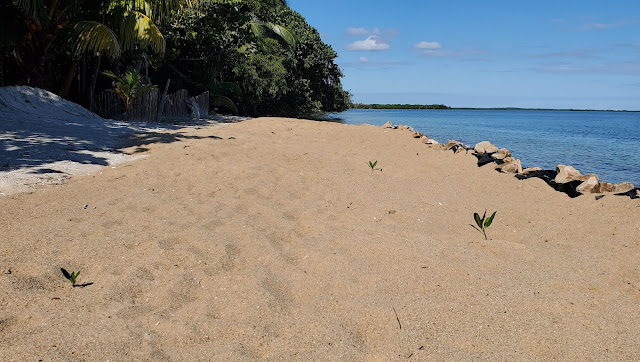
Those little tufts of green are red mangrove seedlings.  We planted 9 north of the dock and about 15 to the south.
Our biggest concern with the sea wall is that it is a barrier to sea turtles coming ashore to nest. I can sooth my conscience  a little bit by recognizing that before the sea wall, they couldn't come ashore right here any longer because the sea had eaten away the sloped shoreline and left behind a vertical cliff. But what we want to do is to re-establish a shore that the turtles nest along. To that end, we are tryng out what I call turtle ramps. The ramps will require ongoing maintenance to keep them turtle friendly, but we can do that. 
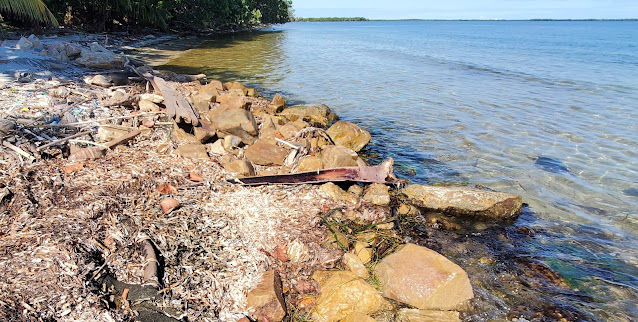
The turtle ramp needs a lot of attention before June when the turtles might start to explore potential nest sites.  It is basically a low spot in the sea wall with a shallow slope the turtles can crawl up.
We did have at least one turtle successfully access the area above the sea wall this past nesting season. I'm not sure if she came up the turtle ramp or crawled along the shore from north of the sea wall. 
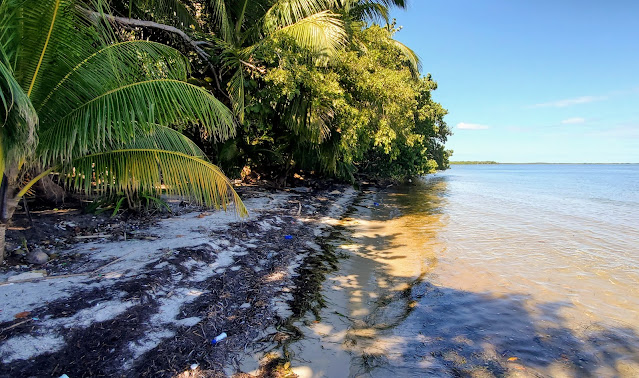
Natural beach to the north of our sea wall.  It is very attractive to turtles!
There was quite a bit of nesting activity to the north of the sea wall and I saw evidence of 3 successful hatchings even though I didn't see any actual baby turtles. We keep that part of the shore free of barriers such as fallen trees, washed up trash, etc.
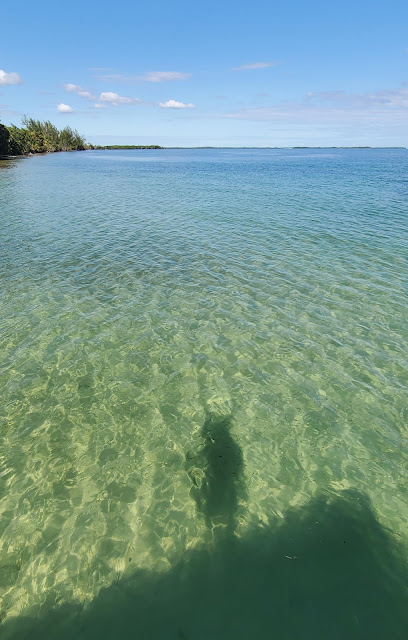
Enlarge to see lots of little fishies in the water!
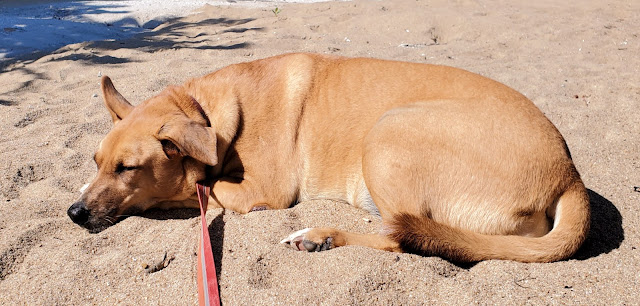
The sea was sparkly and clear today, and the midday sun warmed the sand to toasty bliss for Barnie.  A perfect day for us all.
Sundog.


31 December, 2018

Something Special for the Last Blog Post in 2018

Here we are at the end of another eventful year.  It has been difficult to blog for quite a few months because of our horrible internet access, but I think we have resolved that.  For the time being anyway.

I want to the end year on a high note.  One of the most exciting and special things that happened here in Englishtown was successful nesting of the very endangered Hawksbill Sea Turtle. The first clue that we had sea turtle activity on our property was seeing tracks from their exploratory crawls.  A female turtle will make numerous exploratory crawls in the weeks and days before she actually digs a nest hole and lays eggs.  She will also make several nests over the space of a single nest season.

Here is what a turtle crawl looks like.  She came out of the water to the left of the dock and crawled across our front yard.  Those tank tracks are hers.
Close inspection of the tracks showed that she crawled with alternating front flipper movement, indicating that she was a Hawksbill Turtle.  The other sea turtles in Belize (Loggerhead and Green) use their flippers in tandem like a breast stroke.
 Once she got to the lilies growing at the front of our cabana foundation, she turned north and crawled parallel to our cabana until she reached a soft spot for digging.  She made her nest under the lilies before crawling back to sea.
The crawl back to sea.  The flipper tips are about 3 and half feet apart.
And here is what a nest looks like.
The cabana foundation is along the left side of the photo.  I took the picture while on the front steps looking down onto the lilies.  All the darker colored sand is what she churned up while crawling and digging.  The nest hole itself is only about 10 or 12 inches in diameter and is located just below the 3 brown leaves just to the left of center at the top of the photo.
With the help of one of our Belizean workers, who is the son of a very experienced wildlife conservator, we confirmed that this was a real nest and not a blind dig.  We fenced off the area so we wouldn't walk on it while tending the grounds and also to keep the dogs away from it. Then we started the countdown to hatching in 60+ days.  What we didn't know was that there was an earlier nest at the north end of our property.
Another nest just this side of the jungle at the far end of our property.  
This property with a good sloped beach, open space with some vegetation, and very little nighttime light pollution is ideal for turtle nesting.  Turtles generally come back to their natal beach for nesting, so this activity is probably from turtles that hatched here up to 25 years ago.  We found the mostly empty nest after most of the turtle hatchlings had made their way to the sea.  There were 3 left, trapped at the bottom of the 18 inch deep nest hole.  We brought them to the surface to let them make their way to the sea.
Tiny turtle hatchling next to my size 7 (US) foot.  They are little things considering how big they get - 300+ pounds for the adults.
Turtle track in miniature, with alternating flipper action.
We realized that the hatchlings had probably been trapped in the nest overnight, so rather make them crawl on their own to sea, we carried them closer to the shore.
As soon as they hit the wet sand, they sped up. 
This one is not quite there yet.
Crawling over the washed up Sargassum seaweed for the final couple of feet.
 The waves were gentle and washed the turtles out to deeper water.
As soon as they got wet, they were off.
The three little turtles swam quite strongly away from shore, stopping now and again to poke their heads out of the water to breath and look around.  It will be at least 8 years before they reach maturity.
Bye bye.  See you again in about 8 years.
The nest in front of the cabana hatched out in due time with 78 live hatchlings.  The sea was very rough that day and the little ones kept getting tossed back on shore.  So we gathered them up in buckets and I carried them out past the breakers to let them swim off.  That kept me busy, so I didn't get any pictures of them.  Just like the others, though, they swam off sure and strong into the big sea.  We dug out the nest and found 60 nonviable eggs that did not hatch, probably because they had been submerged in water from the extremely cool and rainy weather in November.  A typical Hawksbill nest will have 130 to 180 eggs, so this one was on par.  Another nest was a complete loss, probably also due to flooded conditions.  In preparation for the next nesting season, we will build up their preferred areas with sand in hopes that the nest holes won't flood.  Turtle nesting activity tends to go in cycles of several years of activity followed by several years with little to no activity.  We sure hope to see more next year and to have improved conditions for them. 

14 August, 2014

Sargassum Invasion

Near the horizon, an olive green mass more than a mile long floats, drifting languidly from north to south.  A moment later the languidness is put to lie as the south tip of the mass makes landfall on our beach.  The Sargassum has arrived.  This happens periodically every year, but this particular Sargassum landfall is part of an impressive invasion that has the entire coast of Belize mainland and cayes covered with the brown alga.  
The Sargassum is closing in.  All day long a seemingly endless line of Sargassum floated in. 
Some has washed up and much more is headed in.
 The next day there were mounds of it on the beach and floating next to the shore.
Sargassum floating next to the shore.
A thick blanket has mounded up, especially to the south of our dock where it is a couple of feet deep on shore. 
Not quite as much to the north of the dock.
This Sargassum is from the Sargasso Sea in the Atlantic Ocean.  The Sargasso Sea is a very cool thing/place - it is where baby sea turtles spend their growing up years as do European and American eels.  Every now and then the ocean currents change up a little bit and push some of the Sargassum to the south where it is picked up in other currents and pushed through the Anegada, Mona, and Windward Passages of the Caribbean Islands into the Caribbean Sea.  Once in the Caribbean, some of it gets taken up to the Gulf of Mexico and gets deposited on beaches in Mexico, Texas, Mississippi, Alabama, and Florida, while some it heads to Belize and Honduras.  Texas A&M University has an informative website devoted to tracking Sargassum drifts.  I found of lot of this information there in addition to the Wikipedia links below.
Most of the Sargassum that has washed up on our beach seems to be S. fluitans, but there may be some S. natans mixed in with it.
There are several species of Sargassum and the 2 of them from the Sargasso Sea are holopelagic, meaning that they float on ocean waters for their entire life cycle.  Other species of Sargassum that grow attached to rocks and corals are not normally found in the Sargasso Sea.
Besides the olive green-colored Sargassum, there are also greener wide blades of turtle grass (Thalassia testudinum) and some narrower blades of another sea grass in the mix that washed up.  The darker reddish brown stuff is Sargassum that has dried out.  There are also some other seaweeds in there that I haven't identified yet - like the clumps of roundish leaves about halfway down the right side of the photo.
Sea grasses, as opposed to the algal seaweeds, are vascular plants.  There are 3 recorded seagrasses in Belize namely, turtle grass (Thalassia testudinum) manatee seagrass (Syringodium filiforme), duckweed (Halodule spp.).  We have large beds of turtle grass along the very shallow water just off our beach.  And we often see manatees grazing the beds of seagrasses about 100 feet off shore in water that is about 10-15 ft deep.  Almost every day dead seagrass blades wash up on the sand.  We normally get that raked up and composted.  This big invasion of Sargassum will take us longer to deal with, but we are gradually getting it raked up.  Beats shoveling snow!