Last evening, we saw a tiger heron on our south lot. There was not enough light left for photos, but I spent a long time watching it hunt for crabs in the deepening dusk. What a bird! It moved in slow motion as it eased up on its prey, first shifting its weight to its front foot, then slowly lifting the back foot, bringing it forward, and setting it down ever so gently. Then it lowers its head forward with its neck extended. Still not moving its feet again, it retracted its head a bit and then slowly wagged its now prominent chest from side to side - almost like a horizontal metronome before resuming its slow forward progress. I saw it go through this stalking series several times, but before it caught dinner, I had to retreat back into the cabana as the evening mosquitoes feasted on me for their dinner . :-(.
This morning, though, we did see it catch a shore crab and knock it senseless before swallowing it. And, although the morning was quite cloudy, I did get some shots. The following are all cropped pretty heavily (because I don't have a long lens yet!), but not too bad given the circumstances.
 |
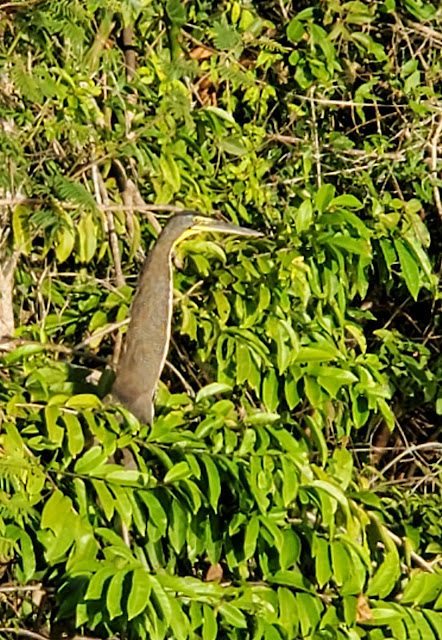
| A juvenile Bare-throated Tiger Heron, Tigrisoma mexicanum. |
Bare-throated tiger herons are year round residents of Belize. They tend to stay pretty local without any seasonal changes in territory. Their species range is coastal along the Pacific Ocean, Gulf of Mexico, and Caribbean Sea over most of Mexico, all of Belize, Guatemala, Honduras, Nicaragua, Costa Rica, and El Salvador, and most of Panama. Tiger herons tend to be solitary; I know we have only ever seen one at a time.
 |
| "Anybody home?" |
 |
| "You in there?" |
Not finding any crabs in their holes, it wandered under a Noni tree toward the back of the property where the Mangrove swamp is.
 |
| Tiger herons will perch in trees - I have seen them in the Noni trees before. |
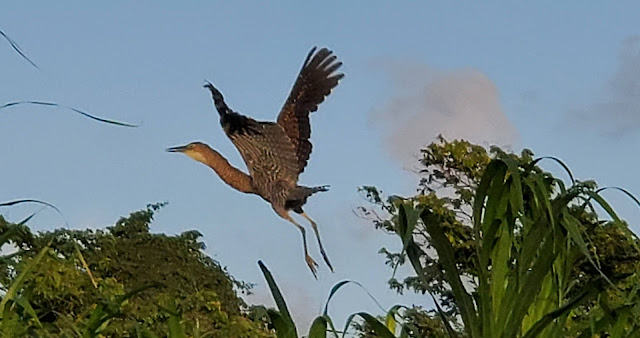
On its way to the mangrove swamp, where Tiger Herons love to hang out and nest, it had a little fluff up, as seen in the series below.
 |
| The striking black and gold stripes are much more pronounced on juveniles like this one. Adults have a more finely streaked back and wings that are a duller brown color and they have a black cap. This is one case where the juveniles are more colorful than the adults. |
After watching the tiger heron, I went to check on the American redstart that hangs out in the small orange tree. To my surprise, in addition to the redstart, there was another warbler that I did not recognize. It took no notice of me as I snapped away at it; it was focused on catching its breakfast while I was attempting to focus on it. It moved around very quickly, in stark contrast to the slow-motion tiger heron. As it foraged on the insects in the sparse grass, it hopped closer and closer to me. A very pretty little bird that Dennis identified as a female Magnolia Warbler.
 |
| Female Magnolia Warbler. |
She hopped around, very actively feeding on little insects.
 |
| White spot on tail, streaked yellow breast, white eye ring, grey head, white wing bars on dark wings, olive upper back. |
 |
| And don't forget the white underwing pits and yellow rump! |
She pranced and danced and fluttered around, showing off her good side - and they are all good sides!
 |
| Lovely little bird that spends its winters here in Belize as well as a large part of Central America in general. |
A fun morning of bird watching with the continued sounds of construction in the background.