01 August, 2010
High Summer in Minnesota and Georgia
I haven’t been very diligent about writing new posts this summer, but not for lack of interesting things to write about. We have had beautiful butterflies in our garden and nearby locations, along with interesting insects, lots of flowers, bird families, etc. I’ve taken loads of pictures here in Minnesota as well as some bird photos on my Mother’s front porch. It has been hard to find the time to write these blog posts because I have been outrageously busy at work and when I get home in the evenings all I want to do is eat some dinner (which means I have to cook it first), watch a little TV (I am a fan of “So You Think You Can Dance”), and go to bed. I really don’t want summer to slip away unnoticed and undocumented, so for the next couple of weeks I will make frequent short posts featuring some of the many photos I have taken.
I’ll start with some of the birds that were coming to the feeder on my Mother’s porch. She keeps sunflower seeds in it, and it really attracts the birds. Many of the birds continued to feed even when we were sitting on the porch only 15 or so feet away from the feeder. But they tended to dart to the feeder, grab a seed, and carry it elsewhere to eat. The young tufted titmice grew a little braver after we sat still for some time. They carried on in a camellia bush just next to the porch and used the porch rail as a staging area as they went back and forth to the feeder.
There was a very wary pair of house finches that showed up right after day break every day. It was difficult to photograph them, but I managed to get a couple of shots.
They didn’t mind sharing the feeder with black capped chickadees.
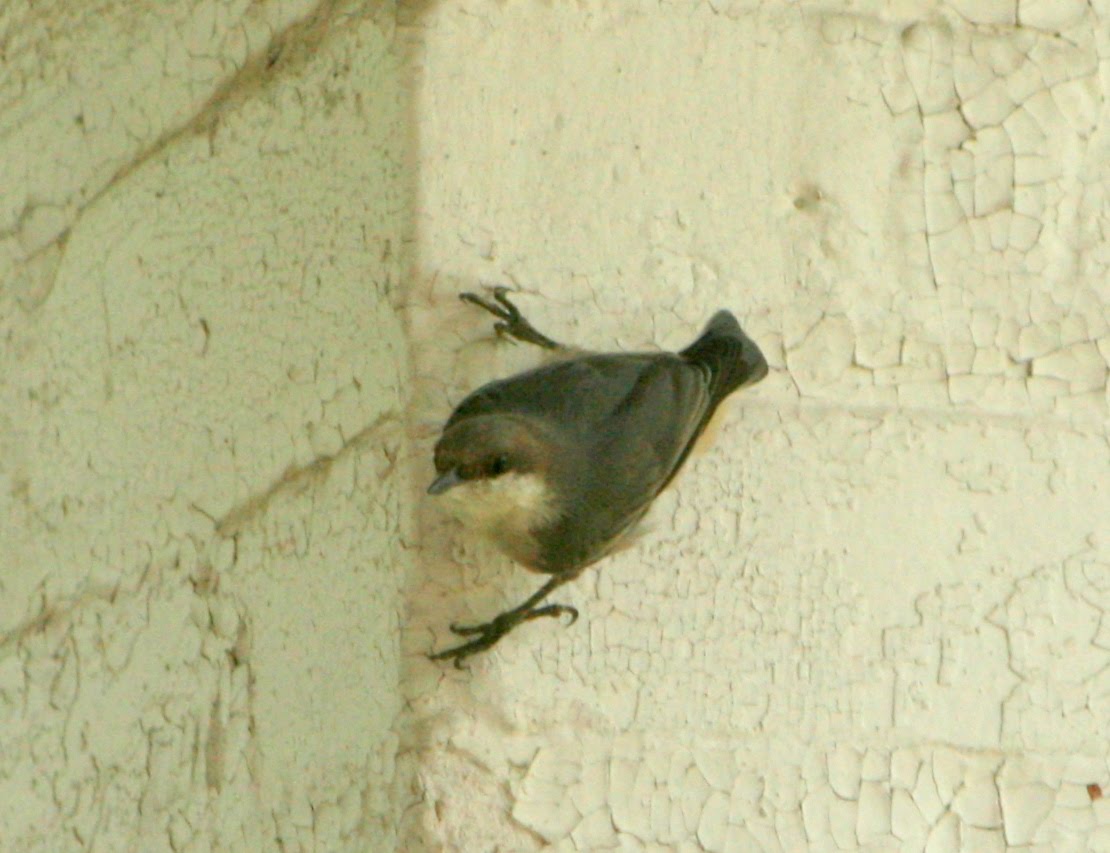
This little brownheaded nuthatch looked so small compared to the whitebreasted nuthatches we are used to seeing in Minnesota. It would cling to the brick column and hop down the rope suspending the birdfeeder.
We saw lots of Northern Cardinals. Cardinals are not comfortable feeding on hanging birdfeeders, but the sunflower seeds were too tempting for them to forego. They would try to perch on the feeder, but it was built for smaller birds, so they usually made a sort of “touch and go” landing as they grabbed a seed to take to the ground or a branch to eat. What they really liked most was to eat spilled seed from off the porch floor, but they would not come to the porch while we were sitting there. I was not able to get a photo of them at the feeders, but did manage to get a shot of a juvenile cardinal in a nearby shrub. I don’t know what that shrub is in the photo. I will have to ask my mother. ;-)
Other birds that we saw but that did not come to the feeder included, blue jays, blue birds, chimney swifts, and doves. One exciting wildlife spotting that I must mention was a red fox that my friend Nancy and I saw early one morning when we had gone for a walk. We saw it back in a wooded area that had a clearing through it for storm sewer drains. I think the fox was as shocked as we were. US red foxes are very secretive animals that are usually not seen near human habitation.
As I get to the end of this post it is obvious that I didn’t keep it very short. But I promise to have more short ones soon!
11 July, 2010
In Georgia
Hello from my hometown of Elberton, Georgia. I am visiting my mother this week. She is the only one of my family that still lives in the town where my father, who was career army, was last stationed. This was basically where my younger brother and I grew up and where my older sisters finished high school. Before moving here, my family lived on Okinawa, in Texas, and in Oklahoma. I consider Elberton my hometown since I lived here from ages 5 through 17, when I moved a whopping 35 miles away to go to college in Athens, Georgia.
Elberton bills itself as “The Granite Capital of the World”, which is only a bit of hyperbole. Elberton actually does produce more granite monuments (mostly tombstones) than any other place in the world, as you can see proudly proclaimed on the sign in the photo below.
That is not a cemetary in the photo above; it is a display of fine monuments that have been commitioned for future use in cemetaries or as examples of fine sculpting and engraving.
The Georgia Guidestones are the biggest granite display from Elberton. The Guidestones (click here to get to Wikipedia's entry) are Elberton’s answer to Stonehenge. ;-) This site has a very detailed accounting of the history of the Guidestones with many photos and drawings. They are actually pretty cool, I think. Some folks got very upset about them, believing that they were satanic. Go figure.
It was too hot today to spend much time outside, but I did take a couple of photos around my mother’s house. Not too many plants in bloom in this heat, but I did find a pretty light pink Rose of Sharon.
And this scraggly climbing fern (for Bill in Louisiana).
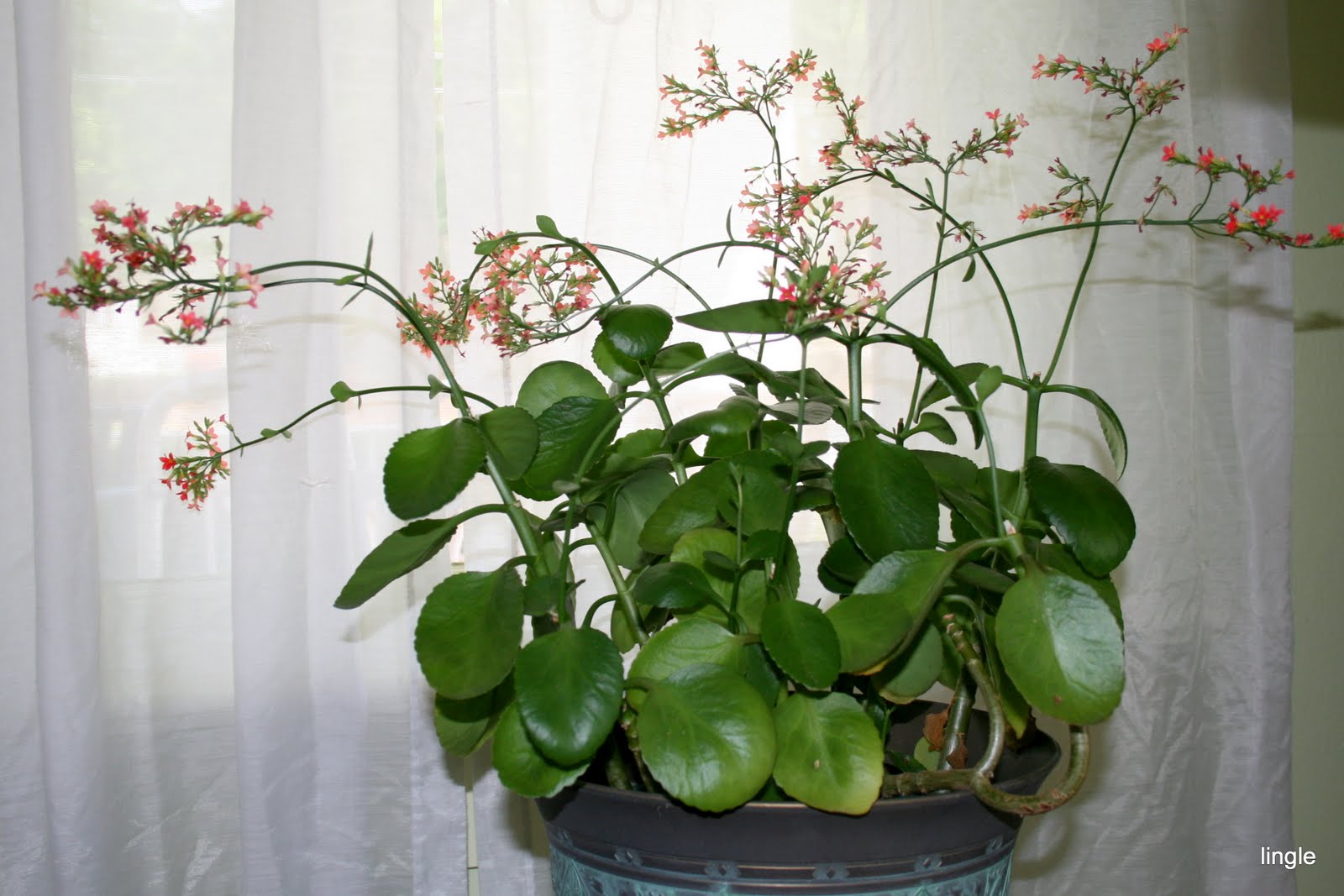
And this pretty kalanchoe in bloom inside her house.
This is not the house I grew up in. She sold that house 10 years ago to rent this smaller house just down the street. It is almost adjacent to the elementary school my brother and I attended. Here is one of the famous Elberton granite monuments (non-tombstone) for the school. ;-)
I also found the pear tree that bore the juiciest pears way back when I went to this school. During recess in the autumn months, we school kids would pick the ripe pears from the branches that hung over onto the school playground. I can’t believe that it is still alive, much less that it is loaded with fruit that will ripen in months to come.
The pear tree outlasted the school. Maybe that monument is a tombstone afterall. The school buildings and grounds are still present, but they are now a private residence.
I will close with a photo of my favorite tree. It is a big old oak on the playground of the school. During summers when I was a child, I would take whatever book I was reading and climb the tree to read in peace and quiet. I would need a ladder to get up that tree (or any tree!) these days …

Elberton bills itself as “The Granite Capital of the World”, which is only a bit of hyperbole. Elberton actually does produce more granite monuments (mostly tombstones) than any other place in the world, as you can see proudly proclaimed on the sign in the photo below.
That is not a cemetary in the photo above; it is a display of fine monuments that have been commitioned for future use in cemetaries or as examples of fine sculpting and engraving.
The Georgia Guidestones are the biggest granite display from Elberton. The Guidestones (click here to get to Wikipedia's entry) are Elberton’s answer to Stonehenge. ;-) This site has a very detailed accounting of the history of the Guidestones with many photos and drawings. They are actually pretty cool, I think. Some folks got very upset about them, believing that they were satanic. Go figure.
It was too hot today to spend much time outside, but I did take a couple of photos around my mother’s house. Not too many plants in bloom in this heat, but I did find a pretty light pink Rose of Sharon.
And this scraggly climbing fern (for Bill in Louisiana).
And this pretty kalanchoe in bloom inside her house.
This is not the house I grew up in. She sold that house 10 years ago to rent this smaller house just down the street. It is almost adjacent to the elementary school my brother and I attended. Here is one of the famous Elberton granite monuments (non-tombstone) for the school. ;-)
I also found the pear tree that bore the juiciest pears way back when I went to this school. During recess in the autumn months, we school kids would pick the ripe pears from the branches that hung over onto the school playground. I can’t believe that it is still alive, much less that it is loaded with fruit that will ripen in months to come.
The pear tree outlasted the school. Maybe that monument is a tombstone afterall. The school buildings and grounds are still present, but they are now a private residence.
I will close with a photo of my favorite tree. It is a big old oak on the playground of the school. During summers when I was a child, I would take whatever book I was reading and climb the tree to read in peace and quiet. I would need a ladder to get up that tree (or any tree!) these days …
04 July, 2010
Break-in!
Saturday morning we discovered that our house had been broken into during the night. The burglars had taken a screen down from one of the windows in the sunroom and climbed in through the open window. You can see the screen and open window in the photo below.
That’s the screen leaning against the ponytail palm and the window is open to the outside. Obviously the work of professionals because the screen remained undamaged, just dexterously and neatly removed from the window frame.
They knocked over the bird feeders that I bring in every night and seed spilled out onto the floor. I don’t know why that racket didn’t wake us up, but it didn’t. Nothing else was disturbed, not even the watering pitcher right next to the feeders. Oddly, much of the seed seems to be missing ...
I had my suspicions as to who the perpetrators were and soon found evidence of their well-known sweet tooth -- the spilled hummingbird feeder on the ground just outside the open window.
And then, the smoking gun, or sticky paw prints, in this case; one the patio steps and others on the wall next to the window. 

Very likely made by this individual caught on surveillance camera just days earlier while obviously casing the joint. 


We'll be keeping our sunroom windows closed at night now ...
03 July, 2010
Belize Bird of the Week #10 – Blue-grey Tanager (Thraupis episcopus)
Tanagers are new world birds that are found mainly in the tropics. The 240 or so species of tanager are medium sized birds and many of them are quite colorful. Tanagers are in the family Thraupidae, which is in the midst of reorganization as scientists learn more about their genetics. In North America, the scarlet tanager is the most common, but the scarlet tanager is now thought to belong to the cardinal family.
The blue-grey tanager is fairly common throughout its large range from southern Mexico, through Central America and into the northern part of South America. They eat fruit, insects, and nectar. You can see it eating the cercropia fruit in one of the photos below. Blue-grey tanagers are friendly and confiding. Like the great kiskadee I wrote about a few weeks ago, blue-grey tanagers often live around human habitation.
All of the photos in the collage below are of one bird as it was hopping around in a Cercropia tree near our cabana. It is a very pretty bird with the blue above and grey below, but the large cercropia leaves shaded the splendor of the blue. I am anxious to get back to Belize to photograph it in more flattering light.
The blue-grey tanager is fairly common throughout its large range from southern Mexico, through Central America and into the northern part of South America. They eat fruit, insects, and nectar. You can see it eating the cercropia fruit in one of the photos below. Blue-grey tanagers are friendly and confiding. Like the great kiskadee I wrote about a few weeks ago, blue-grey tanagers often live around human habitation.
All of the photos in the collage below are of one bird as it was hopping around in a Cercropia tree near our cabana. It is a very pretty bird with the blue above and grey below, but the large cercropia leaves shaded the splendor of the blue. I am anxious to get back to Belize to photograph it in more flattering light.
27 June, 2010
Belize Bird of the Week #9 – Ivory-Billed Woodcreeper (Xiphorhynchus flavigaster)
One afternoon while we were in Belize this past April, Dennis and I walked up the beach to visit our friends Sue and Chris at SteppingStones Resort. When we returned to our cabana, we saw a new hole torn in the screen on the veranda. Now our veranda is our primary living space. We use it as our dining room, sitting room, place to chill, and place to entertain guests.
You readers know that I love Belize, but there is a fly in the ointment. Or should I say flies in the ointment, sandflies, that is. Sandflies are aggravating little beasts no bigger than a speck (a 1/16th of an inch speck, to be exact). Where there is one, there are hundreds. Usually the sea breeze keeps them away, but when the breeze slacks off, the sandflies make you miserable with their constant biting. The first time we experienced sandflies in Belize while on vacation there in 1998, their bites left a tiny little flat, red circle about 3mm in diameter, and they hurt a little at the time of the bite. But the next day the sites of the bites were big red welts that itched like crazy! It took more than a week for the bites to fade away. And of course our legs and arms were covered with dozens of bites; we looked a mess.
The worst part is that sandflies are more numerous when there is no breeze and more active at night. That means that any part of your body not covered by a sheet on a hot, still night will be bitten. Covered with a sheet or covered with bites, those are your choices! So when we designed our cabana, we decided to use a very fine screen on the windows and veranda to keep the sandflies out. We had to purchase the screen in the US and take it down there with us. It turns out that the best screen is made out of nylon and you can get it pre-treated to be resistant to degradation by UV light. Even with that treatment, the screen gets fragile quickly and has to be replaced every 2 years or so. And we wind up having unsightly patches on it just to make it last that long.
So when we came back to the cabana that afternoon after visiting Sue and Chris, we immediately noticed the big hole in veranda screen and wondered how it got there. Had a twig been blown into it? No twig in sight on the veranda or on the ground below. As you could tell from the photos, the cabana is 12 feet off the ground, so it wasn’t a crab. But we patched the screen and forgot about it as we about our business.
Dennis went inside to get something and then I hear “Wilma, get your camera and come see what made the hole in the screen!” It was a bird that was still in the cabana. Poor thing had flown through the screen and hadn’t been able to find a way out. I took a couple of pictures of it clinging to the wall. Then we opened the back door and tried to shoo it out. No dice. We took screens off the windows and tried to herd it out. But it just couldn’t see that as a way out because of the louvers. Finally it was in the back bedroom which has 3 windows. Dennis took the screen off 1 of them and the bird was perched on the 3rd. I took a few more photos as Dennis took the 2nd screen down. By this time Richard, our caretaker, was helping us. Richard and I blocked off the doorway as Dennis moved toward the bird. In desperation, it finally flew to freedom through the 2nd window.
A friend from the village (Ralph Zuniga, who runs a wildlife tour business) stopped by to visit. As usual, we sat on the veranda with Ralph, catching up with each other since our trip last October. Ralph was the person who first showed us this property back in 2004 (click here to read about this trip). Ralph and his wife Ilna helped us immensely before we started building on the property. We showed Ralph the bird photos and he said it was a wood creeper, either a streak-headed or an ivory-billed.
After looking at all the pictures and descriptions in bird books and online, we are pretty sure it is an ivory-billed Woodcreeper. It has the creamy chin with no streaks, streaks down its breast and from the top of its head down its back. They live year round in Belize and the rest of the Yucatan Penninsula and are fairly common birds of the forest. We will definitely be on the lookout for more of these when we go back in October.
You readers know that I love Belize, but there is a fly in the ointment. Or should I say flies in the ointment, sandflies, that is. Sandflies are aggravating little beasts no bigger than a speck (a 1/16th of an inch speck, to be exact). Where there is one, there are hundreds. Usually the sea breeze keeps them away, but when the breeze slacks off, the sandflies make you miserable with their constant biting. The first time we experienced sandflies in Belize while on vacation there in 1998, their bites left a tiny little flat, red circle about 3mm in diameter, and they hurt a little at the time of the bite. But the next day the sites of the bites were big red welts that itched like crazy! It took more than a week for the bites to fade away. And of course our legs and arms were covered with dozens of bites; we looked a mess.
The worst part is that sandflies are more numerous when there is no breeze and more active at night. That means that any part of your body not covered by a sheet on a hot, still night will be bitten. Covered with a sheet or covered with bites, those are your choices! So when we designed our cabana, we decided to use a very fine screen on the windows and veranda to keep the sandflies out. We had to purchase the screen in the US and take it down there with us. It turns out that the best screen is made out of nylon and you can get it pre-treated to be resistant to degradation by UV light. Even with that treatment, the screen gets fragile quickly and has to be replaced every 2 years or so. And we wind up having unsightly patches on it just to make it last that long.
So when we came back to the cabana that afternoon after visiting Sue and Chris, we immediately noticed the big hole in veranda screen and wondered how it got there. Had a twig been blown into it? No twig in sight on the veranda or on the ground below. As you could tell from the photos, the cabana is 12 feet off the ground, so it wasn’t a crab. But we patched the screen and forgot about it as we about our business.
Dennis went inside to get something and then I hear “Wilma, get your camera and come see what made the hole in the screen!” It was a bird that was still in the cabana. Poor thing had flown through the screen and hadn’t been able to find a way out. I took a couple of pictures of it clinging to the wall. Then we opened the back door and tried to shoo it out. No dice. We took screens off the windows and tried to herd it out. But it just couldn’t see that as a way out because of the louvers. Finally it was in the back bedroom which has 3 windows. Dennis took the screen off 1 of them and the bird was perched on the 3rd. I took a few more photos as Dennis took the 2nd screen down. By this time Richard, our caretaker, was helping us. Richard and I blocked off the doorway as Dennis moved toward the bird. In desperation, it finally flew to freedom through the 2nd window.
It was a very pretty little brown bird with a slightly curved, longish bill.
A friend from the village (Ralph Zuniga, who runs a wildlife tour business) stopped by to visit. As usual, we sat on the veranda with Ralph, catching up with each other since our trip last October. Ralph was the person who first showed us this property back in 2004 (click here to read about this trip). Ralph and his wife Ilna helped us immensely before we started building on the property. We showed Ralph the bird photos and he said it was a wood creeper, either a streak-headed or an ivory-billed.
After looking at all the pictures and descriptions in bird books and online, we are pretty sure it is an ivory-billed Woodcreeper. It has the creamy chin with no streaks, streaks down its breast and from the top of its head down its back. They live year round in Belize and the rest of the Yucatan Penninsula and are fairly common birds of the forest. We will definitely be on the lookout for more of these when we go back in October.
19 June, 2010
Belize Birds of the Week #7 and #8 – Baltimore Oriole and Orchard Oriole
I had always thought that the Baltimore Oriole was named after the city of Baltimore in Maryland. Well, I was wrong. It turns out that both the bird and the city were named after Lord Baltimore, Cecilius Calvert, 2nd Baron Baltimore (Ballimore), who, following through on his father’s intentions, founded the state of Maryland. The Baltimore Oriole was first described in1731 by Mark Catesby in his Natural History of Carolina, Florida and the Bahama Islands. Catesby named this bird the “Baltimore-Bird,” because black and orange were the colors of the Baltimores.
The Baltimore Oriole winters in Belize, southern Mexico, and other Central American countries. It migrates to the eastern United States where it breeds in summer. I’m not sure if Baltimore Orioles are seen around our place in Englishtown Belize all winter long, or if they were just migrating through while we were there in April. They seem to like the sea grapes as much as the Golden-Fronted Woodpeckers do. :-)
Orchard Orioles look very similar to Baltimore Orioles, except with dark chestnut instead of bright orange. They are also a little smaller than are the Baltimore Orioles. They spend a very short breeding season in the north, returning to Mexico and Central America as early as July. I saw only one Orchard Oriole during the 2 weeks we were in Belize, and the photos are not very good. But they are good enough for an ID!
The Baltimore Oriole winters in Belize, southern Mexico, and other Central American countries. It migrates to the eastern United States where it breeds in summer. I’m not sure if Baltimore Orioles are seen around our place in Englishtown Belize all winter long, or if they were just migrating through while we were there in April. They seem to like the sea grapes as much as the Golden-Fronted Woodpeckers do. :-)
Orchard Orioles look very similar to Baltimore Orioles, except with dark chestnut instead of bright orange. They are also a little smaller than are the Baltimore Orioles. They spend a very short breeding season in the north, returning to Mexico and Central America as early as July. I saw only one Orchard Oriole during the 2 weeks we were in Belize, and the photos are not very good. But they are good enough for an ID!
13 June, 2010
Belize Bird of the Week # 6 -- Black-Cowled Oriole (Icterus prosthemelas)
The Black-cowled oriole (Icterus prosthemelas) is found in Mexico (the Yucatan in particular), Belize, and Guatemala near the Atlantic. One of the references I am using (The Birds of Mexico and Adjacent Areas, Ernest Preston Edwards) lists it as rare, but it was very conspicuous at our place on the southern coast of Belize. In fact it was the most abundant of the 3 oriole species (Baltimore and Orchard orioles were the other 2), that we saw there in April. However, Birds of Belize (H. Lee Jones, Dana Gardner, authors) lists it as common.
It is easy to see how it gets its name; the heads of the males are black, front and back, just as if they are wearing black cowls covering their heads, chests, and part of their backs. Their tails are black, as are their wings except for their wrists which have a yellow patch. There are no bars on their wings. The rest of the belly and back are bright yellow. One interesting feature of their beak is that at least 1/3rd of the bottom beak at the base is bluish.
They also feed on palm flowers, as you can see from the photos below.
It is easy to see how it gets its name; the heads of the males are black, front and back, just as if they are wearing black cowls covering their heads, chests, and part of their backs. Their tails are black, as are their wings except for their wrists which have a yellow patch. There are no bars on their wings. The rest of the belly and back are bright yellow. One interesting feature of their beak is that at least 1/3rd of the bottom beak at the base is bluish.
They love to feed on the abundant hibiscus flowers, and often hang upside down to get to the nectar.
Some, but not all, females don’t have the full black cowl of the male. Instead the crown and back of the head of the female is a yellowish-olive color. In the collage below a female is gathering a strand from a palm leaf while the male looks on from an upper palm leaf. You can easily see the bluish color at the base of the lower beak on both males and females.They also feed on palm flowers, as you can see from the photos below.
All of these photos were taken just outside our cabana. When they are intent on feeding, you can get quite close to them. In fact I was too close to them feeding on the palm flowers to use the telephoto lens; I had to use my normal lens instead.
I couldn’t get an accurate count of them because they are very busy birds, but I estimate that we saw at least 7 different individuals feeding right around the cabana during the 2 weeks we were there in April. The black-cowled orioles are year-round residents of Belize. I look forward to getting to know them better.
07 June, 2010
Belize Bird of the Week #5 – Golden-fronted Woodpecker, Melanerpes aurifrons
The golden-fronted woodpecker is a fairly common bird in Mexico and Central America that is also sometimes seen in Texas and even Oklahoma. To my eyes, they look very similar to the red-bellied woodpeckers that live in the eastern half of the US (I wrote about red-bellied woodpeckers here).
Below is a female golden-fronted woodpecker in a cecropia tree. What long toes she has!
The specifics of its coloring vary depending on geographic location. In Belize and the rest of the Yucatan Peninsula, the nasal tufts, the nape, and the belly are red, whereas in the rest of Mexico and Texas, the nape and nasal tufts are yellow and south of the Yucatan, the nape is orange. This one is in a sea grape tree. You can see a bit of the red nasal tufts in this perspective.
Even though the coloring differs by location, it is considered one species with four forms. I must confess that I am puzzled by the name because I sure don’t see any golden anywhere on these birds unless the name refers to the nasal tufts of the form seen in Texas and Mexico. And here is a shot of a female in a papaya tree. The red on the head of the females doesn't come all the way to the front as it does in the males.
These woodpeckers are big fruit eaters and eat fruit in preference to insects when fruit is available. I observed them eating fruit of the sea grape, papaya, and the Cecropia (trumpet) tree. They seemed to especially like sea grapes and spent hours in the sea grape trees eating the just ripening fruit. The series of shots below shows the female (turns out that it is only the female that I got good shots of) peeling a strip of sea grape flesh off the still unripe grape. The sea grape is mostly one large seed with only a thin layer of flesh; the woodpecker really worked hard for such a small prize!To end this post I have images of a bright orange star fish in the shallow water with the eel grass and a view of Great Monkey Cay (pronounced “key”) just off shore.
Those golden-fronted woodpeckers sure have a good view!
Subscribe to:
Posts (Atom)